GLM-5.2 Coming Soon? Domestic GPU Code LLM MUSA Coder Goes Open Source

GLM-5.2 nears launch, MUSA Coder open-sourced, and Google backs Anthropic with $35B in guarantees.
GLM-5.2 appears to be in internal testing based on API error clues. Moore Threads open-sourced MUSA Coder, the first code LLM fully trained on domestic GPUs, outperforming Claude Opus on KernelBench. Other highlights include Codex's viral invite mechanic, Quark's Gaokao AI Agent, and Google providing $35B in credit guarantees for Anthropic.
GLM-5.2 Reportedly Enters Internal Testing, Launch Countdown Begins
According to user reports from the Bilibili AI Daily community, when attempting to call the GLM-5.2 model within Zhipu's Coding Plan, the system returns a "no access" error rather than the typical "model does not exist" message. This subtle detail has sparked widespread speculation in the industry.
From a technical standpoint, "no access" typically indicates that the model resource has already been deployed on the server side but cannot be called due to insufficient account permissions — a fundamentally different situation from "model does not exist," which usually means the API path is invalid or the model hasn't gone live yet. This distinction carries strict engineering logic: HTTP status code 403 (Forbidden) means the server has recognized the resource exists but is denying access, while 404 (Not Found) means the routing layer cannot find the corresponding resource at all. Large language model platforms typically employ a canary release strategy — deploying the model to the production environment first and controlling access via a permission whitelist, then gradually opening public access once internal testing stabilizes. This approach ensures service stability while preserving a window for adjustments. The industry therefore widely believes GLM-5.2 is likely in internal testing, with an official launch potentially imminent.
As Zhipu's flagship product line competing at the international frontier, if GLM-5.2 can achieve new breakthroughs in coding and reasoning capabilities, it would further consolidate its position among the top tier of domestic large models and exert competitive pressure on comparable international products.
Moore Threads Open-Sources MUSA Coder: A Code LLM Fully Trained on Domestic GPUs
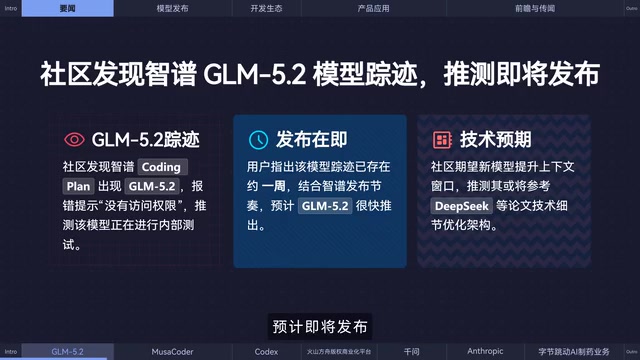
The most technically significant news of this edition: Moore Threads has officially open-sourced MUSA Coder — a code large language model specifically designed for GPU operator generation.
Full-Stack Domestic Training: Strategic Significance Not to Be Overlooked
The company positions MUSA Coder as the industry's first code large model fully trained on a domestically developed, full-featured GPU from the ground up. "Full-stack training" means the entire pipeline — from the underlying hardware and training framework to the model itself — is built on domestic GPUs. Against the backdrop of today's highly sensitive compute supply chains, this kind of self-reliant, independently controllable training capability carries significant strategic value.
It's worth noting that MUSA is Moore Threads' parallel computing platform built on its proprietary MTT S-series GPU architecture, designed with API compatibility close to CUDA in order to reduce software migration costs for domestic GPUs — which means code generated by MUSA Coder has the potential to be migrated to mainstream ecosystems.
Performance: Outperforms Leading Commercial Models in Its Vertical Domain
According to official data, the MUSA Coder 27B version surpasses mainstream commercial models including Claude Opus on the KernelBench evaluation benchmark, which is specifically designed to assess GPU operator generation capabilities.
KernelBench is a specialized benchmark released by a Stanford University research team. Unlike general-purpose code evaluation benchmarks such as HumanEval and MBPP, it focuses on the correctness and performance optimization of CUDA/GPU kernel code — testing whether a model can generate parallel computing code that is both functionally correct and efficiently executed. This aligns closely with MUSA Coder's design goal of "GPU operator generation."
It bears emphasizing that GPU operators (Operators/Kernels) are the low-level program units in deep learning frameworks that execute specific computational tasks — such as matrix multiplication, attention computation, and activation functions. Writing high-performance GPU operators requires deep understanding of GPU thread hierarchies, memory access patterns, pipeline scheduling, and other low-level details. Hand-optimized operators can be several to dozens of times faster than code automatically generated by frameworks. MUSA Coder is not a general-purpose code model; it is a specialized tool focused on the niche domain of operator optimization. For developers and research teams who need to write high-performance GPU operators by hand, this open-source model offers considerable practical value.
Codex Adds Invitation Mechanism for Flexible Rate Limits
Codex has recently introduced a mechanism allowing users to reset the 5-hour rate limit by inviting friends, usable up to 3 times per month.
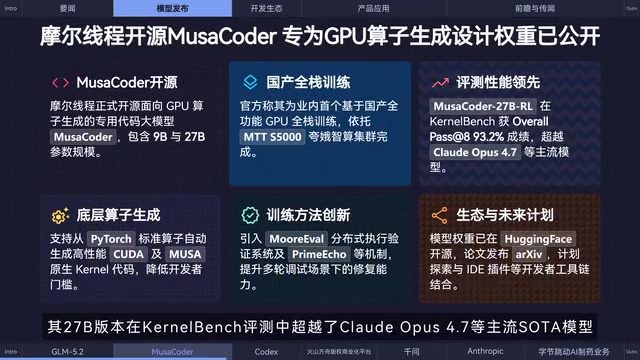
The design is quite clever, built around the classic viral growth loop logic: offsetting user acquisition costs against service usage costs — the long-term value of each new user acquired outweighs the marginal cost of providing a few extra hours of compute to existing users. This mirrors Dropbox's early growth strategy of "invite a friend, get extra storage." The "3 times per month" cap serves as a precise cost control valve, preventing the rate limit from becoming meaningless.
In addition, the Codex mobile app has been updated with two new features: code branch management and token usage tracking. The token tracking feature gives developers clear visibility into their consumption — as pay-per-use pricing models become more prevalent, developers' need to monitor token usage is growing, making this feature especially practical in the AI coding tools era. Mobile support for code branch management further lowers the barrier to code collaboration anytime, anywhere.
Volcano Engine's Commercial Platform Launches with Stephen Chow's Classic IPs
Volcano Engine's copyright commercialization platform has officially launched, with three classic film IPs from Stephen Chow's Bingo Group — The King of Comedy, The God of Cookery, and CJ7 — among the first titles to be onboarded.
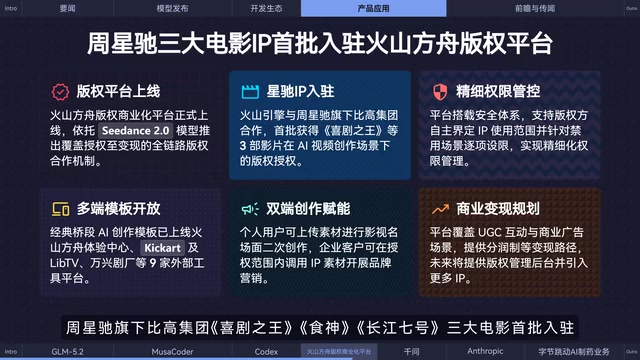
The platform has rolled out AI creation templates around these IPs, open to both individual and enterprise users. This marks a shift for AI-generated content from technical demonstrations toward commercially viable, copyright-compliant applications.
This model's emergence reflects a deep industry backdrop: since 2023, multiple lawsuits involving training data copyright (including The New York Times vs. OpenAI) have put the industry on high alert regarding IP risks, with AIGC copyright compliance becoming one of the biggest obstacles to real-world deployment. The Volcano Engine platform essentially establishes a three-party licensing framework that shares interests among rights holders, the platform, and creators: rights holders earn revenue shares through licensing, the platform provides the technical infrastructure, and users create within a compliant framework. This is analogous to the revenue-sharing agreements between Spotify and record labels in the music industry. The "licensing + templates + creation" business model offers a replicable solution to the copyright challenges facing the broader AIGC industry.
Quark Launches Gaokao College Application Agent, Free for All Students Nationwide
Quark has officially announced the launch of what it claims is China's first full-cycle Gaokao college application agent, available free of charge to students across the country. The agent draws on Quark's accumulated historical data and large model reasoning capabilities to provide application planning and Q&A services.
Gaokao college applications represent a quintessential scenario that is information-dense and decision-complex, involving multiple dimensions including scores, percentile rankings, institutions, majors, and employment prospects — precisely where AI Agents excel. Unlike single-turn Q&A AI assistants, AI Agents can perceive their environment, formulate plans, and execute multi-step tasks: integrating multi-source heterogeneous data (score cutoffs, rankings, university tiers, major employment statistics), dynamically adjusting recommendations based on user preferences, and maintaining state memory across long-horizon tasks. The "full-cycle" positioning means covering the complete workflow from score checking and estimation to application submission and admission results, requiring persistent state management and proactive notification capabilities — not merely responding to user-initiated conversations. This also makes the scenario a comprehensive test of a large model's reasoning and tool-use capabilities.
Capital Moves: Google Provides ~$35 Billion in Guarantees for Anthropic
According to Bloomberg, Google has agreed to provide payment guarantees for Anthropic's chip leases across five data centers, effectively helping Anthropic secure the equivalent of $35 billion in financing capacity.

The deal structure is quite sophisticated — essentially a credit enhancement financial arrangement: Anthropic leases GPU compute resources from data center operators, with Google acting as guarantor, committing to cover payments if Anthropic defaults. This allows Anthropic to leverage much larger compute leases at a lower effective financing cost. Rather than making a direct capital injection, Google helps Anthropic unlock massive funding by guaranteeing chip lease payments. For Google, this move simultaneously deepens its strategic relationship with Anthropic (which relies heavily on Google TPU compute) while using a guarantee structure instead of direct equity investment to avoid potential antitrust scrutiny that further increasing its equity stake might trigger — essentially trading guarantee obligations for an implicit commitment from Anthropic to continue purchasing Google TPU compute, achieving the dual objectives of compute sales and strategic positioning.
This also reflects the reality of the current AI arms race: top model companies have a seemingly insatiable appetite for compute, and tech giants controlling compute and capital are deeply embedding themselves in this competition through increasingly creative financial arrangements.
ByteDance Ventures into AI for Science: Spinning Off AI Drug Discovery Unit for Independent Funding
Reports indicate that ByteDance has initiated the spin-off and independent fundraising of its AI drug discovery business. After the split, ByteDance will retain a controlling stake, with the core team and assets transferring wholesale into a new entity, which will continue to receive compute support.
AI for Science refers to the new paradigm of systematically applying artificial intelligence to scientific research, spanning fields including materials science, climate modeling, and biomedicine. AI drug discovery is the most commercially mature direction within this space, with core technologies including: protein structure prediction based on models like AlphaFold, generative AI-driven de novo drug design, and using large models to accelerate clinical trial protocol optimization. Traditional drug development costs an average of over $1 billion and takes 10–15 years; AI technology has the potential to dramatically compress the timeline for the lead compound discovery phase.
The "spin-off + independent fundraising + retained control" model allows the business unit to attract specialized life sciences investors along with their industry resources and regulatory expertise through a more flexible structure, while the parent company retains strategic oversight and compute support. This is yet another demonstration of China's major internet companies accelerating their pivot from consumer internet toward deep tech and industrial AI.
Related articles

The Truth Behind Codex 'Build a Website in 5 Minutes': AI Isn't Creating Sites—It's Helping You Copy Them
Exposing the truth behind viral Codex 5-minute website videos: creators aren't building original sites with AI—they're copying shared prompts or scraping others' work. Learn AI coding tools' real limits.

Getting Started with AI Agent Development: A Complete Guide from Concept to Practice
A comprehensive guide to AI Agent architecture and development, covering automated marketing, intelligent customer service, and investment analysis scenarios with single and multi-agent collaboration.

The Truth Behind Codex 'Build a Website in 5 Minutes': AI Isn't Creating Sites — It's Helping You Copy Them
Exposing the truth behind viral Codex 5-minute website videos: creators aren't building original sites with AI — they're copying shared prompts or scraping others' work.