GLM-5.2 Released: MIT Open Source + Million-Token Context Long-Horizon Task Benchmark

GLM-5.2 delivers stable 1M context for long-horizon coding tasks under MIT license, rivaling top closed-source models.
Zhipu's GLM-5.2 is a flagship open-source model targeting long-horizon tasks with a stable 1M token context. It introduces IndexShare architecture reducing FLOPs by 2.9x and MTP improvements boosting speculative decoding by 20%. On FrontierSWE, it trails Opus 4.8 by only 1% while beating GPT-5.5. Released under MIT license with no geographic restrictions, it sets a new benchmark for open-source long-horizon coding agents.
GLM-5.2: A Flagship Model for Long-Horizon Tasks
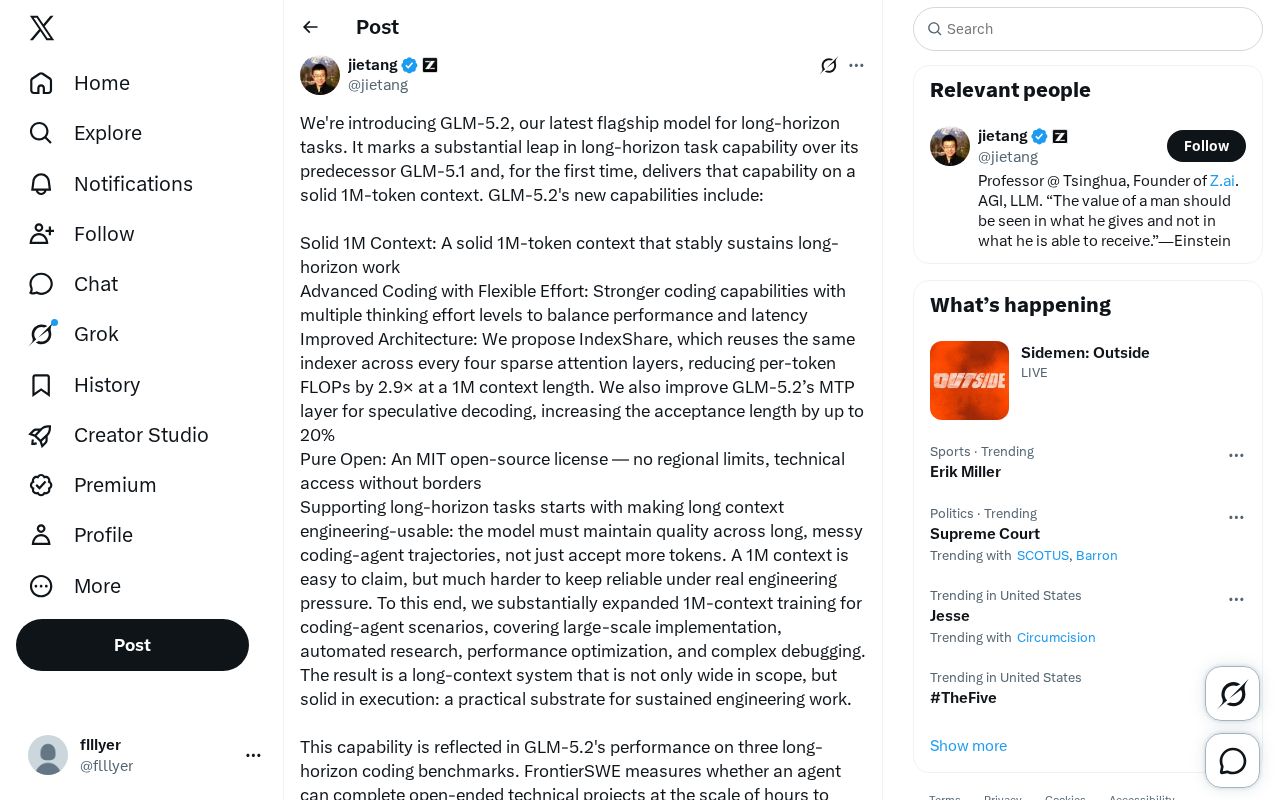
Zhipu has officially released its next-generation flagship model GLM-5.2, placing its bet squarely on "long-horizon tasks" — the current core battleground in large model competition. Compared to its predecessor GLM-5.1, the new model achieves a substantial leap in long-horizon task capabilities, building this ability for the first time on a stable and usable 1-million-token context.
"Long-horizon tasks" refer to scenarios that require models to maintain stable output over hours or even tens of hours of continuous work — such as large-scale code engineering, automated research, performance optimization, and complex debugging. These tasks demand extremely high standards for context length, reasoning stability, and execution coherence, and represent the critical dividing line between "toy-grade" and "production-grade" models.
Notably, the difficulty of long-horizon tasks lies not only in the physical length of the context window, but more importantly in the model's need to maintain consistent goal tracking and error correction across hundreds or even thousands of execution steps. Traditional large models excel at single-turn dialogue or short-form generation, but in real engineering scenarios, models must possess consistency in long-term memory, the ability to backtrack and correct errors, and logical coherence between subtasks. This explains why many models that perform excellently on short-horizon benchmarks frequently exhibit "forgetting" or "drifting" in actual engineering deployments — long-horizon tasks are essentially the ultimate stress test of a model's comprehensive intelligence.
Core Capability Upgrades
Solid Million-Token Context
GLM-5.2's most eye-catching selling point is "solid 1M context" — note that Zhipu deliberately emphasizes "solid" rather than merely "supports." The team states plainly: claiming 1M context is easy, but maintaining reliability under real engineering pressure is far more difficult.
The model must be able to maintain output quality within lengthy, messy coding-agent trajectories, rather than simply "swallowing" more tokens. Coding-agent trajectories refer to the complete interaction history produced by AI programming assistants when executing complex coding tasks — including the full record of code generation, execution feedback, error diagnosis, repair attempts, and other steps. As task complexity increases, these trajectories can easily reach hundreds of thousands or even millions of tokens. The model needs to accurately locate previous decisions within such massive contexts, understand the root causes of errors, and make reasonable subsequent corrections. This is far more difficult than simple "needle in a haystack" information retrieval tests, as it simultaneously requires information localization and causal reasoning capabilities.
To achieve this, the team significantly expanded 1M context training for coding-agent scenarios, covering multiple task types including large-scale implementation, automated research, performance optimization, and complex debugging.
Flexible Coding Effort Levels
GLM-5.2 enhances coding capabilities and introduces multiple "thinking effort levels," allowing developers to flexibly trade off between performance and latency. Simple tasks can be handled with low effort levels for quick responses, while complex engineering problems can invoke deeper reasoning. This adjustable design better aligns with real engineering needs. The logic behind this design philosophy is that not all tasks require the model to think at "full power" — simple format conversions or variable renaming don't need to consume the same computational resources as architectural refactoring. By exposing controllable reasoning depth, developers can find the optimal balance point between API call costs, response latency, and output quality.
Architectural Innovation: IndexShare and MTP Optimization
At the architectural level, GLM-5.2 introduces two noteworthy technical improvements.
The first is IndexShare: within the sparse attention mechanism, every four sparse attention layers reuse the same indexer, reducing per-token floating-point operations (FLOPs) by 2.9x at 1M context length. This is a critical engineering approach to combat the explosion of computational costs with ultra-long contexts — the longer the context, the steeper the growth in attention computation overhead, and index reuse directly alleviates this bottleneck.
To understand the value of IndexShare, one must first grasp the fundamental challenge of ultra-long contexts: the computational complexity of standard Transformer attention mechanisms scales quadratically with sequence length. When context expands from 100K tokens to 1M tokens, theoretical computation increases 100x. Sparse attention mitigates this by computing attention only between selected token pairs, but it requires an indexer to determine "which token pairs need attention computed." IndexShare's insight is that adjacent attention layers tend to focus on highly similar token distributions, making it unnecessary to independently compute indices for each layer. By having four layers share a single indexer, the model significantly reduces computational overhead with virtually no loss in output quality, making million-level context economically viable in actual deployment.
The second is an improvement to MTP layers (Multi-Token Prediction, used for speculative decoding), increasing acceptance length by up to 20%. Speculative decoding is an important technique for accelerating large model inference: traditional autoregressive generation produces only one token at a time, which is inefficient; speculative decoding uses a lightweight "draft model" to predict multiple subsequent tokens at once, which the main model then verifies in parallel. The MTP layer plays exactly this draft model role. "Acceptance length" refers to the number of predicted tokens that the main model confirms as correct in a single pass — the longer the acceptance length, the more effective tokens produced per forward pass, significantly improving generation speed. A 20% improvement means users can perceive noticeable response acceleration in practice, especially in million-level context long-horizon tasks where the cumulative effect of this speedup is considerable.
These two optimizations point toward the same goal: making million-token context both runnable and fast in real deployments.
Benchmark Performance Across Three Long-Horizon Coding Tests
GLM-5.2's capabilities have been validated on three long-horizon coding benchmarks, with highly competitive results.
FrontierSWE: Approaching Top Closed-Source Models
FrontierSWE measures whether an agent can complete open-ended technical projects spanning hours to tens of hours, covering system optimization, large-scale code construction, and applied machine learning research. Unlike traditional benchmarks such as SWE-bench, FrontierSWE tasks require agents to independently complete system architecture design, cross-file refactoring, performance tuning, and other high-complexity tasks. It's considered one of the "ceiling" tests for current AI programming capability, as it simulates the real challenges senior engineers face daily.
On this benchmark, GLM-5.2 trails Opus 4.8 by only about 1%, while narrowly beating GPT-5.5 by 1% and leading Opus 4.7 by 11%. Being able to compete closely with top closed-source models is quite remarkable for an open-source model.
PostTrainBench: Surpassing GPT-5.5
PostTrainBench features a cleverly designed task — each agent is allocated one H100 GPU and evaluated on how much it can improve a small model through post-training. Post-training refers to the process of fine-tuning, alignment, or reinforcement learning after pre-training is complete, and is a crucial phase determining a model's final performance. PostTrainBench requires AI agents to autonomously design training strategies, select hyperparameters, build data pipelines, and maximize target model performance improvements under limited computational resources. This essentially tests a model's meta-ability to "train models" — whether it can understand training dynamics, diagnose training issues, and make optimization decisions. Breakthroughs in this capability may foreshadow the arrival of an accelerating cycle of AI-assisted AI R&D.
GLM-5.2 surpasses both Opus 4.7 and GPT-5.5 on this benchmark, ranking second only to Opus 4.8.
SWE-Marathon: Room for Growth
SWE-Marathon is an ultra-long-horizon software engineering benchmark with tasks including building compilers, optimizing kernels, and developing production-grade services — hardcore engineering challenges. In this most demanding scenario, GLM-5.2 trails Opus 4.8 by about 13%, but still holds a firm second place behind the Opus series. The team candidly acknowledges "room for growth" here, an attitude of honestly presenting weaknesses that deserves recognition.
Across all three benchmarks, GLM-5.2 ranks as the highest-performing open-source model, proving that its million-token context is not a paper specification but has truly translated into practical long-horizon delivery capability.
Purely Open Source: MIT License with No Geographic Restrictions
Beyond technical metrics, GLM-5.2 takes an equally distinctive stance on openness — adopting the MIT open-source license, with the team emphasizing "no geographic restrictions, technical access without borders."
MIT is one of the most permissive open-source licenses, allowing commercial use, modification, and redistribution with virtually no additional restrictions. In the current large model open-source ecosystem, license choice directly impacts a model's actual usability: Meta's Llama series, while publicly releasing weights, attaches user count limitations (requiring separate authorization for over 700 million monthly active users) and specific usage terms; some models have also included geographic usage restrictions or military use prohibitions. By contrast, the MIT license only requires preserving the copyright notice, making it a truly "free software" license.
In the current context of international technology competition, Zhipu's choice of the MIT license with emphasis on "no geographic restrictions" is both a confident expression of technical strength and a strategic choice to attract the global developer ecosystem. For enterprises and developers worldwide, this means they can integrate GLM-5.2 into commercial products without hesitation, free from license compliance risks, further solidifying the leading position of Chinese-developed large models in the open-source ecosystem.
Conclusion: A New Long-Horizon Task Benchmark for the Open-Source Camp
The release of GLM-5.2 sends a clear signal: open-source models can now compete head-to-head with top closed-source models like Anthropic Opus and OpenAI GPT-5.5 on the highly challenging long-horizon task track.
Whether it's the solid million-token context, adjustable coding effort levels, or the computational efficiency gains from IndexShare, GLM-5.2 demonstrates a commitment to "engineering practicality" rather than "parameter showmanship." Combined with the pure MIT license, it is poised to become an important foundation for building long-horizon coding agents and automated research tools. For developers focused on AI programming and agent applications, this is a new option that shouldn't be overlooked.
Key Takeaways
Related articles

Chain of Thought Isn't Just for AI: How Humans Can Use CoT to Improve Thinking Quality
Chain of Thought isn't just a prompt trick for large models. Starting from a Hacker News discussion, this article analyzes why CoT works for human thinking too, breaks down actionable ways to transfer it, and highlights the key differences between human CoT and machine CoT.
Cloudflare Teams Up with OpenAI: Closi…
Cloudflare Teams Up with OpenAI: Closing the Loop from Vulnerability Discovery to Defense with AI
Cloudflare uses OpenAI Daybreak to investigate security vulnerabilities and generate reviewable remediation plans, while developers use Codex to boost coding efficiency and quality.

Orca Multi-Agent Orchestration in Practice: A Guide to Parallel Collaboration with Claude and Codex
Orca is Stable AI's free open-source agent workbench supporting 34 agents like Claude Code and Codex in parallel. Learn its Git worktree isolation, multi-model orchestration, and mobile management.