GLM-5.3 Deep Dive: Frontier Coding Capabilities and Emergent Cybersecurity Abilities

GLM-5.3 combines frontier coding with emergent cybersecurity abilities, sparking debate on potential and risk.
GLM-5.3 positions itself as a frontier coding model with emergent cybersecurity capabilities, sparking intense Hacker News discussion. Its strong software engineering abilities naturally extend into vulnerability discovery and security analysis, raising both excitement about AI-assisted defense and concerns about misuse. The community debates whether these claims reflect genuine emergent abilities or marketing hype, while highlighting the urgent need for robust security governance frameworks.
Introduction: Coding Models Enter a New Phase
As large language models continue to evolve in code generation, the boundaries of model capabilities are being constantly pushed. GLM-5.3, which recently sparked heated discussion on Hacker News, represents the latest embodiment of this trend. The model positions "Frontier Coding" as its core selling point while also claiming to exhibit "Emergent Cyber Capabilities," quickly capturing the tech community's attention—the launch topic garnered 139 upvotes and 41 comments in a short period.
This combination is unusual: on one hand, extremely strong software engineering capabilities; on the other, offensive and defensive skills highly relevant to cybersecurity. The convergence of these two aspects both excites people about the expansion of model potential and triggers deep discussions about security and misuse risks.
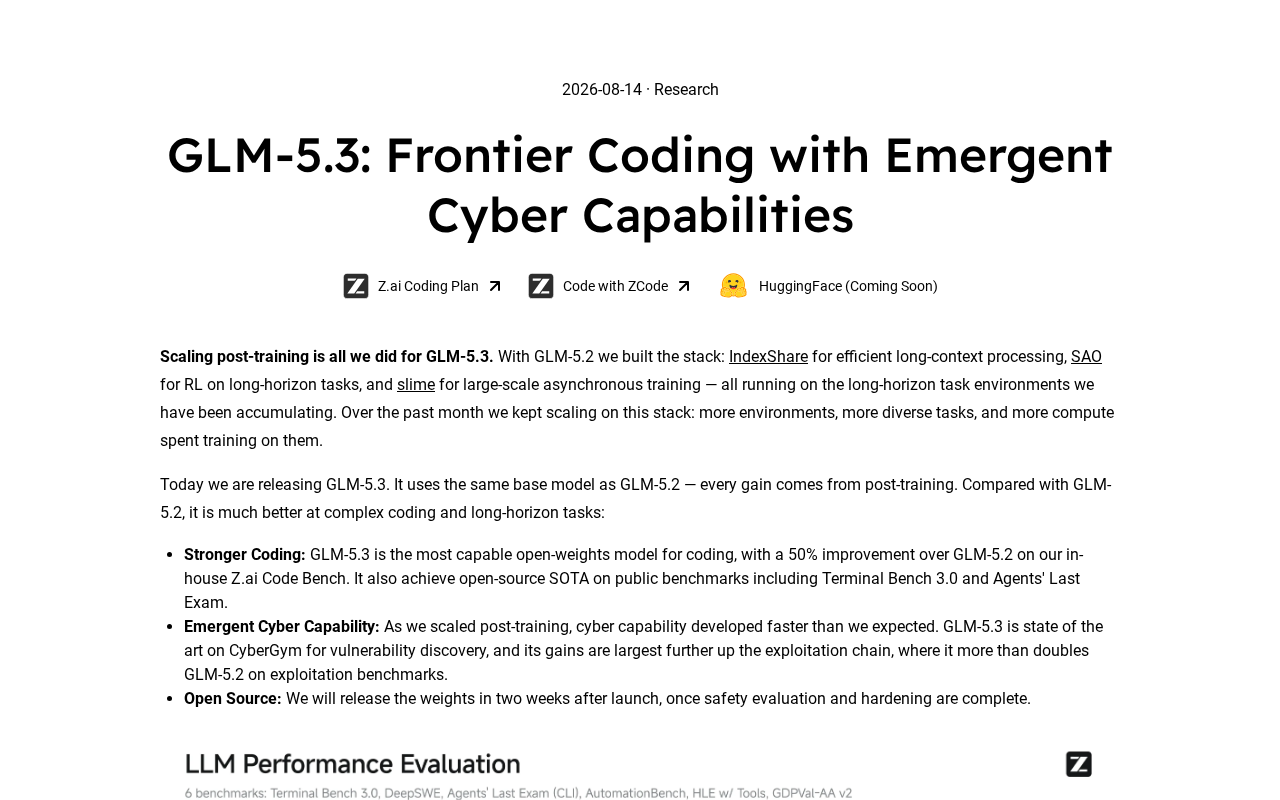
GLM-5.3 Frontier Coding Capabilities: From Code Completion to Autonomous Engineering
The Continuous Upgrade of Coding Abilities
GLM-5.3 is positioned as a "frontier coding" model, meaning it's no longer content with mere code completion or simple function generation—instead targeting more complex software engineering tasks. In the current model race, coding capability has become a crucial benchmark for measuring a model's comprehensive reasoning level, because writing correct, runnable, and maintainable code requires the model to possess multiple competencies including logical reasoning, contextual understanding, and long-range planning.
The term "Frontier" typically means the model achieves or approaches industry-leading performance on mainstream coding benchmarks. These benchmarks each have different focuses: SWE-bench is a software engineering benchmark introduced by a Princeton University team in 2023 that extracts thousands of resolved issues from real GitHub repositories, requiring models to locate problem files and generate correct patches within the context of complete codebases—testing end-to-end problem-solving ability in real engineering environments. HumanEval is a function-level code generation benchmark released by OpenAI, containing 164 hand-written programming problems that focus on algorithmic logic correctness. LiveCodeBench is a continuously updated competitive programming problem set that avoids data leakage by using problems published after the model's training cutoff date, ensuring evaluation fairness. These three benchmarks respectively examine model capabilities in real engineering scenarios, function-level generation, and algorithmic reasoning, forming the primary framework for current coding model evaluation. For developers, the value of such models lies in handling multi-file modifications, bug fixes, refactoring, and even end-to-end feature implementation in real projects.
Why Coding Capability Is So Critical for Large Models
Code is a highly structured, automatically verifiable language. Whether model-generated code is correct can be immediately verified through compilation and testing. This "verifiability" makes coding tasks a natural training ground for reinforcement learning and capability improvement—models can iteratively optimize their reasoning strategies through extensive automated feedback loops without expensive human annotation. For this reason, all major labs treat coding capability as one of the core metrics for model iteration, and GLM-5.3 is no exception.
Emergent Cybersecurity Capabilities: Opportunities and Concerns Coexist
What Are "Emergent" Capabilities in AI Models
GLM-5.3's most striking claim is its "emergent cybersecurity capabilities." "Emergent" in the AI context refers to new abilities that suddenly appear as model scale and training increase—abilities that were not explicitly designed. This concept was first systematically articulated by a Google Research team in their 2022 paper Emergent Abilities of Large Language Models. The research found that certain capabilities barely exist when model scale is below a specific threshold but suddenly appear once that threshold is exceeded, exhibiting phase-transition-like nonlinear jumps. However, this concept was later challenged—a 2023 Stanford University study pointed out that so-called emergence might be a statistical artifact caused by metric selection; if continuous metrics are used instead of discrete ones like accuracy, capability improvements often show smooth, gradual curves.
This academic debate is crucial for understanding GLM-5.3's claimed "emergent cybersecurity capabilities": is it a genuine qualitative shift, or a natural extension of quantitative accumulation in coding ability? When a model is sufficiently powerful at coding, it naturally gains the ability to understand vulnerabilities, analyze code security, and even discover and exploit flaws—because these are fundamentally deep reasoning about code behavior. In other words, cybersecurity capability could be considered a "byproduct" of strong coding ability. A model that can comprehend complex code logic and locate bugs naturally possesses the potential to discover security vulnerabilities.
The Double-Edged Sword Effect of Cybersecurity Capabilities
The emergence of these capabilities has triggered polarized discussion in the Hacker News community. Supporters argue that models with cybersecurity capabilities can dramatically improve defenders' efficiency: automated vulnerability scanning, security code auditing, and penetration testing assistance are all scenarios that would benefit. Security teams have long faced staffing shortages, and AI-assisted tools could help fill this gap.
In fact, AI applications in cybersecurity have been accumulating for several years. On the defensive side, tools like GitHub Copilot and Amazon CodeWhisperer can already identify common security anti-patterns (such as SQL injection, buffer overflow) during development. On the offensive side, DARPA's 2024 AI Cyber Challenge (AIxCC) demonstrated AI systems' ability to automatically discover and fix vulnerabilities in real software. Academia has also extensively explored LLM applications in vulnerability detection (such as CWE classification), fuzz test case generation, and reverse engineering assistance. What makes GLM-5.3 distinctive is positioning these capabilities as a byproduct of a general-purpose coding model rather than a specially trained security tool—meaning any user employing the model for everyday development may simultaneously gain a certain degree of security analysis capability.
But concerns are equally significant. If a model can autonomously discover and exploit vulnerabilities, it can equally be used by malicious actors for attacks. This is precisely what makes "emergent" capabilities most unsettling—they weren't specifically designed, making them harder to fully control and predict. When a general-purpose coding model "incidentally" acquires offensive capabilities, safety alignment and misuse prevention become unavoidable issues.
Community Discussion Focus: Capability Verification and Security Governance
The Gap Between Capability Claims and Real-World Performance
Among the 41 comments, a recurring theme is the cautious attitude toward marketing-oriented expressions like "frontier" and "emergent." The technical community typically maintains skepticism toward vendors' self-claims, placing greater value on independent third-party benchmark testing and real-world scenario validation. High scores on specific benchmarks don't necessarily translate into reliable performance in actual engineering.
This is also a common challenge in current large model evaluation: benchmark overfitting is one of the core issues. When model developers over-optimize for specific test sets, models may perform excellently on benchmark scores but experience significant performance degradation on out-of-distribution real tasks. This phenomenon is particularly prominent in the coding domain—for example, some models achieve over 90% pass rates on HumanEval but perform far below expectations when facing complex dependency relationships and legacy code in real codebases. To address this problem, the community is developing more robust evaluation methods, including using private test sets, introducing timestamp filtering (ensuring test data postdates training data), and conducting blind comparisons by human experts. Therefore, GLM-5.3's actual capabilities still need to be validated through broader community practice.
Challenges in AI Model Security Governance
As models' cybersecurity capabilities strengthen, how to strike a balance between open access and risk prevention has become another focal point of discussion. Should models with offensive capabilities face stricter access restrictions? How should open-source versus closed-source approaches be weighed on this issue?
Safety Alignment refers to ensuring AI model behavior conforms to human intent and social norms through technical means. Current mainstream methods include RLHF (Reinforcement Learning from Human Feedback), Constitutional AI, and various red-teaming tests. In the specific domain of cybersecurity capabilities, the main challenge lies in the "dual-use" problem: the same vulnerability discovery capability serves as security auditing when used defensively and zero-day exploitation when used offensively. Since 2023, multiple organizations have released relevant governance frameworks—OpenAI's "Preparedness Framework" conducts tiered assessments of models' cybersecurity capabilities, triggering additional security reviews when capabilities exceed specific thresholds; Anthropic's "Responsible Scaling Policy" sets explicit capability red lines; and NIST's AI Risk Management Framework provides systematic risk identification and mitigation methodology. These frameworks all attempt to establish tiered control mechanisms for models with potentially dangerous capabilities, but still face numerous gray areas in actual implementation. These questions remain unresolved, but GLM-5.3's release has undoubtedly brought these discussions further into the spotlight.
Conclusion: The Capability Boundaries of Coding Models Continue to Expand
GLM-5.3's release reflects an important trend in current large model development: as coding capabilities continuously improve, models are naturally crossing into more specialized and sensitive domains, such as cybersecurity. This is both a manifestation of technological progress and a new challenge that security governance must confront head-on.
For developers and security practitioners, such models bring significant efficiency improvement opportunities; for the broader AI community, how to manage misuse risks while unleashing capability potential will be a core proposition requiring continued exploration. How much of its "frontier" promise GLM-5.3 can deliver in real-world scenarios remains to be tested by time and practice.
Related articles

Chain of Thought Isn't Just for AI: How Humans Can Use CoT to Improve Thinking Quality
Chain of Thought isn't just a prompt trick for large models. Starting from a Hacker News discussion, this article analyzes why CoT works for human thinking too, breaks down actionable ways to transfer it, and highlights the key differences between human CoT and machine CoT.
Cloudflare Teams Up with OpenAI: Closi…
Cloudflare Teams Up with OpenAI: Closing the Loop from Vulnerability Discovery to Defense with AI
Cloudflare uses OpenAI Daybreak to investigate security vulnerabilities and generate reviewable remediation plans, while developers use Codex to boost coding efficiency and quality.

Orca Multi-Agent Orchestration in Practice: A Guide to Parallel Collaboration with Claude and Codex
Orca is Stable AI's free open-source agent workbench supporting 34 agents like Claude Code and Codex in parallel. Learn its Git worktree isolation, multi-model orchestration, and mobile management.