GLM-5.3 Flash: How Zhipu's Lightweight Model Is Racing to Dominate the Low-Cost Inference Market
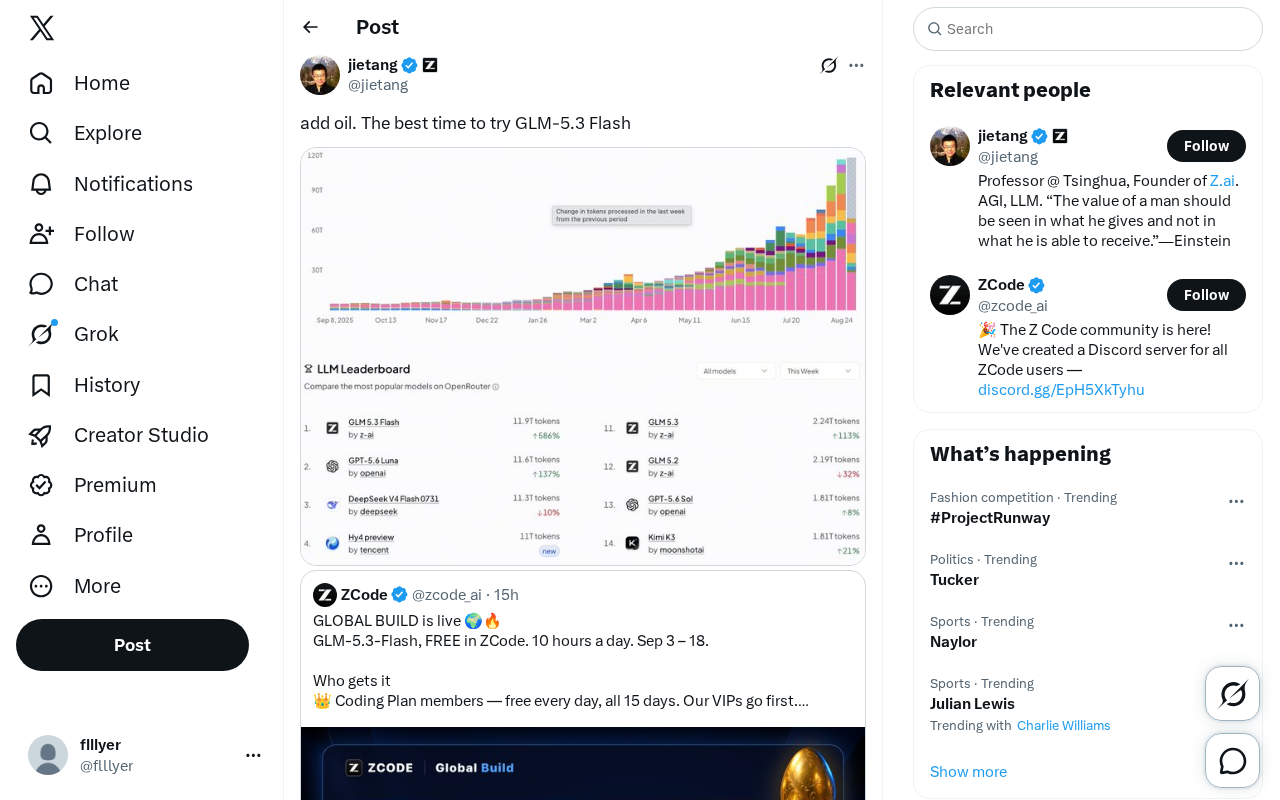
Zhipu's GLM-5.3 Flash targets developers with a fast, low-cost alternative to flagship LLMs.
Zhipu AI has released GLM-5.3 Flash, a lightweight model optimized for high throughput, low latency, and low-cost inference. This article explores the Flash model's positioning within Zhipu's product matrix, the GLM series' architectural evolution from ChatGLM to GLM-5, the industry-wide race for cost-effective lightweight models, and practical guidance for developers looking to evaluate it for real-world Chinese and multilingual applications.
The Signal Behind a Single Tweet
Recently, a brief tweet caught the attention of the AI community: "add oil. The best time to try GLM-5.3 Flash." This promotional message — tinged with a distinctly Chinese-English flavor of encouragement — points to the lightweight model in Zhipu AI's GLM lineup: GLM-5.3 Flash.
Despite the brevity of the original message, it reflects a clear trend in the large language model industry: Leading players are accelerating the release of "Flash"-class lightweight, high-speed models to capture developers and low-cost inference use cases. For anyone who has been following the evolution of Chinese-developed LLMs, every iteration of the GLM series is worth paying attention to.
The GLM Series and the "Flash" Model Positioning
What Problem Do Flash Models Actually Solve?
In the naming conventions of large language models, "Flash" typically denotes a lightweight model variant that prioritizes high throughput, low latency, and low cost. Rather than competing on raw reasoning power or parameter count, these models seek the optimal balance between performance and cost, specifically serving real-world applications that are sensitive to response speed and involve massive call volumes.
This naming approach wasn't invented by Zhipu. In the LLM product landscape, the "Flash" naming convention originated with Google's Gemini 1.5 Flash, released in 2024. These models typically employ techniques like distillation, pruning, or Mixture of Experts (MoE) to dramatically reduce parameter counts and computational overhead while preserving core capabilities. Typical characteristics include: 50–80% reduction in inference latency, 60–90% lower API call costs, and context windows maintained in the 32K–128K token range. Google's Gemini Flash, along with the "mini" and "lite" series from numerous other vendors, all convey the same product logic: not every task requires the most powerful flagship model.
The technical trade-off in these models involves sacrificing some complex reasoning capability (such as multi-step mathematical proofs or deep code refactoring) in exchange for exceptional cost-efficiency on high-frequency tasks like information extraction, sentiment analysis, and content moderation. For high-frequency, lightweight tasks such as content classification, intent recognition, simple Q&A, and batch text processing, a fast and cheap model is often the optimal engineering solution.
The Version Evolution of GLM-5.3
GLM is Zhipu's proprietary general-purpose language model series. From the early open-source ChatGLM versions, through GLM-4 and GLM-4.5, to the GLM-5.3 Flash mentioned in the tweet, the iteration pace has clearly accelerated. The GLM (General Language Model) series is built on a bidirectional attention architecture developed at Tsinghua University, combining both autoregressive and autoencoding pre-training paradigms. Its core innovation lies in a "Blank Infilling" pre-training objective, which enables the model to handle both text generation and comprehension simultaneously.
The jump from version 4 to version 5 typically signals a major upgrade in the underlying architecture or training data. The addition of the "Flash" suffix indicates that Zhipu is refining its tiered model matrix strategy — using flagship models to push the upper bounds of capability while deploying Flash models to cover large-scale deployment needs. Compared to pure decoder architectures (like GPT), GLM achieves an average improvement of 8–15 percentage points on Chinese NLU tasks; compared to encoder-decoder architectures (like T5), inference efficiency improves by approximately 40%. Starting with GLM-4, multimodal capabilities were introduced, while the GLM-5 series has further strengthened long-context processing (supporting 128K context) and Function Calling capabilities.
Why "Now Is the Best Time to Try"
The phrase "The best time to try" in the tweet isn't mere marketing fluff — it typically corresponds to several real-world incentives:
- Free or discounted quotas: When a new model launches, vendors commonly offer free API call quotas or deep discounts to attract developers to try it out and collect real-world feedback.
- A performance inflection point: GLM-5.3 may have achieved qualitative improvements over previous versions in inference speed, context length, or multilingual capability — reaching a critical threshold where it's genuinely "worth a try."
- An ecosystem window: Before developers have locked in on a particular model provider at scale, capturing mindshare is crucial for new product promotion.
For developers, the initial launch period is precisely when testing costs are lowest and migration risks are smallest. Taking advantage of generous quotas and active community discussions to run evaluations lets you determine at minimal cost whether the model fits your use case.
The Industry Logic Behind the Lightweight Model Race
Cost Is the Real Dividing Line for Scaling Deployment
As large models shift from "showcasing capabilities" to "real-world deployment," enterprises are increasingly focused on per-call costs. LLM APIs typically charge by token, where 1 token equals approximately 0.75 English words or 0.5 Chinese characters. The mainstream pricing model distinguishes between input tokens (Prompt) and output tokens (Completion), with the latter typically priced at 2–3x the former. For example, GPT-4 charges $0.03/1K input tokens and $0.06/1K output tokens, while Flash-class models can bring this down to $0.0015/1K input and $0.002/1K output — a cost reduction of up to 95%.
A Flash model that's slightly less capable but priced at one-tenth of the flagship can deliver order-of-magnitude cost savings in high-volume call scenarios. At 10 million daily calls, this translates to monthly costs dropping from hundreds of thousands of dollars to just a few thousand. The sensible model selection strategy is therefore: use Flash for 80% of simple tasks, and only invoke the flagship model for the remaining 20% of complex scenarios. This is exactly why virtually every major provider is pursuing a dual-track product strategy of "premium flagship + cost-effective lightweight."
Differentiated Breakthroughs for Chinese LLMs
Among Chinese LLM providers, competition is fierce between Zhipu, DeepSeekAd, Alibaba's Tongyi, Moonshot AI, and others. The release of GLM-5.3 Flash is fundamentally about seeking breakthroughs across three dimensions: Chinese language optimization, cost control, and developer ecosystem.
Chinese language processing faces three major technical challenges compared to English: 1) Word segmentation ambiguity (e.g., '研究生命' can be segmented as '研究/生命' [study/life] or '研究生/命' [graduate student/fate]); 2) High character density (Chinese requires roughly 60% of the tokens English does for equivalent information, effectively shrinking the usable context window); 3) Visually similar character interference (models easily confuse characters like '己/已/巳' or '戊/戌/戍'). Chinese-developed models typically employ targeted optimizations: increasing Chinese corpus share to over 70%, using character-word hybrid tokenization, and incorporating auxiliary signals like Chinese character glyph and pinyin data during pre-training.
Rather than going head-to-head against GPT-class flagships, entering the high-frequency application market through lightweight, high-speed models is actually a more pragmatic path.
How Developers Should Evaluate GLM-5.3 Flash
When evaluating the newly launched GLM-5.3 Flash, developers should take a pragmatic approach:
-
Define your task type: Flash models are suited for high-frequency, lightweight tasks (such as classification, summarization, and simple Q&A). The core technology behind Flash-class models is Knowledge Distillation, proposed by Hinton et al. in 2015. The principle involves using the output probability distribution of a large "teacher model" to guide the training of a smaller "student model," enabling the latter to mimic the former's decision patterns rather than simply fitting labeled data. For complex reasoning, long-form content creation, or code generation, you'll still need to compare against flagship model performance.
-
Benchmark latency and throughput in practice: Speed is Flash's core selling point, so make sure to test response latency and stability under realistic concurrency conditions. Cloud-based LLM services typically implement rate limiting strategies constrained across three dimensions: RPM (requests per minute), TPM (tokens per minute), and concurrent request count. Because Flash models have faster inference (50–200ms per request vs. 500–2000ms for flagship models), they can support higher QPS under the same TPM limits. During evaluation, use load testing tools (such as Locust or JMeter) to simulate real concurrency and measure P95/P99 latency and 429 error rates.
-
Do the long-term cost math: Calculate long-term costs based on projected call volumes, compare them horizontally against your current solution, and assess the economic viability of migration.
-
Prioritize Chinese language capability verification: Performance in Chinese scenarios is a traditional strength of domestically developed models. This includes Chinese comprehension accuracy, multi-turn dialogue coherence, and more — all worth prioritizing in your evaluation. When assessing Chinese capabilities, focus on testing idiom comprehension, classical Chinese text processing, dialect recognition, and other areas where English-centric models tend to be weak.
Conclusion
A single brief tweet reflects a deeper industry shift — from "competing on parameters" to "competing on deployment." The emergence of GLM-5.3 Flash is both a sign of Zhipu's increasingly mature product matrix and a microcosm of the intensifying competition in the lightweight, high-speed model space. For developers on the front lines, rather than continuing to wait and watch, it's better to get hands-on during this early-access window — because ultimately, real-world business performance is the only true measure of a model's value.
Related articles

Workbuddy for Absolute Beginners: How a Desktop AI Agent Fits Into Real Workflows
A beginner's guide to the Workbuddy desktop AI agent: installation, claiming credits, file management, and building automated workflows—compared with CodeX for fit and cost, helping professionals shift from AI question-askers to AI managers.

OpenAI's New Agent Stack: Computer Use, Decisions API, and Ultra-Fast Workflows
OpenAI Dev Day unveiled a new agent stack: Computer Use outperforms humans, Decisions API delivers ultra-low-latency classification via Luna, Agents API opens the same Computer Use capabilities, and GPT-6.1 Sol costs only one-seventh of Astra. Core updates, benchmark data, and developer insights.

Liang Wenfeng Open-Sources DeepInfo Inference Framework, Takes On U.S. Ban
DeepSeek open-sources its DeepInfo inference framework after its models, featuring GPU/CPU cross-pipelining, small-model prediction with large-model verification, and full Huawei Ascend and NVIDIA chip support—facing the U.S. federal ban head-on. This article analyzes its significance for AI deployment and open-source strategy.