GLM 5.3 Flash Lands on Token Pass: A Million-Token Multimodal Coding Model

Z.ai's GLM 5.3 Flash joins the Token Pass model pool with multimodal and million-token context.
Token Pass is a $30/month subscription offering $80 in credits, routed through AI Gateway, supporting coding agents like fx, Pi, Cline, and Command Code, with Zero Data Retention enabled by default. Z.ai's GLM 5.3 Flash has joined alongside Kimi K3, GLM 5.3, and DeepSeek V4.1 Flash. It's a native multimodal coding model with a 1M token context window suited to UI screenshots, design mockups, and large codebases. Integration requires only adding the model in the gateway dashboard, with no workflow changes. The article notes that long-context effective utilization still needs testing and that credit consumption rates across models are worth monitoring.
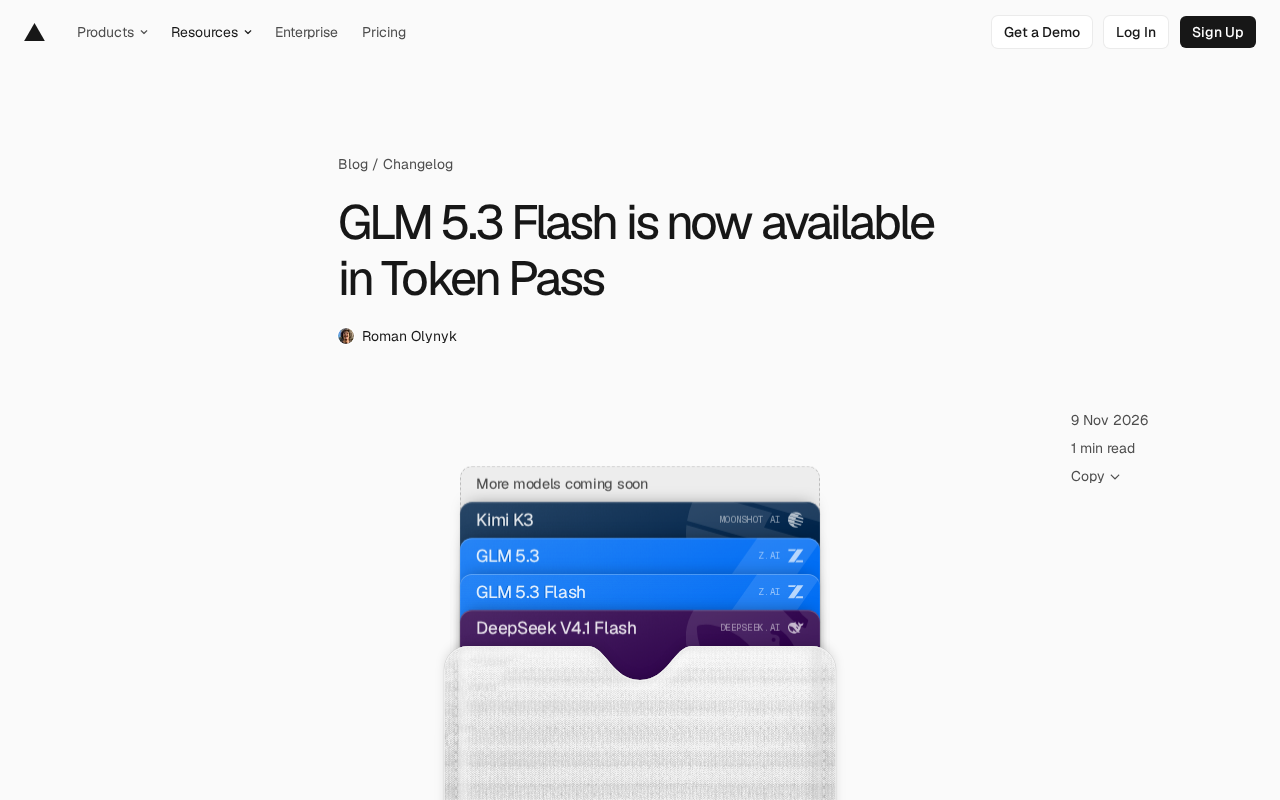
Token Pass's model lineup has expanded once again. According to official sources, Z.ai's GLM 5.3 Flash has officially joined Token Pass, standing alongside Kimi K3, GLM 5.3, and DeepSeek V4.1 Flash, with more models reportedly on the way.
What Is Token Pass
Token Pass is a subscription service from the Pro team priced at $30 per month, offering $80 in monthly credits and running through AI Gateway. It supports a range of coding agents including fx, Pi, Cline, and Command Code, and developers can also build their own tools with the AI SDK. Zero Data Retention is enabled by default.
This pricing structure is appealing to teams that heavily use coding agents: there's a clear gap between the subscription fee and the actual usable credits, effectively trading a fixed monthly fee for a larger model-call budget.
AI Gateway is a unified proxy layer sitting between applications and model providers. Developers only need to integrate a single endpoint; the gateway handles authentication, routing, rate limiting, usage metering, and failover, and performs format conversion between different providers' APIs. Its real value lies in decoupling: switching models means changing gateway configuration rather than business logic, and teams can route requests to different models based on task, cost, or latency policies. Compared with calling each provider's official API directly, the gateway adds a layer of observability and centralized billing, at the cost of one extra network hop and the need to trust the gateway operator's data handling practices.
Zero Data Retention means the service provider does not persist prompts or outputs after a request completes, retaining only the necessary billing and abuse-monitoring metadata. It is typically distinguished from the weaker commitment of "not used for training" and represents a stricter data handling model, commonly found in enterprise procurement terms. For teams submitting private code to third-party models, zero data retention can significantly reduce the risk of source code leakage and compliance audit exposure, though the specific retention scope and log duration should still be confirmed against the terms of service.
Where GLM 5.3 Flash Fits
GLM 5.3 Flash is Z.ai's native multimodal coding model with a 1 million token context window. That spec means it can process large codebases or long documents in a single pass, reducing the number of segmented calls.
Compared with the other models in this batch—Kimi K3, GLM 5.3, and DeepSeekAd V4.1 Flash—GLM 5.3 Flash emphasizes the combination of multimodal capability and coding scenarios. It can not only read code but also handle non-text inputs such as images, which is especially relevant for front-end and full-stack development tasks that require understanding UI screenshots, design mockups, or diagrams.
Context window refers to the total number of tokens a model can accommodate in a single request, covering both input prompts and output. One million tokens is roughly equivalent to hundreds of thousands of lines of code or several full-length documents. The main benefit of long context is reducing the need for retrieval-augmented generation (RAG)—placing all relevant files from an entire repository directly into the prompt, avoiding the information gaps and error accumulation that come with chunked retrieval. But note the "effective context" problem: models often utilize information in the middle of very long inputs less effectively than information at the beginning and end—the so-called "lost in the middle" phenomenon—and long inputs significantly increase latency and per-call cost. In practice, engineering teams usually still need to combine file filtering and structured summarization rather than indiscriminately filling the window.
How to Get Started
The integration path is straightforward: add GLM 5.3 Flash on the Token Pass page of your team's AI Gateway dashboard, or consult the Token Pass documentation to complete configuration. Since Token Pass itself routes everything through AI Gateway, developers don't need to maintain separate integration logic for each model.
For teams already using agents like fx or Cline, adding a new model is essentially a configuration-level operation that requires no changes to existing workflows. This "model pool + unified gateway" design also lets teams switch models across different tasks without being locked into a single provider.
Points Worth Noting
The practical value of multimodal coding models is being reassessed. In the past, coding models mainly competed on the accuracy of code generation and completion, but as agents take on more complex tasks—reading screenshots to reproduce bugs, generating components from design mockups, understanding flowcharts—multimodal input has shifted from a bonus feature to a necessary capability. The addition of GLM 5.3 Flash gives Token Pass another option for these scenarios.
The 1 million token context window represents competition on another front. Long context paired with coding agents can bring all relevant files from an entire repository into context, reducing the error accumulation of the retrieval step. Of course, there's still a gap between context length and actual effective utilization, and real-world performance still needs to be verified through testing.
Zero data retention being enabled by default is a compliance plus for enterprise users. When handing code to third-party models, data retention policy is often one of the key thresholds in procurement decisions.
Token Pass is still in a phase of continuous model expansion, and the official team has made clear that more models will be added. For developers, this means a single subscription can cover more model choices, though it's also worth watching whether credit consumption rates are consistent across different models.
One-line Summary
Z.ai's GLM 5.3 Flash joins the Token Pass model pool, emphasizing multimodal capability and million-token context.
Paragraph Summary
Token Pass is a subscription service from the Pro team priced at $30 per month, offering $80 in credits and routed through AI Gateway. It supports coding agents like fx, Pi, Cline, and Command Code, and allows building custom tools with the AI SDK, with Zero Data Retention enabled by default. Z.ai's GLM 5.3 Flash has officially joined, standing alongside Kimi K3, GLM 5.3, and DeepSeek V4.1 Flash, with more models reportedly coming. GLM 5.3 Flash is a native multimodal coding model with a 1 million token context window, suited to understanding UI screenshots, design mockups, and large codebases. Integration only requires adding the model in the gateway dashboard or consulting the documentation, with no changes to existing workflows. The article also notes that the actual effective utilization of long context still needs testing, and that credit consumption rates across different models are worth monitoring.
Related articles

RePlan-VLA: Progress-Aware Replanning Breakthrough for Long-Horizon Robotic Manipulation
The RePlan-VLA framework converts VLA models' short-horizon capabilities into reliable long-horizon execution through progress-aware adaptive replanning, improving success rates by 21.9% and 10.4% on RoboCasa365 and CALVIN, and validating real-world deployment on a Franka Research 3 robot.

Geometric Bridge Flow Matching: A New Breakthrough in Blind Rigid Motion Correction
Geometric bridge flow matching enables blind rigid motion correction in head CBCT, achieving 37.1 dB PSNR and 0.27 mm RPE on simulated data in ~9.1 minutes, outperforming existing methods.

Google Releases Gemini 4 Hydrogen: 2.5x Faster Without Sacrificing Intelligence
Google releases the lightweight Gemini 4 Hydrogen: 2.5x faster task completion, AA Intelligence Index of 54 beating its flagship sibling, 7.3s single-step on Agent Arena faster than Claude and GPT rivals, four thinking levels with pay-as-you-need pricing, now available across AI Studio and more.