GLM 5.3 Flash Launches on Serverless Training API: Supports Vision and Text Fine-Tuning

GLM 5.3 Flash launches on Serverless Training API with multimodal fine-tuning for agentic app developers.
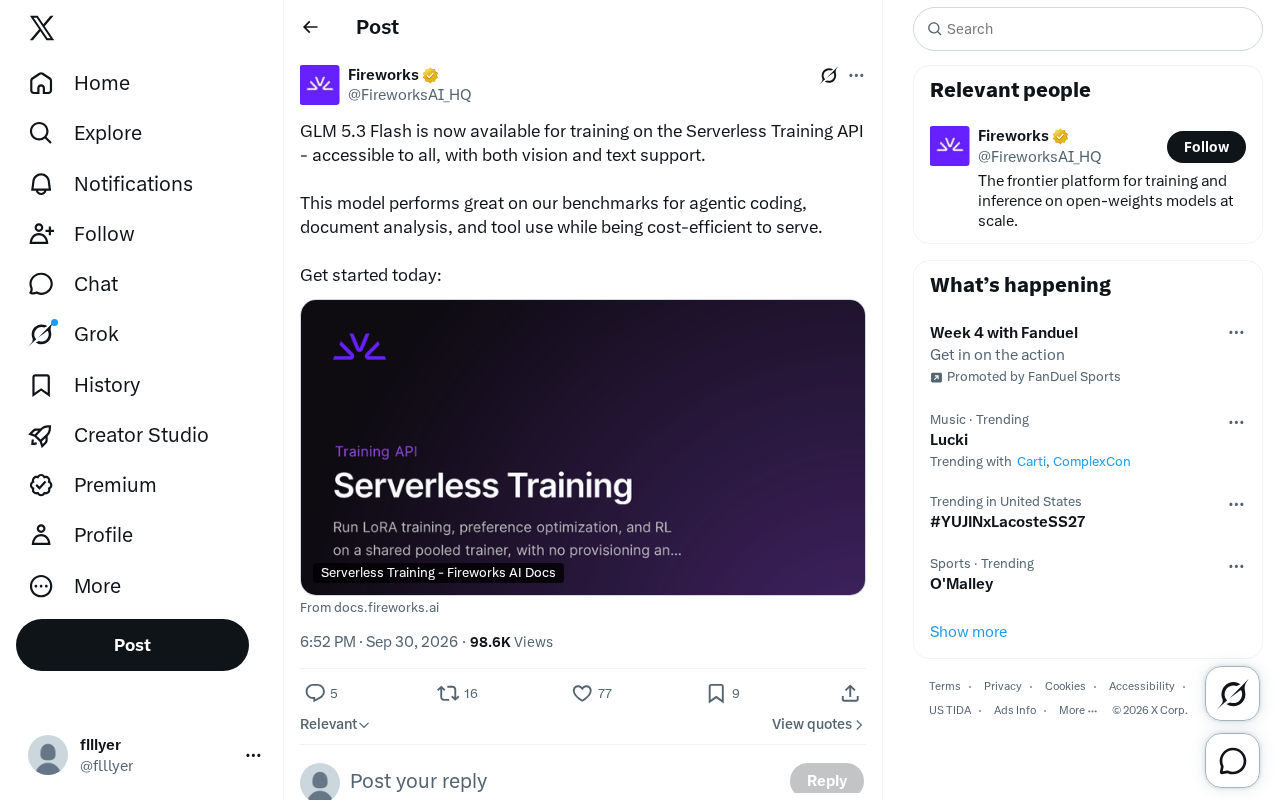
GLM 5.3 Flash is now integrated into the Serverless Training API, opening fine-tuning capabilities to all users with support for both vision and text modalities. The model targets agentic coding, document analysis, and tool use benchmarks, positioning it as a lightweight, cost-efficient inference engine for high-frequency calls. The Serverless approach abstracts away GPU cluster setup and data pipeline management, letting small teams train custom models on demand. The combination of customizability, multimodal support, and low cost offers a low-risk iteration path for teams building document processing or agentic workflows. Detailed benchmarks and pricing require referencing official documentation.
GLM 5.3 Flash Opens Training Capabilities
GLM 5.3 Flash is now available on the Serverless Training API, meaning developers can fine-tune this model without having to set up and manage their own training infrastructure. More notably, the capability has been announced as open to all users, lowering the barrier to building customized models.
Unlike many lightweight models that only support plain text, GLM 5.3 Flash offers training support for both vision and text modalities. This enables a broader range of use cases — from document image parsing to mixed image-text understanding — and provides a more flexible foundation for deploying multimodal applications.
Performance Profile: Built for Agentic Scenarios
According to official documentation, GLM 5.3 Flash excels across three benchmark categories: agentic coding, document analysis, and tool use. These three areas happen to align with the most critical capability directions in modern AI application development.
Agentic coding tests a model's reliability in autonomous coding, debugging, and multi-step reasoning. Document analysis measures how accurately a model can extract information from unstructured documents. Tool use is the core capability that allows agents to call external APIs and execute real-world actions. A Flash-tier model that performs well across all three is well-suited to serve as a high-frequency inference engine within agentic workflows.
Why Cost Efficiency Matters
The official announcement specifically highlights that the model is "cost-efficient to serve," meaning inference costs are relatively low. Flash-tier models are typically positioned as fast, affordable lightweight options suited for production environments that require high-volume concurrent calls. In agentic applications, a single task often involves multiple rounds of model inference, causing inference costs to scale quickly — making a model that balances performance with cost a practical choice.
Agentic scenarios differ fundamentally from traditional single-turn Q&A. In an agentic architecture, the model continuously runs as the "brain," responsible for planning tasks, breaking them into steps, calling tools, and adjusting strategies based on feedback — a process that may involve dozens or even hundreds of model inference calls. This places two special demands on the model: first, consistency in instruction-following, so the model maintains alignment with the original goal across multiple interactions; and second, reliability in structured output, such as generating correctly formatted JSON function calls that downstream programs can parse and execute. Lightweight Flash-tier models in agentic scenarios typically serve as the "execution layer," handling high-frequency, low-complexity subtasks while delegating complex reasoning to larger flagship models. This layered invocation architecture has become a common design pattern in production-grade AI applications.
What Serverless Training Actually Means
Traditional model fine-tuning requires developers to provision GPU clusters, configure training environments, and manage data pipelines — a process with significant overhead and cost. The Serverless Training API shifts all of that underlying complexity to the platform. Users simply upload their data and trigger a training job; the platform handles resource allocation on demand.
This model is especially developer-friendly for small and mid-sized teams — no upfront hardware investment, pay-as-you-go billing, and a fast path to validating the effectiveness of a customized model. Combined with GLM 5.3 Flash's multimodal support, developers can train versions more tightly tailored to their own business data, rather than relying solely on a general-purpose out-of-the-box model.
At its core, fine-tuning involves continuing to update some or all parameters of a pretrained model using domain-specific data, shifting the model's output distribution toward the target task. Common lightweight fine-tuning methods include LoRA (Low-Rank Adaptation) and QLoRA, which drastically reduce GPU memory requirements by training only a small number of additional parameters — techniques commonly used by Serverless platforms under the hood. For multimodal models, the alignment layer between the vision encoder and the language model may also be a target for fine-tuning, which is why customized results on image-text tasks often outperform pure prompt engineering approaches. The Serverless Training API encapsulates this complex process into a simple API call, so developers can focus on data quality and task definition without needing to understand the details of distributed training — the same logic by which serverless functions abstract away the complexity of server management.
Practical Value for Developers
Putting it all together, the core proposition of this release is the combination of customizability + multimodality + low cost. For teams building agents, document processing pipelines, or image-text understanding applications, GLM 5.3 Flash offers a relatively low-risk path: validate requirements with general-purpose capabilities first, then fine-tune a purpose-built model via Serverless.
It's worth noting that the official announcement is fairly concise — specific benchmark figures, pricing details, and training parameter constraints have not been fully disclosed in this release. Before making a final technical decision, developers are advised to consult the official documentation for complete specifications and pricing information.
Related articles

ChatGPT Space Launches: Team Collaboration and New Pages Features Explained
ChatGPT Space is OpenAI's new team collaboration feature with Pages, real-time collaboration, and Slack/Google Drive sync. We break down its privacy design, multi-platform integration, and the full workflow from conversation to document.

Migrating Apache Spark UDFs to GPU Acceleration with AI Agents
NVIDIA developer blog explains how AI Agents rewrite Apache Spark UDFs for GPU acceleration, covering migration criteria, agent rewriting and verification workflows, plus pitfalls like result consistency and CPU-GPU transfer overhead.

Zed Editor v0.40.4-rc2 Released: Usage Credits Now Available Without Upgrading
Zed editor releases v0.40.4-rc2, allowing users to use usage credits for AI features without upgrading to a paid plan, lowering the trial barrier.