GLM 5.3 Flash Officially Confirmed: Zhipu AI Reveals Ox Alpha's True Identity and Releases Weights
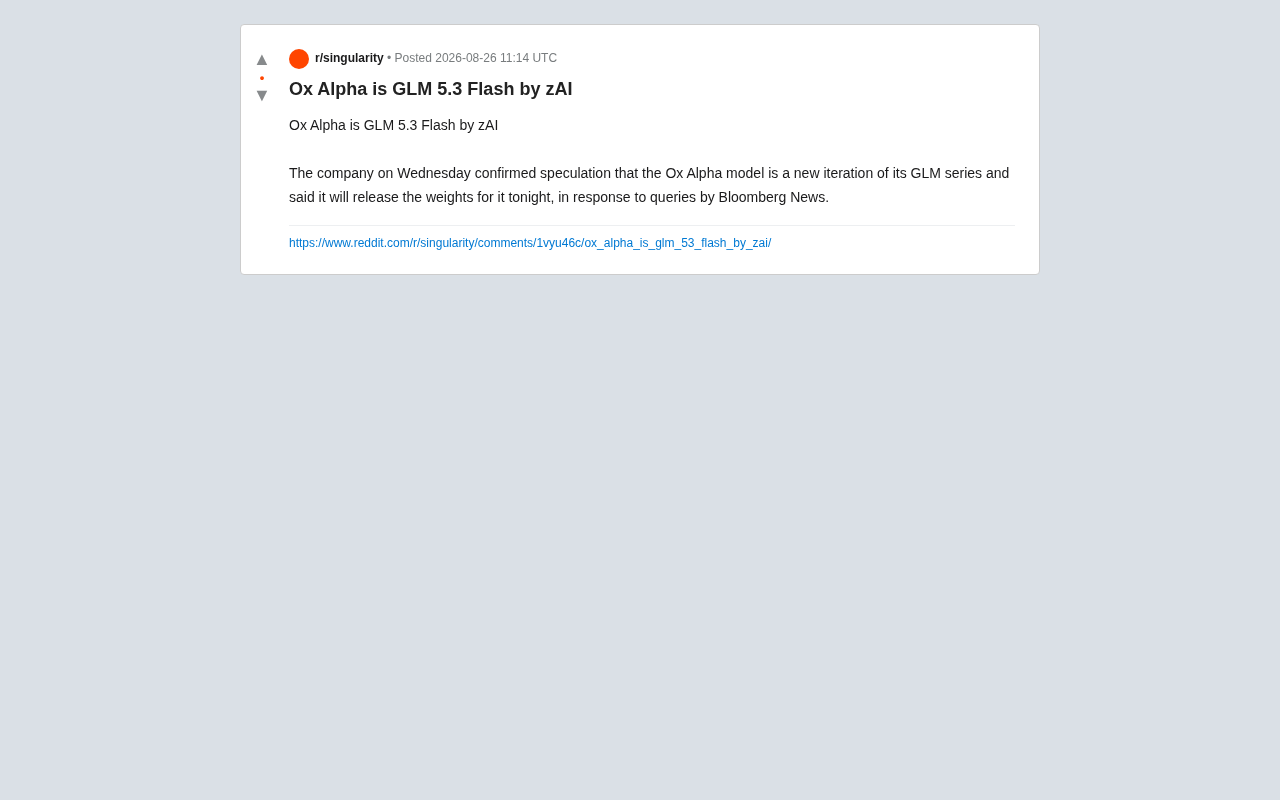
Zhipu AI reveals Ox Alpha as GLM 5.3 Flash and releases model weights to the public.
Zhipu AI officially confirmed that the mysterious Ox Alpha model is GLM 5.3 Flash, releasing its weights publicly. The Flash positioning targets high-speed, cost-effective inference for production workloads. Open weights enable local deployment, fine-tuning, and customization while maintaining data privacy. This move intensifies competition in the open-weight LLM ecosystem alongside Meta's Llama, Alibaba's Qwen, and DeepSeek.
Mystery Model Revealed: Ox Alpha Is GLM 5.3 Flash
The mysterious codename "Ox Alpha," which has been appearing frequently on developer communities and model evaluation leaderboards recently, has finally been unmasked. According to Bloomberg News, Zhipu AI officially confirmed on Wednesday that the Ox Alpha model — which had sparked widespread speculation — is the latest iteration in its GLM series: GLM 5.3 Flash.
Zhipu AI was founded in 2019, incubated by the Knowledge Engineering Group (KEG) at Tsinghua University's Department of Computer Science. Its core team includes prominent academics such as Professor Tang Jie. The company was among the first in China to commercialize large language models. Its GLM (General Language Model) series employs a distinctive autoregressive blank-filling pre-training framework, differentiating it from GPT's purely autoregressive approach. Having secured multiple funding rounds with a valuation exceeding 10 billion RMB, Zhipu AI is one of the leading players in China's large model landscape.
More notably, Zhipu AI announced it would publicly release the model's weights that same evening, meaning GLM 5.3 Flash will be made available to developers and researchers in an open-weight format. It's important to note that "open weights" differs from "open source" in the strict sense — open weights means the model's parameter files are publicly released for download, deployment, and inference, but this doesn't necessarily include training code, training data, data processing pipelines, or other materials needed for full reproduction. Additionally, open-weight models typically come with specific license agreements that may impose restrictions on commercial use, redistribution of modified models, and other conditions. Meta's Llama series is a classic example of open-weight but not strictly open-source. This move continues Zhipu AI's consistent strategy in the open ecosystem and once again positions Chinese LLM companies at the forefront of global open-source competition.
Anonymous Testing with Ox Alpha: A New Industry Convention for Model Releases
In recent years, debuting anonymously on public evaluation platforms under mysterious codenames has become a common tactic for LLM companies to test market reception. From anonymous models appearing on LMArena (formerly Chatbot Arena) to codename models sparking heated discussions on developer forums, companies often seek objective, brand-agnostic performance evaluations through real user blind testing before making official announcements.
LMArena (formerly LMSYS Chatbot Arena) is a model battle evaluation platform initiated by a UC Berkeley team that uses an ELO rating system to rank models. Its core mechanism allows real users to blind-test and vote on responses from two models without knowing their identities, producing more objective capability assessments. The platform has become one of the industry's recognized reference standards for model capability, with cumulative votes exceeding one million. This evaluation method based on real human preferences better reflects model performance in actual use compared to traditional automated benchmarks (such as MMLU, HumanEval, etc.).
Ox Alpha is a textbook case of this strategy. Before its identity was revealed, it had already built up a certain reputation and discussion momentum in the community. When users don't know a model's origin, their evaluations better reflect the model's true capabilities rather than being influenced by brand expectations. This "test first, reveal later" approach serves both as a marketing tactic and a pragmatic product validation path.
Why GLM 5.3 Flash Chose the Flash Positioning
From a naming perspective, "Flash" typically represents a lightweight, high-speed, low-cost model positioning. These models are often specifically optimized for inference speed and deployment cost, suited for latency-sensitive, high-volume scenarios such as online customer service, real-time conversation, and batch text processing.
Flash-class models typically achieve acceleration and cost reduction through multiple technical approaches: model distillation (compressing knowledge from a large model into a smaller one), quantization (compressing model weights from high-precision floating point to lower-precision representations), sparse attention mechanisms (reducing the complexity of attention computation in Transformers), and speculative decoding (using a small model to predict the large model's output to speed up generation). Google's Gemini Flash and OpenAI's GPT-4o mini both embody this product philosophy — dramatically compressing the compute resources needed for inference while maintaining core capabilities.
If GLM 5.3 Flash continues this positioning, it signals that Zhipu AI is refining its model matrix — providing more cost-effective options beyond flagship-level large models to cover different tiers of application needs. This aligns with the current industry trend of "large-small model collaboration": flagship models (with hundreds of billions of parameters) handle complex reasoning, creative generation, and other high-difficulty tasks, while lightweight models (typically tens of billions of parameters) take on high-frequency, low-complexity daily interactions. Through intelligent routing mechanisms, systems can automatically select which model tier to invoke based on the complexity of user requests, achieving optimal balance between performance and cost. This layered architecture significantly reduces the total cost of ownership (TCO) for AI applications.
Strategic Significance of GLM 5.3 Flash's Open Weights
Zhipu AI's decision to publicly release GLM 5.3 Flash's weights is the most significant aspect of this announcement. Open weights mean developers can deploy, fine-tune, and even build upon this model locally, without being entirely dependent on the vendor's cloud API.
For enterprises and research institutions, open weights deliver value across multiple dimensions:
- Data Security and Privacy: Sensitive data doesn't need to be uploaded to third-party servers — inference can be completed in private environments. This is particularly important for industries with strict data sovereignty requirements such as finance, healthcare, and government, where some scenarios even have explicit compliance requirements prohibiting data from leaving the country or being uploaded to public clouds.
- Cost Control: For large-scale invocation scenarios, local deployment may be more economical than per-token billing. Especially when daily call volumes reach millions, API fees can far exceed the amortized cost of self-built inference clusters. Combined with high-performance inference frameworks like vLLM and TensorRT-LLM, local deployment throughput and latency performance have become increasingly impressive.
- Customization Capabilities: Developers can fine-tune the model on their own business data to create domain-specific models. Common fine-tuning methods include full-parameter fine-tuning, LoRA (Low-Rank Adaptation), and QLoRA — the latter two enable efficient parameter adaptation on consumer-grade GPUs, significantly lowering the hardware barrier to customization.
In the global open-weight LLM landscape, Zhipu AI's GLM series has been an important representative among Chinese companies. Current major players in the open-weight ecosystem include Meta (Llama series), Mistral AI, Alibaba (Qwen series), and DeepSeekAd. The release of GLM 5.3 Flash will further enrich the selection of open models and intensify healthy competition within the open-source camp.
Impact on Developers and the LLM Industry
With GLM 5.3 Flash's weights now public, the developer community is expected to quickly launch a round of targeted evaluations and experimentation. Real-world performance and head-to-head comparisons with similarly-sized open-source models (such as various 7B and 9B-class models) will become the immediate focus. These comparisons typically span multiple dimensions: general knowledge Q&A (e.g., MMLU), code generation (e.g., HumanEval, LiveCodeBench), mathematical reasoning (e.g., GSM8K, MATH), instruction following (e.g., IFEval), and multi-turn conversation capabilities.
From an industry perspective, this event reaffirms several trends:
First, anonymous testing is becoming a standard pre-release step for LLM launches. Companies increasingly value community reputation and objective evaluations rather than relying solely on official benchmarks. Multiple companies have previously adopted similar strategies — for instance, the anonymous model "gpt2-chatbot" once sparked widespread speculation on the Arena before being confirmed as related to OpenAI. This approach also helps companies discover potential issues and optimize before release.
Second, open weights remain a critical competitive strategy for China's leading AI companies. In competing with closed-source giants, the open ecosystem has become a key lever for attracting developers and building technical moats. Open weights not only rapidly expand the user base and community ecosystem but also accelerate model iteration through community feedback, creating a positive flywheel effect.
Finally, the value of lightweight Flash models continues to be amplified. In an era of high compute costs, Flash-class models that deliver usable performance with fewer resources are becoming the workhorses of AI deployment. Industry estimates suggest that over 70% of current LLM API calls don't actually require the full capabilities of a flagship model — Flash-level models can handle them adequately. This means Flash models are carrying the primary traffic of AI commercialization.
Conclusion
The reveal of Ox Alpha's identity is both a successful community marketing play and an indirect demonstration of Zhipu AI's technical capabilities. Whether GLM 5.3 Flash can withstand rigorous developer scrutiny after its open-weight release will determine how far it can go in the fiercely competitive open model market. For developers following LLM progress, the public weights are worth hands-on testing right away — download the model weights through platforms like Hugging Face, deploy quickly with the Transformers library or inference engines like vLLM, and verify its performance on specific tasks firsthand.
Related articles

Is the Agent Harness Dead? Cursor's Early Engineer Breaks Down the Real Architecture of AI Coding Agents
Cursor early engineer Jediah breaks down the real architecture of the agent harness: why "the harness is dead" is only half right, how the data flywheel lets the harness obsolete itself, and how Grokbot, software factories, and primitive design open new frontiers for agents.

Python Visitor Pattern and Better Alternatives Explained
A deep dive into Python's visitor pattern and four alternatives: method pattern, pattern matching, dictionary mapping, and functools.singledispatch. Choose the best decoupling design by change frequency.

357 Days of Deep Experience: Why Omarchy Made Me Stop Distro-Hopping
A 357-day deep dive into Omarchy: 59-second install, out-of-the-box audio and GPU support, the Quattro QuickShell rewrite migration pains, and why Arch users should try it.