GLM 5.3 Flash Tops Cyber Index, Surpassing Claude
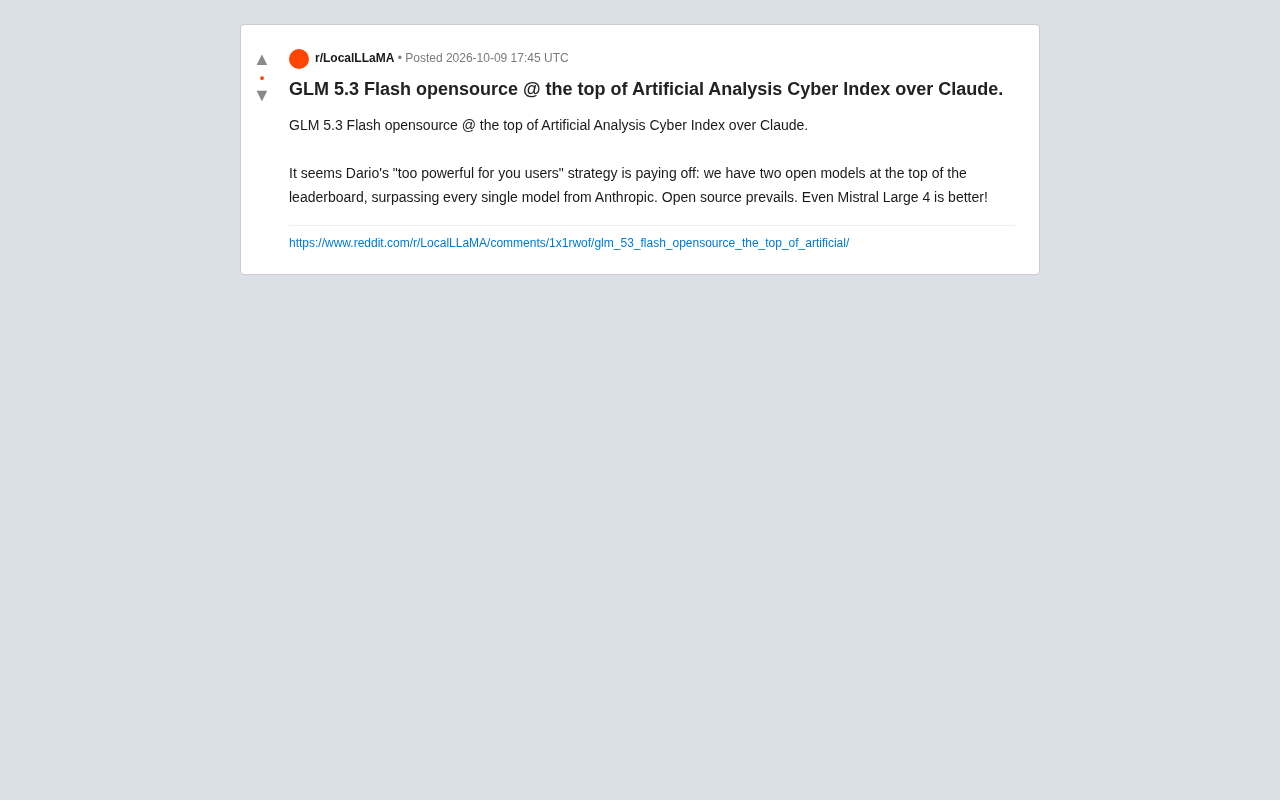
Zhipu's open-source GLM 5.3 Flash tops the Cyber Index, overtaking Anthropic's entire Claude lineup.
Zhipu AI's open-source model GLM 5.3 Flash has claimed the top spot on Artificial Analysis' Cyber Index, surpassing Anthropic's Claude family, with Mistral Large 4 also ranking above them. The result, widely discussed on Reddit, is seen as a landmark moment for the open-source AI ecosystem. Some observers argue that Anthropic's conservative strategy of restricting model capabilities in the name of safety has inadvertently created space for open-source models to catch up — highlighting the ongoing tension between safety alignment and capability release. The article cautions that single benchmarks reflect only specific dimensions of performance, and rankings should be weighed alongside broader evaluations and real-world use.
Open Source Model Claims Top Spot on Security Benchmark
A notable shift has appeared on the Cyber Index — a cybersecurity capability benchmark maintained by AI analytics firm Artificial Analysis: GLM 5.3 Flash, an open-source model developed by Zhipu AI, has claimed the top position, edging out Anthropic's Claude model family. This marks the first time a fully open-source model has overtaken one of the most closely watched closed-source flagships in a benchmark focused on cybersecurity-related capabilities.
The result sparked discussion across Reddit communities. Some users declared outright that "Open source prevails," pointing out that two open-source models now sit above Anthropic's entire lineup. For the open-source camp, this represents a meaningful milestone — historically, closed-source models have dominated the upper tiers of demanding professional benchmarks, but that dominance is beginning to crack.
Artificial Analysis' Cyber Index is a benchmark specifically designed to evaluate large language models across a range of cybersecurity tasks, including vulnerability analysis, penetration testing assistance, malicious code detection, and security Q&A. The organization tracks performance and cost metrics for leading models on an ongoing basis, and its rankings carry real weight in developer communities. GLM 5.3 Flash is a lightweight, high-efficiency model released by Zhipu AI — a Tsinghua-affiliated startup — as part of the GLM-4 series. It is released as open weights, allowing local deployment and downstream customization.
The Backfire of "Too Powerful for Users"
One of the more provocative threads in the discussion targeted Anthropic CEO Dario Amodei's well-known safety stance. Community members remarked, half-jokingly, that Dario's strategy of treating models as "too powerful for ordinary users" appears to be "working against him" — as closed-source vendors tighten model capabilities and access controls in the name of safety, open-source models have quietly taken the lead on at least some professional benchmarks.
This reflects a long-standing tension in the AI industry: the tradeoff between safety alignment and capability release. Anthropic is known for its cautious, controllability-first philosophy and invests heavily in behavioral constraints. But the Cyber Index result suggests that an overly conservative approach may leave measurable gaps in certain specialized capability dimensions — gaps that open-source models can step into and exploit.
It's worth noting that Cyber Index measures performance on cybersecurity-related tasks. A high ranking does not simply mean a model is "safer" or "more dangerous" — it reflects overall capability in that specific domain.
The Broader Rise of the Open-Source Ecosystem
Beyond GLM 5.3 Flash, the community also highlighted Mistral Large 4 as another standout performer that outranked Anthropic's offerings. Mistral, the European AI company that has been a key driver of open-weight model development, joining GLM at the top of the rankings signals that this isn't a one-off result — it reflects a systemic improvement in open-source ecosystem capabilities.
Zooming out, the pace of progress among open-source large language models has far outpaced early expectations. The conventional wisdom was that open-source models would always lag behind closed-source flagships by one or two generations. The sustained iteration from players like GLM and Mistral is steadily closing — and in specific tasks, erasing — that gap. For developers and enterprises, this translates to more high-performance options that are self-hostable, auditable, and cost-controllable.
Mistral AI is a French startup founded in 2023 by former DeepMind and Meta researchers, focused on high-efficiency open-weight models. Its flagship Mistral Large series and Mixtral (mixture-of-experts architecture) models are released under open licenses and have gained significant traction in European privacy-compliance use cases. Mistral Large 4 is its latest generation flagship, featuring substantially increased parameter scale while retaining the open-weight, locally deployable strategy. Mistral and Zhipu GLM — despite taking different technical paths — have both simultaneously surpassed Anthropic on the cybersecurity benchmark, reinforcing the narrative of a systemic open-source ascent.
How to Interpret Benchmark Rankings
As exciting as this result is, it warrants a measured reading. A single benchmark — whether Cyber Index or any other — can only capture performance along specific dimensions, and cannot represent a model's all-around capability. Strong cybersecurity performance does not imply equivalent leadership in reasoning, coding, long-context handling, or multimodal tasks.
Furthermore, rankings are influenced by evaluation methodology, test sample composition, and model version updates — standings shift over time. The Reddit discussion largely reflects community observation and sentiment, with obvious camp affiliations baked in (the "open source wins" narrative is naturally amplified by its supporters). Readers should factor in independent evaluations and real-world deployment experience before drawing firm conclusions.
Regardless, GLM 5.3 Flash topping the Cyber Index is a positive signal in the ongoing trajectory of open-source large language model development. It reminds the entire industry that closed-source does not automatically mean best-in-class, and that open, collaborative development remains a powerfully competitive path. What's worth watching next is whether this capability advantage can hold — and extend — across broader benchmarks and real-world deployment scenarios.
Related articles

Felix Rieseberg Personal Homepage
Felix Rieseberg's personal homepage sparks attention on Hacker News. This article covers the Slack engineer's technical background, the rise and fall of nativefier, and the value of a developer homepage as a tech calling card.

@ai-sdk/vue 3.0.306 Patch Release Syncs with [email protected] Update
@ai-sdk/vue 3.0.306 released, synced with [email protected]. A routine patch release for the Vercel AI SDK ecosystem with no public API changes; the Vue adapter layer stays version-aligned with the core package.

Gemini 4 Argon API Launches: The Era of Million-Token Output Begins
Google launches Gemini 4 Argon with sparse MoE architecture, up to 1M output tokens, and a 68.90% Vals Index score, available across API, AI Studio, and the Gemini app.