GLM-5.3 Open Weights: Zhipu AI's Open Strategy and Developer Ecosystem Explained

Zhipu AI releases GLM-5.3 open weights, signaling China's growing push into the global open model ecosystem.
Zhipu AI's GLM-5.3 model has officially gone open-weight, sparking major discussion on Hacker News. This article explores the distinction between open weights and full open source, the practical value for developers including data privacy and fine-tuning capabilities, and how Chinese AI companies are using openness as an ecosystem strategy. Key community concerns around benchmarks, licensing, and deployment hardware requirements are also examined.
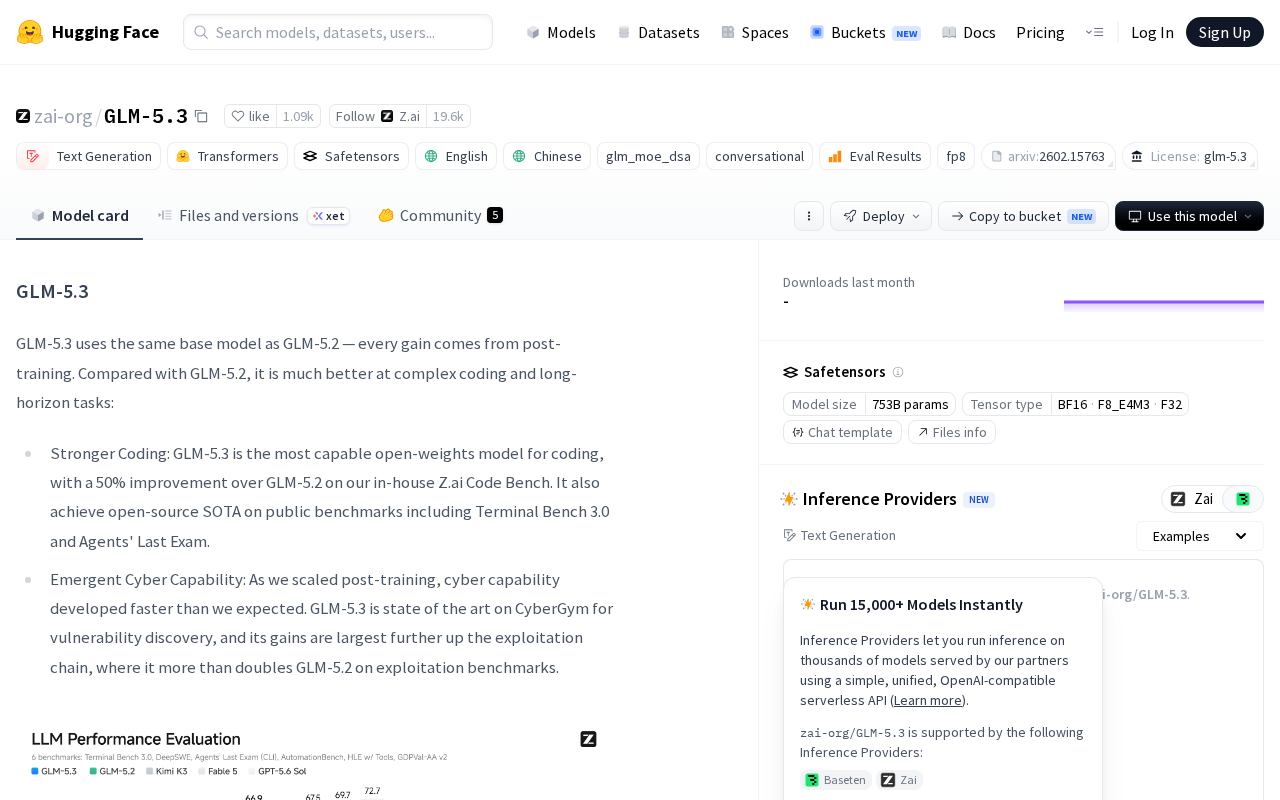
GLM-5.3 Announces Open Weights
Zhipu AI recently announced that its GLM-5.3 model is now officially open-weight. The news quickly climbed the Hacker News front page, garnering 537 upvotes and 189 comments, sparking widespread discussion across the global developer community.
Founded in 2019, Zhipu AI grew out of Tsinghua University's Knowledge Engineering Group (KEG), led by Professor Jie Tang's team. The GLM (General Language Model) series employs a distinctive Autoregressive Blank Infilling pre-training paradigm, setting it apart architecturally from the pure decoder-only GPT approach. From ChatGLM to GLM-4 to GLM-5.3, the series has continuously improved its bilingual Chinese-English capabilities, long-context understanding, and tool-calling features, gradually becoming one of the flagship products in the Chinese large model landscape.
For developers and enterprises, "open weights" means the model's parameters can be downloaded, deployed, and even fine-tuned — no longer limited to access through an official API. Model weights refer to the billions or even hundreds of billions of parameter values that a deep neural network learns during large-scale training. These parameters are stored as tensors in files and constitute the entirety of the model's "knowledge" for inference. Open weights means these parameter files are publicly released in standard formats (such as SafeTensors, GGUF, etc.), allowing developers to load and run the model locally using inference frameworks like PyTorch, vLLM, or llama.cpp. This strategic shift marks a significant step for the GLM series in building an open-source ecosystem and once again puts the question of "how Chinese-made large models can go global" in the spotlight.
Open Weights vs. Fully Open Source
It's important to clarify that "open-weight" and "open-source" are not the same thing. Open weights typically means the organization has released the model's trained parameter files, allowing users to deploy and run inference locally, and even perform further fine-tuning — but the training data, complete training code, and details of the training process are usually not disclosed.
This approach has become the dominant form of openness in the large model space. From Meta's Llama series and Mistral to Alibaba's Qwen and DeepSeekAd, many leading organizations have adopted similar strategies. It strikes a balance between "fully closed commercial APIs" and "completely open source" — building a thriving developer community and ecosystem influence while retaining the commercial moat around core training assets.
Notably, licensing in the large model space has formed a complex spectrum. Meta's Llama series uses a custom Llama Community License that requires separate authorization for companies with over 700 million monthly active users. Mistral's models mostly use the permissive Apache 2.0 license. Alibaba's Qwen series uses Apache 2.0 for some smaller variants and a custom Tongyi Qianwen License for larger ones. These licensing differences directly affect enterprise selection decisions in production environments — whether commercial use is permitted, whether there are user volume restrictions, and whether derivative models must be open-sourced all require careful review. The license GLM-5.3 chooses will directly determine its acceptance in the enterprise market.
The Practical Value of Open Weights for Developers
For SMBs and individual developers, open-weight models deliver tangible value:
- Data privacy control: Models can be deployed entirely in local or private cloud environments, eliminating the need to send sensitive data externally. This is especially critical for regulated industries like healthcare, finance, and government.
- Predictable costs: Once deployed, inference costs depend mainly on hardware investment, avoiding the unpredictable expenses of per-token API billing in high-concurrency scenarios.
- Customization capabilities: Models can be fine-tuned on proprietary data to create specialized models for vertical domains. Common fine-tuning techniques include LoRA (Low-Rank Adaptation) and QLoRA, which effectively adapt models to specific tasks by training only a small number of parameters, significantly reducing the computational resources required for fine-tuning.
China's Open-Source Large Model Wave
GLM-5.3's release is not an isolated event but another milestone in Chinese AI companies' collective embrace of open strategies. Over the past year or so, a series of models including DeepSeek, Qwen, and GLM have successively released open weights, earning significant attention and reputation in the international developer community.
In the Hacker News discussion, many overseas developers expressed recognition of the progress Chinese teams have made in both model capabilities and openness. This "openness for ecosystem" approach is helping Chinese models break through brand awareness barriers — when developers can personally download, deploy, and evaluate a model, word-of-mouth spreads far more efficiently than any marketing campaign.
The New Logic of Large Model Ecosystem Competition
The core of large model competition is shifting from pure "capability comparison" to "ecosystem dominance." Whoever attracts more developers to build applications on their model, contribute to the toolchain, and form communities will hold the advantageous position in the long run.
Open weights are precisely the key lever for building this ecosystem flywheel. They lower the barrier to experimentation, allowing models to rapidly penetrate real-world use cases while leveraging community feedback to improve model iterations. The ecosystem flywheel in the large model space draws on classic platform economics theory: when a model is opened up, developers build fine-tuned versions, adaptation tools, inference optimizations, and downstream applications on top of it. These derivative contributions in turn attract more developers to join, creating a positive feedback loop. Model download counts and the number of derivative models on Hugging Face are key metrics for measuring this flywheel's momentum — for example, the Llama series has accumulated tens of thousands of community fine-tuned versions on Hugging Face, covering vertical domains like healthcare, law, and code generation. This ecosystem depth constitutes a powerful competitive moat. This is why more and more organizations are willing to adopt open strategies for their flagship models — sacrificing some short-term commercial interests in exchange for long-term ecosystem leadership.
Core Topics in Community Discussion
Based on the nearly 200 comments on Hacker News, the developer community's attention centers on several key areas:
Performance and benchmark results: Open weights make third-party evaluation possible, and the community is eager to see GLM-5.3's real performance across various benchmarks, as well as head-to-head comparisons with competitors like Llama, Qwen, and DeepSeek. Current mainstream evaluation frameworks include: MMLU (Massive Multitask Language Understanding), which tests knowledge breadth across 57 subjects; HumanEval and MBPP for code generation; GSM8K and MATH for mathematical reasoning; and MT-Bench and Chatbot Arena, which use human preference voting for evaluations closer to real-world use. However, benchmarks have significant limitations — models may be over-optimized for specific benchmarks (a practice known as "benchmark gaming"), causing test scores to diverge from actual application performance. As a result, community hands-on testing reports after weight release are often more valuable than officially published scores.
Licensing and commercial terms: The commercial use terms of open weights — including whether there are parameter count or use-case restrictions — directly determine whether enterprises can confidently deploy them in production environments. This is also a critical dimension for evaluating the value of an "open" model.
Hardware requirements for deployment: The larger the model, the higher the VRAM and compute costs for local deployment. The community is interested in whether quantized or distilled versions are available as lighter alternatives to accommodate different hardware configurations. Quantization converts model weights from high-precision floating-point numbers (such as FP16, BF16) to lower-bit integers (such as INT8, INT4, or even more aggressive 2-bit), dramatically reducing VRAM usage and inference latency at the cost of some precision loss. Common quantization methods include GPTQ, AWQ, and the GGUF format. Distillation involves training a smaller "student model" to learn the output distribution of a larger "teacher model," thereby retaining as much capability as possible while significantly reducing parameter count. DeepSeek-R1's distilled versions are a successful example of this technique — the original model may require multiple A100/H100 GPUs to run, while quantized or distilled versions can be deployed on consumer-grade GPUs or even laptops.
Open Strategies Are Reshaping the Large Model Competitive Landscape
GLM-5.3's open-weight release is both a proactive strategic choice by Zhipu AI and a microcosm of the broader industry trend toward openness. In the ongoing tug-of-war between closed-source giants and the open camp, open models are winning over an increasing number of developers with their flexibility, controllability, and community vitality.
For practitioners focused on real-world AI deployment, the continued emergence of such open models is a positive signal — it means lower barriers to entry, a richer selection of options, and a faster pace of application innovation. Whether Chinese-made large models can leverage open strategies to gain a firm foothold in the global ecosystem is a development worth watching closely.
Key Takeaways
Related articles

Chain of Thought Isn't Just for AI: How Humans Can Use CoT to Improve Thinking Quality
Chain of Thought isn't just a prompt trick for large models. Starting from a Hacker News discussion, this article analyzes why CoT works for human thinking too, breaks down actionable ways to transfer it, and highlights the key differences between human CoT and machine CoT.
Cloudflare Teams Up with OpenAI: Closi…
Cloudflare Teams Up with OpenAI: Closing the Loop from Vulnerability Discovery to Defense with AI
Cloudflare uses OpenAI Daybreak to investigate security vulnerabilities and generate reviewable remediation plans, while developers use Codex to boost coding efficiency and quality.

Orca Multi-Agent Orchestration in Practice: A Guide to Parallel Collaboration with Claude and Codex
Orca is Stable AI's free open-source agent workbench supporting 34 agents like Claude Code and Codex in parallel. Learn its Git worktree isolation, multi-model orchestration, and mobile management.