GLM-5.4 Claims 2T-3T Model Parity, But Its Only Controlled Test Was at 30B

Z.ai claims GLM-5.4 reaches 2T-3T model level via 28 recurrent layers, but the evidence chain has multiple gaps.
Z.ai claims GLM-5.4 reaches the level of a 2T-3T parameter model by looping 28 layers twice on a 750B base model. The only controlled experiment was on a 30B model with aligned parameter count and about 10% more training compute, showing clear gains on GPQA Diamond and MMLU Pro and a 10-14% drop in average output length. However, the 2T-3T comparison names no specific benchmark and lacks comparison with larger models at equal inference compute; the 30B results appear only in a chart image; and the 750B flagship weights are unreleased with the API marked coming soon.
Z.ai recently made a striking claim: GLM-5.4 achieves the level of a 2T to 3T parameter model by running the same 28 layers twice, rather than stacking more parameters. If this holds true, it could mean the paradigm for evaluating parameter efficiency needs to be rewritten. The problem is that the public evidence supporting this conclusion is quite limited, and the most critical controlled experiment did not take place on the flagship model.
Core Mechanism: Looping 28 Layers Instead of Adding Parameters
According to Z.ai, GLM-5.4 works by iterating 28 layers twice on top of the 750B-scale GLM-5 base model. In other words, model depth is not scaled by adding more layers—the same set of layers participates in computation repeatedly. This approach is not unfamiliar in recent model design; it essentially trades compute for "depth reuse," improving representational capacity without increasing parameter count.
This design choice is worth noting in itself. Parameter scale has long been used as a rough proxy for model capability, and recurrent layer structures offer a different scaling path: training and inference compute costs rise, but memory footprint and parameter count stay the same. For deployment cost-sensitive scenarios, this trade-off has practical appeal.

Recurrent Layers are an architectural design in which the same set of network layers is called multiple times during inference. Unlike standard Transformers, where each layer computes only once, recurrent layers feed intermediate representations repeatedly through the same weight matrices, increasing effective computational depth without increasing parameter count. This idea traces back to work such as the Universal Transformer, whose core motivation is that model capability depends not only on parameter scale but also on compute (i.e., test-time compute). Recurrent layers allow models to achieve deeper computational graphs with fewer parameters, at the cost of higher inference latency and compute overhead. In recent years, this idea has regained attention in efficient inference and parameter efficiency research.
The Only Controlled Test: Validation on a 30B Model
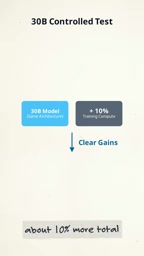
Z.ai describes only one controlled experiment, and it did not take place on the 750B flagship model but on a 30B model with the same architecture as the 750B base model. The 30B test model is said to have exactly the same parameter count as the original, with about 10% more total training compute, and to have achieved significant performance gains.
This experimental design has merit: parameter counts are aligned, architectures are aligned, and only the presence of recurrent layers is varied, which can cleanly isolate the gain from the recurrent structure. But its limitations are equally obvious—the validation scale is 30B, yet the conclusion is extrapolated to the 2T to 3T level. Whether the gains from recurrent layers hold linearly from 30B to 750B and then to trillion-parameter scale is a question the public materials do not answer.
Parameter efficiency usually refers to the performance level a model can achieve per unit of parameter count, often measured as "performance/parameter count" or "performance/compute." Traditionally, scaling parameter count has been the main path to improving model capability, but the parameter efficiency argument holds that architectural innovations (such as recurrent layers, sparse activation, and mixture-of-experts) can achieve equivalent performance without increasing—or even while reducing—parameters. However, evaluating parameter efficiency depends heavily on control conditions: whether training compute, inference compute, and data scale are controlled. If only parameter counts are compared while ignoring compute overhead, efficiency gains may be overestimated. Therefore, validating parameter efficiency claims requires rigorous controlled experiments and transparent benchmarking protocols.
Benchmark Performance and Changes in Output Length
On benchmarks such as GPQA Diamond and MMLU Pro, the 30B test model showed clear performance gains. At the same time, a notable phenomenon appeared: average output length dropped by 10-14%. Shorter outputs with higher scores usually mean the model has reduced redundant reasoning steps and answers more directly.
This detail is useful for practical use. Shorter output length can both lower inference costs and suggest that the model is more efficient in its reasoning path. However, this 30B result exists only in a chart image and does not appear in the body text of the post, which reduces verifiability.
Three Gaps in the Evidence Chain
Breaking down Z.ai's public statements, at least three areas lack support.
First, the 2T to 3T comparison does not name any specific benchmark. The post gives an order-of-magnitude comparison but does not state which evaluation set was used or what protocol produced the comparison result.
Second, there is no comparison with larger models under equal inference compute. Recurrent layer structures significantly increase inference compute, and without controlling for inference compute, directly comparing a recurrent model with a standard model is unfair. This is precisely the key to validating the "parameter efficiency" claim.
Third, the 30B controlled results are hidden in a chart rather than stated in the body text, making it difficult for readers to directly verify the experimental conditions from the text.

Accessibility of the Flagship Model Remains a Blank
A more practical issue is that the weights of the 750B flagship model have not been released, and the API status is marked "coming soon." In other words, the outside world currently can neither verify locally nor test through an interface this highly anticipated model. For a technical claim whose core selling point is efficiency, the lack of a reproducible access path raises the verification barrier to a level that only the official team itself can cross.

How to View This Claim
As a scaling idea, recurrent layers have research value in themselves, and the controlled experiment at 30B provides an initial positive signal. But between the controlled 30B results and the public conclusion of "reaching the 2T-3T level" lie three hurdles: scale extrapolation, benchmark transparency, and inference compute alignment. None of these has yet been filled in by public materials. With neither weights nor API available, this claim is better treated as a technical direction awaiting validation rather than an established conclusion.
Related articles

Xenon Flash Bug Returns: Radxa Dragon Q8B Affected
The Xenon flash bug resurfaces, this time on the Radxa Dragon Q8B board. This article reviews early Hacker News discussion and analyzes the potential impact and community concerns.

ChatGPT Plus Subscription Guide for Users in China: Official Top-Up Channel Walkthrough and Comparison
A complete guide to subscribing to ChatGPT Plus from China via official top-up platforms: plan selection, account login, copying account info, payment verification, plus a comparison of top-up, proxy, and self-supplied card channels.

The Complete Guide to Subscribing to ChatGPT Plus in China: Hands-On Walkthrough of Third-Party Top-Up Channels and Risk Analysis
How can users in China subscribe to ChatGPT Plus? This article breaks down the complete process of third-party top-up platforms, analyzes account security, renewal sustainability, and risk-control risks to help you decide which subscription option suits you better.