GLM-5.4 Flagship Model Released: Hands-On with Vision + Million-Token Context

Zhipu releases GLM-5.4: flagship gains image input and million-token context for the first time, but no benchmark scores.
Zhipu AI quietly launched its new flagship coding model GLM-5.4, whose biggest change is the flagship's first vision capability — it can read screenshots directly to locate front-end layout misalignment, error pop-ups, and other visual issues. Architecturally it uses a "loop transformer" that runs 28 layers of weights twice to deepen reasoning and self-correction, but this is only a company claim with no public paper to verify it. The model supports a million-token context, subscription weekly quota is 50% higher than the previous generation, and it integrates with over 20 agent tools through coding subscription plans at three tiers: Lite $18, Pro $80, and Max $168. The public API is still under security review, open-source weights have no timeline, and no official benchmark results have been released — the performance claims await third-party reproduction.
GLM-5.4 Flagship Model Released: Hands-On with Vision + Million-Token Context
Zhipu AI (ZAI) quietly launched its new flagship coding model, GLM-5.4. No teasers, no launch event — an official tweet posted on Monday afternoon Korea time was quickly retweeted and took over developers' timelines within hours, racking up hundreds of thousands of views.
The core of this upgrade can be summed up in one sentence: the flagship model can finally "see." The previous flagship could only read code, not view what that code actually produced when it ran; GLM-5.4 supports image input, so you can drop a screenshot straight into it — misaligned buttons, broken page layouts on mobile, error pop-ups — and the model can pinpoint the problem based on the actual visuals.
Vision Goes from "Small-Model Experiment" to "Flagship Standard"
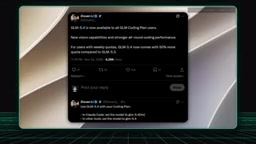
Vision capabilities had previously only been tested in Zhipu's smaller flash models. Putting them into the top-tier flagship this time is a different matter entirely — this is an official release, not an experiment. For front-end development, the significance of this change is underrated: a large share of front-end bugs are fundamentally visual problems. In the past you could only describe in words that "the button slid over to the left" and then pray the model guessed right. Now you can just hand it an image.
Behind this lies a clear product evolution path: coding tools have gone from autocomplete to agents that can execute commands and browse the web, and the next step is to "look at the screen" and inspect their own output the way a developer does. Putting vision into the flagship with GLM-5.4 is a step in exactly that direction.
Loop Transformer: Running the Same Weights Twice
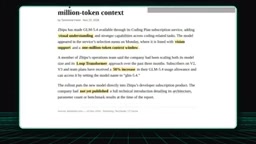
On architecture, Zhipu calls the design a "loop transformer." The idea isn't complicated: instead of adding more layers, let the 28-layer network run twice using the same set of weights — the equivalent of reading a difficult passage twice rather than buying a thicker book. The second pass can capture information the first one missed.
Zhipu claims looping makes reasoning deeper and self-correction stronger, which matters especially for long-running agent tasks. But to be clear: this is the company's own claim, not an independently verified conclusion. There is currently no public paper to compare against, and Zhipu also claims its performance is comparable to models with two to three times the parameter count — equally unverified.
How a Loop Transformer Differs from a Standard Transformer
A standard Transformer has a fixed depth: each layer has its own parameters, the input passes through all layers in sequence, and the computation graph is a one-way path. A loop transformer calls the same layer (or group of layers) repeatedly, and the second call reuses exactly the same weights. Computationally this is equivalent to a "deeper network," but the parameter count stays the same and memory usage doesn't grow linearly with the number of loops. The cost is increased inference latency and compute, since the forward pass is effectively performed more times.
This kind of design has appeared in recent research under names like "recurrent depth," "looped transformer," and "universal transformer," all with the same core motivation: letting the model trade more compute at test time for stronger reasoning. What distinguishes it from "chain of thought" is that the looping happens inside the hidden layers and doesn't require generating intermediate tokens. The article mentions that Zhipu runs the 28 layers twice, which is the most modest two-round loop configuration; whether the gains are significant still needs external evaluation to confirm.
Million-Token Context and a 50% Quota Boost
In Clawed Code, users can choose a version that supports a one-million-token context — roughly equivalent to loading an entire codebase at once. In other tools you can likewise select GLM-5.4 and enjoy this long-memory capability.
For heavy users, the more practical change is quota: the weekly limit is the real constraint on long tasks, and Zhipu has raised the allowance by 50% over the previous flagship, so the same subscription plan can run more tasks starting on launch day.
What a Million-Token Context Means
A token is the basic unit of text a model processes. In English, one token roughly corresponds to 0.75 words; in Chinese, one character is usually about 1 to 2 tokens. A million tokens is roughly equivalent to hundreds of thousands of lines of code, or a book of several hundred pages. For coding scenarios, this means you can put an entire medium-sized codebase — along with dependencies, configuration, and tests — into the context at once, and the model no longer has to piece together understanding from retrieved fragments.
But long context has two practical limitations: first, the "effective context" is often shorter than the nominal upper limit, and the model's utilization of information in the middle declines — an industry phenomenon often called "lost in the middle." Second, long context significantly increases the compute and latency of a single request. So a million-token context is better treated as a "use only when necessary" capability rather than something to fill up every time.
Subscription First: 20+ Tools Integrated, but No API Yet
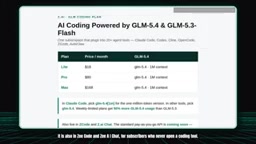
GLM-5.4 currently exists only in the GLM coding subscription plan, which gives access to more than 20 agent tools, including Clawed Code, Codex, Klein, OpenCode, Zcode, Autoclaw, and others. The subscription comes in three tiers: Lite at $18/month, Pro at $80, and Max at $168. Subscribers can also use it in Zcode and Zhipu Chat, even if they never open a coding tool.
It is not yet a public API model. The pay-as-you-go standard API is still "coming soon" and will only open after a security review. Open-source weights are also planned, but with no date and no license information.
Coding Subscription Plans vs. Pay-as-You-Go APIs
A pay-as-you-go API bills by actual token consumption and suits developers embedding the model into their own products and automated pipelines; costs scale linearly with usage but are controllable and transparent. A coding subscription plan, by contrast, charges a fixed monthly fee and issues quota per week or per time window — essentially packaging model capability into an end-user product.
The subscription model benefits vendors with predictable revenue and high user stickiness; for developers, the benefit is a lower unit cost under heavy use. The trade-off is a hard cap within the quota window, where long tasks can easily hit the ceiling, and the model can't be integrated into third-party applications. GLM-5.4 going subscription-first and API-later shows that Zhipu is prioritizing developers who use coding tools directly, rather than teams building downstream products.
Official Demos and the "Generalized Coding" Narrative
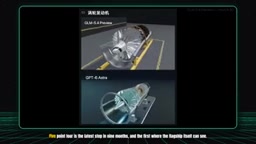
Zhipu is also promoting a bigger concept: generalized coding. Code no longer serves only software — the same model can write code to generate video, build games, and design parts in 3D. The official demos include a music video, a game, a 3D scene, and a robotic arm modeled in FreeCAD.
These demos cover a lot of ground, but they all come from the company itself, and no one outside has reproduced them. Treat them as a directional signal, not a test result.
The Most Honest Part: No Benchmark Scores
It must be said plainly: Zhipu has not published any official benchmark results for GLM-5.4 — no SWE-bench, no terminal-bench, no parameter count, no API pricing, no open-source weight date. At launch, the company's own developer documentation didn't even have an entry for GLM-5.4 yet. So we can't tell you whether it beats Claude, GPT, or any competitor, because no one has put up the numbers yet.
This leads to a second observation: flagship models are now released through subscriptions first, rather than with a one-shot blog post, benchmarks, and open-source weights. Fixed-rate subscriptions lock in developers, and long tasks burn through tokens quickly — subscriptions have become the main battleground for launches.
What to Watch Next
GLM-5.4 is live: it can see images, remember a million tokens, and comes with 50% more quota. Two things to watch going forward: first, benchmarks, and whether those tests hold up to third-party reproduction; second, the public API and open-source weights, and whether "subscription first" becomes the standard launch practice for all models.
The iteration speed of this series is worth noting: GLM5 landed in February, 5.1 in April, 5.2 in June, 5.3 in August. 5.4 is the latest step in nine months, and the first time the flagship itself has vision capabilities.
One-line Summary
Zhipu releases GLM-5.4 — the flagship gains image input and million-token context for the first time, but no benchmark scores.
Related articles

Xenon Flash Bug Returns: Radxa Dragon Q8B Affected
The Xenon flash bug resurfaces, this time on the Radxa Dragon Q8B board. This article reviews early Hacker News discussion and analyzes the potential impact and community concerns.

ChatGPT Plus Subscription Guide for Users in China: Official Top-Up Channel Walkthrough and Comparison
A complete guide to subscribing to ChatGPT Plus from China via official top-up platforms: plan selection, account login, copying account info, payment verification, plus a comparison of top-up, proxy, and self-supplied card channels.

The Complete Guide to Subscribing to ChatGPT Plus in China: Hands-On Walkthrough of Third-Party Top-Up Channels and Risk Analysis
How can users in China subscribe to ChatGPT Plus? This article breaks down the complete process of third-party top-up platforms, analyzes account security, renewal sustainability, and risk-control risks to help you decide which subscription option suits you better.