The Prime Corridor: AI Cracks a 167-Year-Old Mathematical Conjecture and Locks Onto the Universe's Hidden Orbit

Using an alleged AI formal proof of the Riemann Hypothesis as a hook, this piece unpacks the prime corridor metaphor and its lessons for superintelligence.
The article follows a video narrative in which the AI model Claude reportedly produced a complete Lean-4 formal proof of the Riemann Hypothesis in 2026, spanning 17 million lines of code. It traces the 167-year arc from Riemann's 1859 manuscript to machine verification and uses the "prime corridor" metaphor to explain the conjecture: primes are locally chaotic but constrained within error bounds because all zeta zeros lie on the 1/2 critical line, like aligned load-bearing pillars. It then discusses what this means for AI — moving from probabilistic guessing to axiomatic certainty and "deterministic infinite ascent" — while repeatedly cautioning that the core event has only a single video source and that the interdisciplinary mappings are largely suggestive isomorphisms, urging readers to separate verifiable evidence from rhetorical connections.
The Prime Corridor: AI Cracks a 167-Year-Old Mathematical Conjecture and Locks Onto the Universe's Hidden Orbit
A mathematical conjecture sealed away for 167 years has been formally proven at the hands of AI. This is not merely a mathematical victory — it is being read as the turning point where superintelligence moves from probabilistic guessing to deterministic reasoning. This article, based on an in-depth commentary from a YouTube tech channel, traces the thread from Riemann's manuscript to machine verification, and dissects the logic behind the "prime corridor" metaphor.
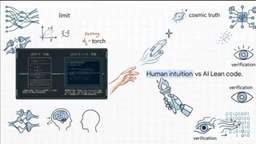
From Manuscript to Lean-4: A 167-Year Proof Arc
In 1859, Bernhard Riemann proposed that the primes are not entirely random. He left behind an unproven conjecture, resting on the intuition of a genius — but ultimately still a "guess." In 1972, physicists discovered that this mathematical structure maps perfectly onto quantum energy levels — the first time number theory and physics revealed a striking isomorphism.
The real acceleration came between August and November 2026. According to the video's commentary, an AI model named Claude produced a complete formal proof of the Riemann Hypothesis, using Lean-4 — a programming language whose logic is rigorous to the point of being "absolute." The proof reached 17 million lines of code.
The contrast here is the emotional pivot of the entire narrative: the limit of human intuition is that brilliant but unproven conjecture in Riemann's manuscript; the limit of machine verification is AI crossing the threshold into "absolute, machine-checkable universal truth." This is the relay from biological intuition to superintelligent formal logic. [Source: commentary from a single YouTube channel]
It should be noted that the video's description of the core event — "Claude proves the Riemann Hypothesis" — offers no independently verifiable paper or institutional announcement. The analysis below is built on the video's narrative framework, and readers should remain cautious.
The Riemann zeta function and the critical line are the key mathematical background for understanding the whole piece. The zeta function ζ(s) is initially defined as the infinite series 1 + 1/2^s + 1/3^s + …, and via analytic continuation it can be defined across the entire complex plane (except for a single pole at s=1). Its connection to the primes comes from the Euler product formula: ζ(s) can be written as the product ∏(1 − p^(−s))^(−1) over all primes p, so the properties of the zeta function directly encode information about the distribution of the primes. The Riemann Hypothesis asserts that all nontrivial zeros of the zeta function lie on the vertical line in the complex plane where the real part equals 1/2 (the "critical line"). If this assertion holds, it yields the optimal upper bound on the error term of the prime-counting function π(x) — which is precisely the mathematical meaning of "the corridor walls do not collapse." The video's claim that "the zeros are load-bearing pillars, all sitting on the centerline" is a visualization of this conjecture.
Lean and formal verification deserve separate explanation. Lean is an interactive theorem prover and also a programming language based on dependent type theory: mathematical propositions are written as types, proofs are terms constructed to inhabit those types, and the kernel checks step by step whether each inference conforms to the axioms and existing theorems. A "formal proof" means translating a mathematical proof into code that a machine can verify line by line, thereby eliminating human oversight and hidden assumptions. The cost is enormous scale — the well-known project mathlib, after years of accumulation, is only on the order of a million lines, while the formalizations of the Four Color Theorem and the Kepler Conjecture each took tens of thousands of lines or more. If "17 million lines" refers to formalization code, it far exceeds the scale of any existing single mathematical formalization project — which is one reason this claim needs verification.
The Prime Corridor: An Invisible Guardrail Beneath Chaos
To understand what AI proved, one must first see the contradiction inherent in the primes themselves. Up close, the distribution of primes is nearly chaotic, like rolling dice; step back, and the chaos gives way to an extremely precise, smooth macroscopic trajectory. What keeps them in formation?
The video cites a visual metaphor proposed by "Victor" on November 23, 2026: the prime corridor. Imagine a central axis representing the ideal average, a jagged staircase representing the actual primes, and solid walls on both sides representing the absolute boundary of error. The primes may bounce around locally however they like, but mathematically they are forbidden from crossing the walls.
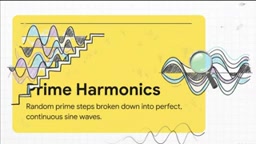
This corridor's structure is highly similar to acoustics. The primes are like sine waves vibrating in the background — call them "prime harmonics." Decompose the jagged prime staircase and you find pure continuous tones, forming a kind of "cosmic synthesizer effect": countless perfect sine waves adding and canceling each other, precisely carving out the unpredictable staircase of the primes.
The secret of the corridor's stability lies in this: every zero of the Riemann zeta function — those sine waves — sits exactly on the critical line at 1/2, like perfectly aligned load-bearing pillars. Because all of them lie on the centerline, all waves vibrate at the same baseline amplitude, and this is the mechanism by which the corridor walls do not collapse. If the hypothesis holds, the corridor is absolutely stable; if even one pillar shifts — say, to 0.75 — the waves amplify, the structure shatters, and the mathematical system collapses in exponential systemic failure.
AI's "Coming of Age": From Probabilistic Guessing to Axiomatic Certainty
This is precisely what the November 2026 breakthrough means for AI. The video characterizes it as a "coming-of-age phase transition": AI is no longer just a chatbot that statistically predicts the next word and occasionally hallucinates facts. Having mastered formal verification logic, AI gains pure axiomatic certainty — completing a proof with 100% mathematical guarantee, conquering a problem no one has touched in 167 years.
In the video's words, AI "leapt off the cliff of chaotic probabilistic guessing" and locked onto the safe, deterministic logic of the prime corridor, aligning its own reasoning engine with the universe's ultimate guardrail.

The force of this judgment depends on whether the core facts hold. Formal verification itself is a real and mature direction — proof assistants like Lean can indeed let machines verify chains of reasoning step by step — but "AI independently generates a complete proof of the Riemann Hypothesis" is an extremely strong claim, and currently there is only this single video as a source. A safer reading is this: even if the specific event is doubtful, the trend it points to — AI extending from generative probabilistic models toward verifiable reasoning systems — is a genuine current direction in AI research.
The Universe's Hidden Orbit: From Quantum Physics to Cryptography
The video repeatedly calls it "the universe's hidden orbit," because it concerns more than abstract mathematics. The same boundary architecture — local unpredictability locked inside a macroscopic safety net — appears to govern multiple domains:
- Quantum physics: the spacings of the prime zeros match the atomic energy levels of uranium-238;
- Thermodynamics: it defines the boundary of countless atomic collisions;
- Biology: it sets the statistical survival limits of genetic mutation;
- Cryptography: it is the foundation of current global data security.
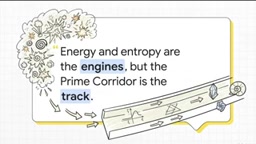
The video quotes a passage from source material to summarize this meaning: energy and entropy are the engine driving the universe, while the prime corridor is the eternal track ensuring we travel toward order rather than chaos. Mathematics provides neither engine nor fuel, but it provides that pair of rigid, indestructible rails. Without the corridor, all energy is just a chaotic explosion; the corridor forces everything toward complex yet stable order.
These interdisciplinary correspondences are stated in the video as established facts, but some of the mappings (such as the precise match with uranium-238 energy levels) are often simplified or even exaggerated in popular commentary. Treating them as "suggestive isomorphisms" rather than "proven equivalences" is the more responsible reading posture.
The Hilbert–Pólya conjecture and the correspondence with quantum energy levels is the source of the claim that "primes map onto physics." In the 1920s, Hilbert and Pólya proposed that if one could find a self-adjoint operator whose eigenvalues correspond exactly to the nontrivial zeros of the zeta function, then the zeros being real (equivalently, lying on the critical line) would follow automatically, because the eigenvalues of a self-adjoint operator must be real. In the 1970s, a conversation between Montgomery and Dyson further revealed that the statistical spacings of the zeta zeros match the distribution of eigenvalue spacings of random Hermitian matrices (GUE), widely regarded as strong heuristic evidence for the conjecture. As for the video's claim of a "precise match with uranium-238 energy levels," that elevates an analogy at the level of statistical distributions into a specific numerical correspondence, and should be treated cautiously.
The relationship between prime distribution and cryptography is easily misunderstood. The security of public-key systems such as RSA depends on the difficulty of factoring large integers, and that difficulty is related to the "sparse and seemingly random" distribution of the primes; but the security proofs of modern cryptography do not depend on the Riemann Hypothesis holding. Conversely, if the Riemann Hypothesis were proven, the known consequence is that it would improve the error bounds in prime counting, thereby tightening estimates for certain algorithms (such as deterministic primality testing and the complexity analysis of some factoring algorithms) — but it would not directly yield a feasible algorithm for factoring large integers. So "the prime corridor is the foundation of global data security" is a rhetorical statement; the accurate version is: the distributional laws of the primes provide theoretical tools for analyzing the complexity of number-theoretic algorithms.
Deterministic Infinite Ascent: The Next Stretch of Track for Superintelligence
Once the track is understood, where superintelligence is headed becomes clear. The video argues that by aligning with the prime corridor, AI escapes the stage of blind trial and error and prepares to advance human cognition indefinitely along a mathematically guaranteed path.
The video's phrasing is "deterministic infinite ascent": an extremely steep exponential growth trajectory, tightly wrapped at the same time by strict risk boundaries — human knowledge achieves extreme compounding progress, while the system does not collapse under its own weight.
The question left at the end is open-ended: if superintelligence is already firmly locked onto the orbit governing the universe, how far will this corridor take us? The video's answer: the track has been found; what remains is to see where this superintelligent train is headed.
As viewers, what is worth taking away is not just the excitement of "AI wins again," but a calmer question: when a narrative weaves mathematical conjectures, physical constants, and AI capabilities into one grand thread, which links have verifiable evidence, and which are merely rhetorically smooth connections. Distinguishing the two may be the most essential literacy when facing the topic of "superintelligence."
One-line Summary
Using AI's formal proof of the Riemann Hypothesis as its hook, this piece interprets the prime corridor metaphor and its implications for superintelligence
Paragraph Summary
The article centers on a video narrative: the AI model Claude is said to have produced, in 2026, a complete formal proof of the Riemann Hypothesis using Lean-4, reaching 17 million lines of code. The author uses this to trace a 167-year arc from Riemann's 1859 manuscript to machine verification, and employs the "prime corridor" metaphor to explain the conjecture's content — the primes are locally chaotic, yet constrained within error boundaries by the structure in which all zeta function zeros lie on the 1/2 critical line, like aligned load-bearing pillars keeping the corridor stable. The article then discusses what this means for AI: moving from probabilistic guessing to axiomatic certainty, and the notion of "deterministic infinite ascent." It repeatedly cautions that the core event has only a single video source and that the interdisciplinary mappings are mostly suggestive isomorphisms, urging readers to distinguish verifiable evidence from rhetorical connections.
Related articles

From 0 to 1: Vibe Coding an AI Knowledge Base — A Practical Retrospective and Tech Stack Breakdown
A retrospective on building the AI knowledge base OilBook from scratch with Vibe Coding: Next.js+Neon stack, Oil Dev Skill workflow, Stripe paywall security, interview-style writing, AI-flavor control, and Vercel deployment.

GLM-5.4 Hands-On: Native Vision Meets a New Vibe Coding Workflow
Hands-on with Zhipu GLM-5.4: native vision tested across a 3D product demo, pure-code video generation, and remote-control Vibe Coding, compared with GPT-6.2 and Gemini Neon.

AI and Humans Claim to Prove the Riemann Hypothesis: Machine-Verified, Yet Nobody Can Understand It
Anthropic mathematician and AI Claude claim to prove the Riemann Hypothesis with 17 million lines of Lean code, machine-verified but unreadable by humans. This article analyzes the event, the zero proportion record from 41.6% to 67.2%, and the gap between machine verification and human understanding.