GLM-5.4 vs. Opus and Neon: How Far From the Top?
GLM-5.4's architecture upgrade improves quality, but a clear gap with frontier US models remains
With almost unchanged parameter count, GLM-5.4 gains quality by executing some network layers twice, improving markedly over its predecessor but at much longer processing time. Developer tests show it beats domestic models like DeepSeek on floating-island tasks, yet in Z.ai's own 200-task coding comparison it nearly ties DeepSeek, giving it limited advantage over domestic peers. It trails Claude Opus 5.5 and Gemini 4 Neon while costing one-sixth to one-quarter as much. The speed bottleneck is not per-step speed but a step count about 5 times competitors', with long coding tasks taking over 7 hours. With no API and closed weights, it is available only via a subscription starting at $18 per month—suitable as a cheap code review tool, while enterprise agent scenarios should wait for the API and independent evaluations.
Zhipu AI quietly released GLM-5.4 without publishing any benchmark scores, relying solely on first-day comparison videos from the developer community to prove its strength. However, an in-depth analysis by a YouTube tech channel points out that while this new model shows clear improvement over its predecessor, it still lags significantly behind frontier US models. This article reconstructs GLM-5.4's true level based on that video and multiple developer tests.
Design Philosophy: Making the Model "Think Before It Acts"
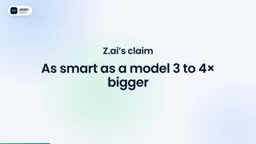
GLM-5.4's parameter count has barely changed; what changed is the architecture: some network layers execute twice. To use the video's analogy, it's like a person writing an answer and then reading it over before sending—same mind, no new knowledge, but the second pass can fix mistakes. Z.ai claims this design makes the model "as smart as models 3 to 4 times its size," but the company has not released any benchmark data for GLM-5.4 itself.
Compared with its own previous generation, the progress is visible: the same dancer, the same prompt, and the new version is far richer in detail. But the cost is also obvious—a task the old version finished in 13 minutes took the new version 37 minutes. Although the test environments differ (higher load on release day, different tool versions), the directional signal is clear enough: GLM-5.4 trades more compute time for quality gains.
The "some network layers execute twice" mentioned in the article corresponds to the recurrent depth and adaptive computation ideas that have appeared in recent large-model architectures. Each layer of a traditional Transformer performs forward computation only once, whereas this kind of design has specific layers (often middle layers) called repeatedly during inference, effectively lengthening the computation path without increasing parameter count. The intuition comes from "latent-space reasoning": one more forward pass gives the model one more round of opportunity to refine its representation in hidden states, similar to a human reviewing a draft. The cost is that each additional execution adds latency and compute overhead, so it is usually paired with routing or gating mechanisms that trigger repeated computation only for complex inputs. This also explains why the parameter count barely changes while quality improves, and why total time increases significantly.
Comparison with Domestic Models: Some Highlights, but Limited Advantage
In multiple tests in the developer community, GLM-5.4 performed well against domestic models such as DeepSeekAd. One developer asked several models to build a "floating island"; GLM's island included waterfalls and grassland with a complete structure, while DeepSeek's version was judged to have "too sparse grass and insufficiently realistic water," and GLM consumed fewer tokens. Two other developers' comparisons reached the same conclusion.
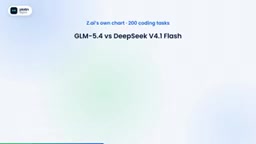
But the key detail is hidden in Z.ai's own Chinese release post: in a comparison of 200 coding tasks, GLM-5.4 was almost tied with the same DeepSeek model. When a company hand-picks its opponent and can only manage a tie, that clearly does not amount to a claimed lead.
How Big Is the Gap With Frontier US Models?
The video's author provides an estimation anchor: on the independent Artificial Analysis index, DeepSeek scores 33, top US models are around 60, and even US models from two generations ago score 44. On that basis, GLM-5.4 is "at best around that level."
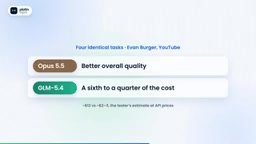
Actual tests support this judgment. One developer used Claude Opus 5.5 and GLM-5.4 to generate a "peacock riding a bicycle"; the styles were similar, but by his account GLM was "a notch below." Another YouTuber gave both four tasks (from a cinematic intro to a browser-based image editor), and Opus won all of them; however, he also estimated that GLM's cost was only one-sixth to one-quarter of Opus's.
A comparison circulating online reaches the opposite conclusion, claiming that GLM-5.4 beat Opus. But look carefully at the conditions: the four models used the same scene, and the video's author believed GLM actually performed weakest here—the image starts with flat octagonal floor tiles, and although the nearby rocks have some sense of volume, the overall picture lacks depth. Moreover, the test conditions were not equivalent: reasoning settings were not standardized, and GLM ran at its highest setting; the person who posted the comparison was also handing out Z.ai trial cards that day.
Against Google's Gemini 4 Neon, both testers preferred Neon. One asked for a seaplane and rated GLM as "not bad, but I expected much more"; the other compared a pelican riding a bicycle and said flatly that GLM "can't catch up with the flagship models."
Artificial Analysis Intelligence Index is an independent third-party composite benchmark index for large models. It normalizes results from multiple public benchmarks (reasoning, knowledge, coding, instruction following, etc.) and weights them into a single score for easy horizontal comparison across vendors' models. Its value lies in not relying on vendor-reported data, but its limitations are also obvious: the question sets are fixed, updates lag, and when score gaps are in the single digits they often fall within evaluation noise. Therefore, using "DeepSeek 33, top US models about 60, US models from two generations ago 44" as an anchor in this article can only indicate the rough tier position, not an exact ranking; it is safer to treat it as an order-of-magnitude reference than as a ranking.
Speed Bottleneck: Not Slower per Step, but More Steps
The 37-minute puzzle now has an answer. In a series of long coding tasks, GLM-5.4 worked for more than 7 hours, while Neon completed the same work in under 2 hours. The reason is not that each step is slower, but that GLM used almost 5 times as many steps—repeatedly checking, hesitating, and looping back. Z.ai itself calls this "marathon-style thinking."

Current availability is also a major drawback: there is no API for real business use, it can only be used through a coding tool subscription starting at $18 per month, and the model weights cannot be downloaded. Z.ai says it will open the weights after security hardening, but has not given a timetable.
Reasoning effort / thinking budget is an adjustable parameter commonly offered by current reasoning models to control how many internal thinking steps the model may take before giving a final answer, typically tiered as low / medium / high / max. The higher the tier, the more the model tends to repeatedly verify, self-correct, and backtrack; quality usually rises, but token consumption and latency grow multiplicatively. This maps exactly onto the phenomenon in the article: GLM-5.4's per-step speed is not necessarily behind, but at high tiers its step count balloons to several times that of competitors, so end-to-end time diverges. For practical deployment, dynamically adjusting the tier according to task complexity (for example, high for code review and low for simple Q&A) is often more cost-effective than fixing it at the highest tier.
Business Scenarios: Should You Use It Now?
Imagine a customer sending a message to an agent you have deployed and waiting for a reply—a model that needs half an hour of thinking to draw an image clearly cannot respond on time. For developers, it may be suitable as an extra low-cost code reviewer: one tester said GLM-5.4 found bugs and security vulnerabilities that other models missed, and recommended lowering the reasoning tier from max to high to avoid excessive detours.
The author's conclusion is worth considering: GLM-5.4 is a huge improvement over its predecessor and roughly on par with domestic peers, but far from touching the US frontier. For enterprise agent scenarios, it is advisable to wait for the API and independent evaluation data before making a decision.
Open weights and open API are two different forms of availability, and they matter a great deal for enterprise model selection. Open weights mean the model files can be downloaded and privately deployed, data does not leave the internal network, and fine-tuning and quantization compression are easier; an open API lets developers pay by call volume without building their own compute, but it is constrained by the provider's rate limits, pricing, and compliance policies. In the article, GLM-5.4 has neither and can only be used through a subscription-based coding tool, which effectively binds model capability to a specific product form: it cannot be embedded into one's own agent pipeline, and it is difficult to optimize engineering-wise for cost and latency. This is also one reason the author advises enterprises to wait for the API and independent evaluations.
One-line Summary
GLM-5.4's architectural upgrade brings quality gains, but there is still a clear gap with frontier US models
Paragraph Summary
With almost unchanged parameter count, GLM-5.4 trades an architecture in which some network layers execute twice for quality gains. It improves markedly over its own predecessor, but at the cost of much longer processing time. Developer tests show that it beats domestic models such as DeepSeek on tasks like floating islands, yet in Z.ai's own published 200-task coding comparison it is almost tied with DeepSeek, giving it only a limited advantage over domestic peers. In comparisons with Claude Opus 5.5 and Gemini 4 Neon it comes out behind, though at one-sixth to one-quarter of the cost. The speed bottleneck lies not in per-step speed but in a step count about 5 times that of competitors, with long coding tasks taking more than 7 hours. Currently there is no API and the weights are not open; it is available only through a subscription starting at $18 per month. It is suitable as a low-cost code review tool, and for enterprise agent scenarios it is advisable to wait for the API and independent evaluations.
Related articles

Netflix's Most Comforting Show Returns Quietly: A Hidden Gem Amid Streaming Content Overload
Netflix's library keeps expanding, and a show hailed as the most comforting has quietly returned with little fanfare. This article analyzes content overload in the streaming era, the limits of algorithmic recommendations, and how viewers can discover hidden gems.
Uncertainty in Machine Learning: Concepts, Sources, and Mitigation
Machine learning models are not always deterministic. This article introduces the two major types of uncertainty in ML—aleatoric and epistemic—and discusses their sources, quantification methods, and practical significance in reliable AI systems.

Banks Seek to Dump AI Debt: A Risk Signal Behind the AI Investment Boom
Banks are seeking to sell AI-related debt assets, a move that reveals financial risk reassessment behind the AI investment boom. This article analyzes possible reasons for banks reducing AI debt and the impact on AI industry financing.