GLM-5.5 Training Pipeline Revealed: 32B to 256B, Why the Community Went from Elation to Disappointment

Zhipu reveals GLM-5.5 three-tier training pipeline; local community disappointed by lack of small-to-medium models.
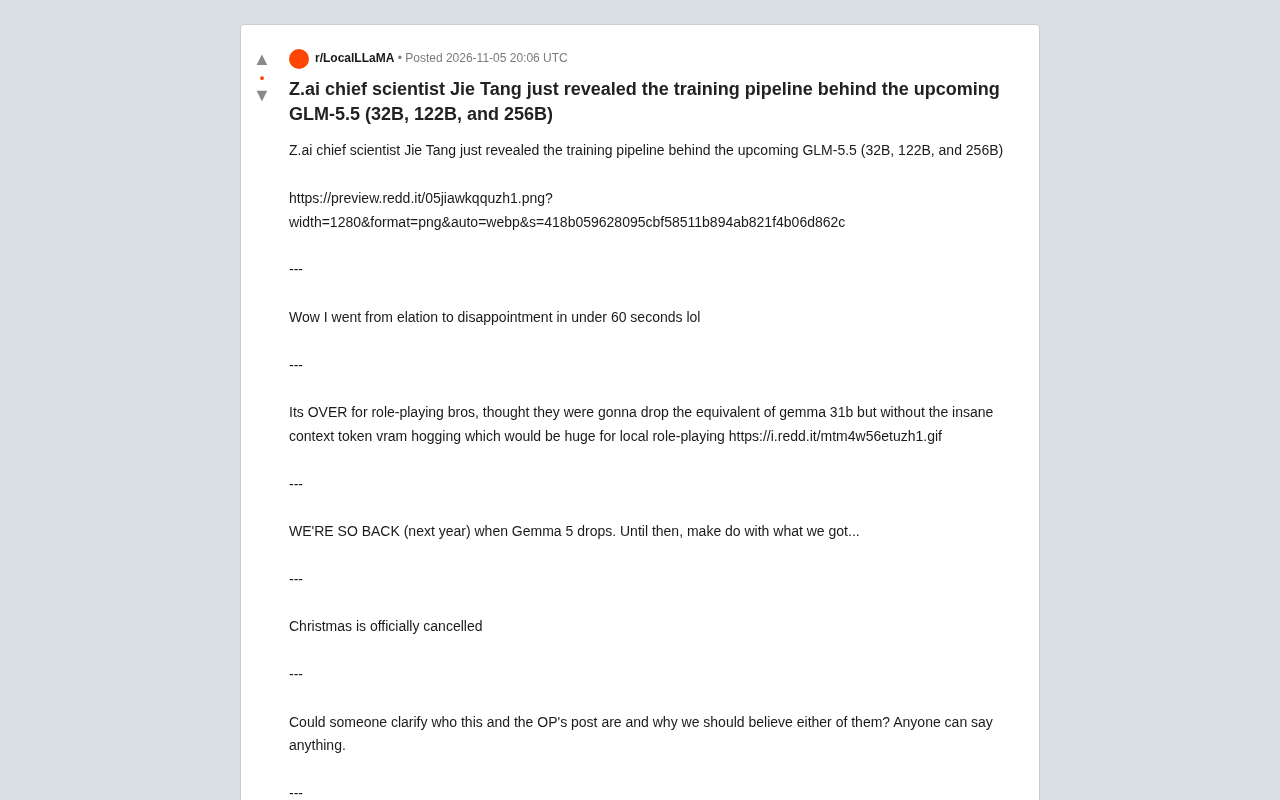
Z.ai Chief Scientist Tang Jie disclosed the training pipeline for the GLM-5.5 series on social media, covering three parameter scales — 32B, 122B, and 256B — but without revealing architecture, training data, or benchmark results. The news sparked discussion in Reddit's LocalLLaMA community, where sentiment quickly shifted from excitement to disappointment. The core reason: the community wanted small-to-medium models with high VRAM efficiency, controllable context overhead, and the ability to run on consumer hardware, but the disclosed scales skew large. Some users questioned the credibility of a single-source claim, while others wondered why the vendor isn't releasing models at these sizes. The article notes that 32B sits in a delicate range for local deployment, and the controversy is essentially about expectation management between roadmap disclosure and community expectations.
Z.ai (Zhipu) Chief Scientist Tang Jie revealed the training pipeline for the upcoming GLM-5.5 series on social media, covering three parameter scales: 32B, 122B, and 256B. The news quickly spread through Reddit's LocalLLaMA community, but the sentiment in the comments shifted from excitement to disappointment in under a minute — and the reason isn't complicated: the parameter sizes speak for themselves, and what the community wants most is a small-to-medium model that can actually run locally.
What Tang Jie Disclosed
Based on the original post, Tang Jie made public the GLM-5.5 training pipeline, not the model weights or a complete technical report. Three scales were mentioned: 32B, 122B, and 256B. This means GLM-5.5 is not a single model but a series tiered by parameter scale, ranging from the relatively locally-deployable 32B to large-scale versions aimed at the cloud.
It should be noted that the source material only provides information at the level of parameter scale and "training pipeline" — it does not disclose specific architectural changes, training data composition, context length, or benchmark results. For readers interested in technical details, these gaps are precisely what's most worth waiting for the official technical report to fill in.
Parameter scale (B = Billion) refers to the total number of trainable parameters in a model, typically counted in billions. Parameter count is roughly positively correlated with model capability and VRAM usage: a 32B model at FP16 precision requires about 64GB of VRAM for weights alone; even with 4-bit quantization it needs about 16GB, far exceeding most consumer-grade GPUs. Meanwhile, 122B and 256B can basically only be deployed on multiple GPUs or in the cloud. This is why the community is fixated on the 32B tier — it's the only scale in the series that has a chance of falling within range of high-end consumer hardware (such as 24GB VRAM GPUs).
Training pipeline refers to the complete sequence of steps from data preparation, pre-training, mid-training, to post-training (such as supervised fine-tuning, preference alignment, and reinforcement learning). Disclosing a training pipeline typically only indicates what the vendor "plans to do" — it does not mean the model has finished training or that weights will be released. This is a different tier of information from releasing weights or a technical report.
Why Community Sentiment Took a Sharp Turn
The most typical comment in the Reddit thread was: "Wow I went from elation to disappointment in under 60 seconds lol." This letdown isn't about GLM-5.5's capabilities per se, but about the mismatch between release strategy and local deployment expectations.
One user stated outright that what they had hoped for was "something like a Gemma 31B equivalent, but without the crazy context token VRAM usage" — which would be a huge boon for local role-playing scenarios. The implication is that while 32B is close in size, the community still has concerns about VRAM efficiency and context overhead. Another user joked that "Christmas is officially cancelled," using dark humor to express frustration at not getting an ideal local model in the near term.
Other comments pinned their hopes on a future Gemma 5 — "WE'RE SO BACK (next year) when Gemma 5 drops." This "wait for the next vendor" mentality reflects the open-source community's persistent hunger for small-to-medium models with high VRAM efficiency.
Context token VRAM usage refers to the VRAM consumed by the key-value cache (KV Cache), which grows linearly with sequence length when a model processes long contexts. Taking a 32B model as an example, at longer contexts the KV Cache can reach several GB or even a dozen-plus GB; combined with weight usage, this can significantly compress the available VRAM headroom locally. The "crazy context token VRAM usage" mentioned by the community refers precisely to some models sacrificing local deployment feasibility in pursuit of ultra-long contexts. Quantization (such as 4-bit, 8-bit) compresses model size by reducing the numerical precision of weights and is a key technique for local deployment, but it introduces some quality loss — which is why the community is particularly concerned about the post-quantization performance of the 32B version.
Doubts and Disagreements: The Credibility Debate
The community wasn't unanimously convinced. One user asked directly: "Could someone clarify who this and the OP's post are and why we should believe either of them? Anyone can say anything."
This is a legitimate methodological challenge: disclosure of a training pipeline is roadmap-level information, and without verifiable weights or evaluation data, the community can only choose to trust the discloser's credentials. Tang Jie's position as Z.ai Chief Scientist is the main source of credibility for this information, but it remains a single source — the Reddit discussion itself provided no independent cross-verification.
Another highly upvoted question pointed at the release strategy itself: "I don't understand why are they not releasing models at those sizes?" The asker believes demand clearly exists and the community response has been enthusiastic, making non-release hard to understand. This may reflect a commercial-versus-open-source tradeoff, but the source material provides no explanation from Z.ai, so it would be inappropriate to speculate further here.
In the open-source model community, there is a clear credibility hierarchy between roadmap information and reproducible artifacts: the former is a vendor's statement of future plans, while the latter includes model weights, technical reports, and independently runnable evaluation results. The former can only rely on the discloser's identity and track record as backing, while the latter can be downloaded and verified by anyone. This is the methodological root of the skepticism in that thread — in the absence of weights and evaluations, the community cannot distinguish between "definitely going to be released" and "still being explored."
What This Means for the Local Model Ecosystem
Looking at several comments together, the community's demands are actually highly consistent: not the biggest model, but a small-to-medium model that can run on consumer-grade hardware with controllable context overhead. 32B sits in a delicate range — much larger than mainstream 7B/8B models, with more demanding VRAM requirements, but if paired with efficient context management, it still has a chance to become the sweet spot for local deployment.
The core of the controversy is expectation management. When "training pipeline revealed" is automatically interpreted by the community as "usable weights coming soon," any detail that doesn't match local deployment expectations gets magnified into disappointment. For model vendors, the cadence of roadmap disclosure and the way they communicate with the community have themselves become part of the product experience.
Open Questions
Around GLM-5.5, a series of key questions remain unanswered: whether all three scales will be open-sourced, how the 32B version performs in terms of quantization and VRAM, whether the context length strategy is optimized for local scenarios, and whether the training pipeline includes the efficiency improvements the community hopes for. The answers to these questions will determine whether this wave of "disappointment" on Reddit is a temporary mood swing or a long-term judgment on the release strategy.
Until official technical details are published, there are probably only two things the community can do: keep joking with each other in the comments, and wait for the next "we're so back" moment.
Related articles
 Tech Frontiers
MuJoCo: An Analysis of DeepMind's Open-Source General-Purpose Physics Simulator
An in-depth analysis of Google DeepMind's open-source physics simulator MuJoCo: high-performance C++ kernel, MJCF modeling format, contact solving principles, MJX GPU acceleration, and robot reinforcement learning use cases.
 Tech Frontiers
Claude API Quick Start: The Official Quickstarts Project Collection
Anthropic's official claude-quickstarts project collection helps developers quickly build deployable apps with the Claude API. Nearly 20k stars, Python-based, great for beginners and prototyping.
 Tech Frontiers
AI Agents Connecting Directly to APIs: Which Calls Can Be Safely Allowed?
AI agents can call any API, but the real challenge is deciding which calls can be safely allowed. This article analyzes allowance decisions from three dimensions—intent matching, least privilege, and controllable impact—and argues that the control layer should sit outside the agent, combined with audit traceability to build a trustworthy API call governance mechanism.