GLM5.1 Coding Capabilities Put to the Test: Building a Full-Stack AI Canvas App from Scratch

GLM5.1 shows notable gains in problem understanding and debugging in real full-stack development.
This article analyzes GLM5.1's coding improvements through a developer's hands-on experience building a full-stack AI canvas app from scratch. The project used Agent Teams multi-agent parallel collaboration, covering a complete architecture with frontend canvas interaction, AI image generation, and a PostgreSQL database. GLM5.1's key gains are more accurate problem understanding and fewer interaction rounds needed — though the article emphasizes that iterative refinement remains essential in AI-assisted programming.
GLM5.1's Rapid Iteration: How Much Has Its Coding Ability Actually Improved?
Shortly after GLM5 launched, GLM5.1 followed with a quick release and open-source availability. Zhipu AI's GLM (General Language Model) series is a large language model incubated from Tsinghua University technology, using an autoregressive blank-filling pretraining approach with unique strengths in both Chinese and English bilingual capabilities. According to Coding Evaluation benchmarks, GLM5.1 shows significant improvements in programming ability over its predecessor. Coding Evaluation refers to the standardized benchmarking system used by the industry to measure code generation capabilities — common benchmarks include HumanEval, MBPP, and LiveCodeBench, which assess models across dimensions like function-level code generation, programming problem solving, and real-time competitive coding.
However, there's often an "evaluation-to-practice gap" between benchmark scores and real-world development experience. Benchmark problems are typically isolated algorithmic challenges, while real development involves multi-file collaboration, framework comprehension, error debugging, and other complex scenarios. So how noticeable is this improvement in actual full-stack development?
This article is based on a developer's complete hands-on experience building a full-stack AI canvas application from scratch using GLM5.1, offering an in-depth look at the model's real-world programming performance.
Project Overview: Dissecting the Full-Stack AI Canvas Tool Architecture
The project built here is a complete AI Canvas web application, with the core goal of integrating all AI image operations within a single canvas interface. The AI canvas has become an important paradigm in image creation tools in recent years — notable examples include Adobe Firefly's Generative Fill and Stable Diffusion WebUI's inpainting. The core tech stack typically includes: a frontend built on the HTML5 Canvas API or wrapper libraries like Fabric.js and Konva.js for interactive drawing; a backend responsible for calling image generation model APIs and handling image data streams; and a database for storing user projects, history, and generated results.
The challenge of implementing this type of application full-stack lies in aligning data formats between frontend and backend (e.g., Base64 image encoding for transmission), managing canvas state (coordinate transformation matrices for zoom and pan), and polling for async AI generation task status — all of which are exactly the kinds of scenarios that test an AI coding assistant's comprehensive capabilities.
The project integrates the Nano Banana 2 API internally, supporting AI image generation and editing operations.
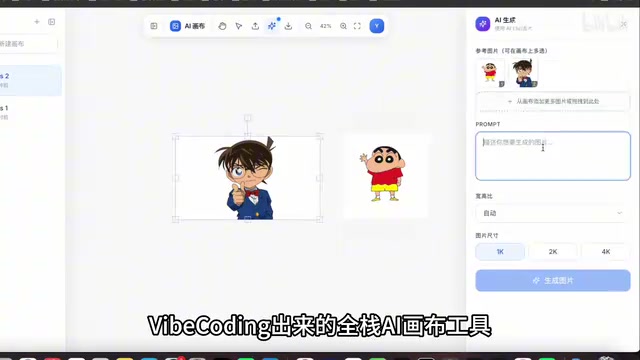
Specifically, the project includes the following core capabilities:
- Canvas Interaction: Supports image upload, mouse click, canvas drag, zoom, and other basic operations
- AI Image Generation: Generates new images based on uploaded reference images and prompts
- Full-Stack Architecture: Frontend canvas interface + backend service + PostgreSQL database — a complete production-grade architecture
The entire project was completed entirely through Web Coding, using Cloud Code as the development tool, with the model swapped directly from GLM5 to GLM5.1.
Development Workflow: Agent Teams Multi-Agent Parallel Collaboration
Intelligent Task Decomposition and Parallel Development
The development process made use of Cloud Code's Agent Teams feature. Multi-agent parallel development is a cutting-edge direction in AI programming tools, grounded theoretically in the software engineering principle of "separation of concerns." At the implementation level, Agent Teams typically employ a Task Decomposition strategy, where a coordinating Orchestrator Agent breaks down complex requirements into independent subtasks and assigns them to specialized agents for parallel execution. Each agent maintains its own context window and tool-calling permissions, and integrates results through interface contracts (such as API schemas and database schemas) upon completion. The advantage of this model is that it overcomes the length limitations of a single context window while reducing overall development time through parallelization.
The developer first described the desired frontend and backend behaviors, after which GLM5.1 intelligently decomposed the tasks.
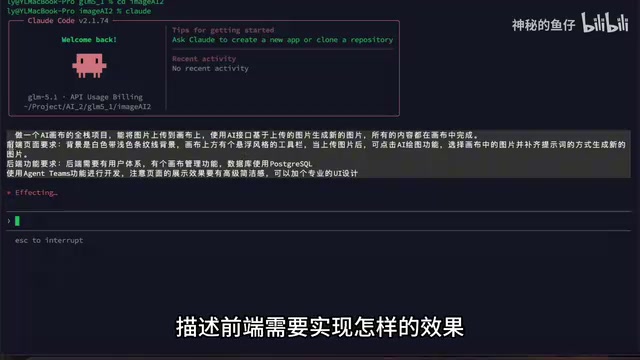
Agent Teams simultaneously spun up three separate agents to work on the project, with each agent responsible for its own module. This parallel development model is particularly well-suited to GLM5.1 — it performs especially well when handling complex or multi-task coding requirements.
Worth noting is that each agent works in a way that closely mirrors a real developer: they perform integration testing, and any errors encountered during execution are automatically located and resolved without manual intervention.
Iterative Optimization: The Right Way to Use Web Coding
One important takeaway to share: don't expect to generate a complete project in one shot — continuous iterative refinement is the core of Web Coding.
Iterative development carries a special meaning in the context of AI programming. Research suggests that feeding complex requirements to an AI all at once often leads to "hallucination stacking" — the model tends to generate code that looks plausible but contains flaws in areas of uncertainty. A more effective strategy is "scaffolded prompting": first have the AI generate the core skeleton, verify it runs, then incrementally add functional modules. This shares common ground with Test-Driven Development (TDD) — each iteration has a clear acceptance criterion, ensuring that every incremental step is verifiable.
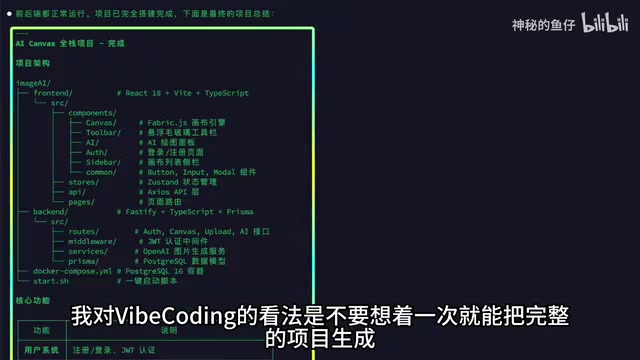
Taking this AI canvas project as an example, the first generated version had quite a few gaps:
- No mouse click or canvas drag buttons on the page
- Canvas zoom functionality not implemented
- The AI panel could only select one image at a time, limiting functionality
All of these details required multiple rounds of iterative refinement to polish. This reflects the true state of AI-assisted programming today — AI handles rapid scaffolding and core feature implementation, while the developer steers the direction and refines the details.
GLM5.1's Core Improvements: Problem Understanding and Debug Localization
More Accurate Problem Understanding
The most noticeable improvement when debugging with GLM5.1 is its ability to more accurately understand how a developer describes a problem. A model's ability to "understand a problem" corresponds technically to Intent Recognition and Contextual Reasoning capabilities. GLM5.1's improvements likely stem from multiple dimensions: higher-scale or higher-quality code corpus pretraining for deeper semantic understanding of the programming domain; targeted optimization during the reinforcement learning (RLHF/RLAIF) phase for programming dialogue scenarios, enabling more accurate inference of user intent from vague descriptions; and more effective utilization of longer context windows, allowing the model to extract key clues from project file structures and existing code style. This is critically important in real development — developers often describe problems in vague or incomplete terms, and the model needs to infer the true intent from context.
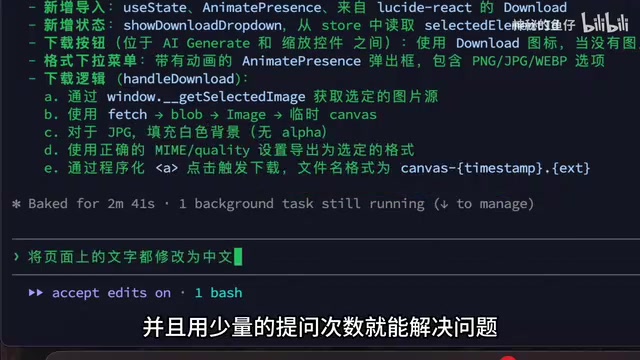
GLM5.1's progress in this area is quite notable — it can extract key information from imprecise descriptions and quickly zero in on the root cause of a problem.
Fewer Interaction Rounds to Resolve Issues
Compared to GLM5, GLM5.1 requires noticeably fewer prompting rounds to solve problems. The metric of "fewer interaction rounds" is engineering-equivalent to an improvement in "First-Contact Resolution Rate" — one of the core metrics for measuring the practical utility of an AI assistant. Developers report that previously a single problem might require several rounds of back-and-forth before the AI could truly pinpoint the issue, whereas GLM5.1 can accurately locate and resolve problems in fewer exchanges.
The practical value of this improvement is immediately tangible:
- Higher development efficiency: Reduces the time cost of repeatedly re-describing the same problem
- Better context utilization: Fewer rounds means less context consumption, allowing the model to maintain a clearer understanding state
- Smoother development experience: Significantly reduces the frustration of "the AI just doesn't understand what I'm saying"
Related articles
 Product Reviews
The Programmer's Desk Setup Guide: Building a Workspace That Feels Like Home
Discover how programmers build productive, comfortable workspaces. From multi-monitor setups to ergonomic design, explore the desk philosophy that drives focus and flow.
 Product Reviews
Qoder vs Cursor Real-World Comparison: Which $20/Month AI IDE Is Better?
Hands-on comparison of Qoder vs Cursor AI IDEs: Agent autonomy, human interaction count, and architecture decisions. Qoder needed only 2 interactions vs Cursor's 8.
 Product Reviews
Cursor Cloud Agent Demo: Eliminating Bottlenecks Across the Entire Software Development Lifecycle
Deep analysis of Cursor's Cloud Agent demo showing how cloud VMs, automated test artifacts, and a full-chain control plane systematically eliminate human bottlenecks across the software development lifecycle.