GLM5.1 Coding Test: An In-Depth Review of Real Code Capabilities and Cost-Effectiveness

GLM5.1 is a cost-effective AI coding assistant — great for small tasks but struggles with complex projects
GLM5.1, Zhipu AI's developer-focused large language model, delivers "deliverable" quality for small-to-medium programming tasks with directly runnable code. However, it has two notable weaknesses: poor long-context stability (multi-turn conversations easily lead to logical confusion) and fast Token consumption. Price is its biggest competitive advantage, making it ideal for individual developers and small teams needing rapid prototyping. A "quick and focused" strategy is recommended, with flagship models as complements for complex projects.
Core Takeaway: It Gets the Job Done, But Don't Expect Too Much
GLM5.1 is an AI coding assistant aimed at everyday developers, and its positioning is clear — spend a little money to get a code helper that works most of the time. If you're looking for an AI tool to help write code and fix bugs, it's absolutely worth trying right now. But if you expect it to take over an entire large project or stay coherent through a dozen conversation turns without going off the rails, you might want to temper your expectations.
Don't get misled by online benchmark scores. For regular users choosing an AI coding model, there are really only three questions that matter: Can it actually get the work done? Is it affordable? Does it hold up when it counts?
The GLM Model Series: A Homegrown Chinese LLM Technical Approach
GLM (General Language Model) is a large language model series co-developed by Tsinghua University's KEG Lab and Zhipu AI. Its technical approach differs from OpenAI's GPT series — GLM uses an autoregressive blank-filling pre-training objective rather than pure Next Token Prediction, giving it unique optimization potential for instruction understanding and code generation tasks. GLM5.1 is the version in this series specifically enhanced for developer scenarios, with targeted improvements in code generation and instruction following. As a representative Chinese-developed LLM, the GLM series adopts a pricing strategy that's clearly more competitive domestically, which is a key reason it continues to attract attention among individual developers.
GLM5.1's Actual Coding Ability: Small-to-Medium Tasks at "Deliverable" Quality
For small-to-medium features like building frontend pages, small utilities, mini-games, or API logic, GLM5.1 has reached "deliverable" quality. By "deliverable," I mean the code it gives you actually runs — it's not churning out impressive-looking code that throws errors the moment you execute it.
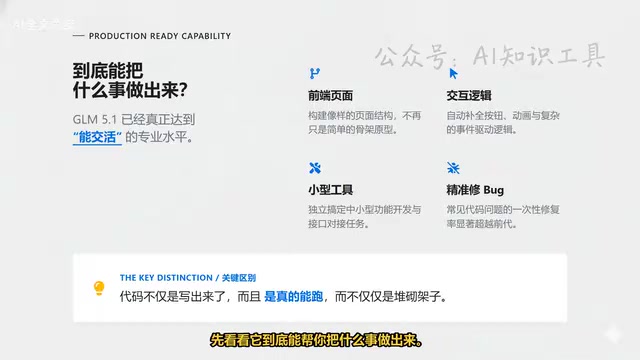
The current AI coding assistant market has formed a clear capability hierarchy: at the top are flagship models like Claude 3.5 Sonnet and GPT-4o, which excel at complex architecture design and long-context engineering tasks but come at a premium; the middle tier consists of standard versions from major providers offering balanced cost-effectiveness; the bottom tier includes lightweight, low-cost models suitable for simple code completion. GLM5.1 is positioned between the middle and bottom tiers, and its core value of being "deliverable" means: for 80% of daily programming needs, its output quality is sufficient — you don't need to pay a premium for the remaining 20% of complex scenarios. This "good enough" product philosophy is reshaping how ordinary developers choose AI tools.
Specifically, when you ask it to build a page with interactive buttons, animations, and logic, it can generally handle all of it. Even for fixing common issues, it's often more likely to get it right on the first try compared to the previous generation. For repetitive work in daily development, the efficiency boost is very real.
Weaknesses Exposed: Two Major Pitfalls in Complex Projects
But don't treat it as a fully autonomous workhorse that can handle everything. As soon as your project gets complex, or the context grows extremely long and requires back-and-forth revisions, GLM5.1 starts showing its weak spots.

The most typical symptom: it looks smart during the first few conversation turns, then suddenly starts going in circles, producing garbled output, or even "fixing A but breaking B in the process." At its core, it's a model that's quite capable but tends to degrade during sustained operations.
Two Major Pitfalls to Watch Out For

- Poor long-context stability: As conversation turns accumulate, the model's attention and consistency start declining, easily producing contradictory code modifications.
- Extremely fast Token consumption: In complex tasks, advanced features consume Tokens far faster than expected — cost control requires attention.
Why do these two problems occur? The long-context stability issue stems from inherent limitations of the Transformer architecture's Attention Mechanism. When processing conversations, the model needs to compute attention weights across all historical Tokens. As the context window grows, weights for earlier information get diluted, causing the model to "forget" previous constraints. This phenomenon is known in the industry as the "Lost in the Middle" effect — the model remembers content at the beginning and end of conversations well, but tends to lose information in the middle. For programming tasks, this means the model may forget variable naming conventions, architectural constraints, or business logic you defined initially, producing contradictory code.
Regarding Token consumption: Tokens are the basic units through which LLMs process text. In Chinese, 1-2 characters typically correspond to 1 Token, and variable names and symbols in code each consume Tokens as well. Under API billing models, both input Tokens (your content plus conversation history) and output Tokens (model-generated content) are billed. Complex programming tasks consume Tokens quickly because: code itself has high Token density, multi-turn conversations repeatedly include all history as context, and the model's Chain-of-Thought reasoning also generates large amounts of output Tokens.
These two issues mean GLM5.1 is better suited for a "quick and focused" task approach — give it one clear small task at a time, collect the result, and move on. Don't try to complete an entire project in a single long conversation. This not only avoids stability problems but is also the most economical way to use it.
Target Users: Three Types Who Benefit Most from GLM5.1
Who is GLM5.1 really for? Essentially three groups:
- Type 1: Regular users who want to experience AI coding at low cost — curious about AI-assisted programming but don't want to spend big
- Type 2: Individual developers or small teams who need to quickly prototype and validate ideas
- Type 3: Workers who frequently need to write scripts, APIs, or automation tools in their jobs
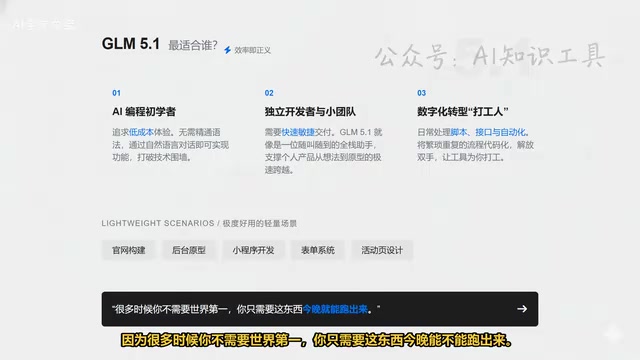
If you have a task at hand — building a company website, a mini-app prototype, a form system, or a campaign page — and you need to turn an idea into something visible quickly, it can absolutely help. Because most of the time you don't need the world's best; you just need "can this thing be running by tonight."
GLM5.1's Biggest Killer Feature: Clear Price Advantage
Finally, let's talk about GLM5.1's biggest competitive edge — price.
Many top-tier AI coding models aren't avoided because people don't want to use them, but because long-term use is simply unaffordable. In that context, spending a little money to get a model that works most of the time — and occasionally delivers pleasant surprises — feels like a great deal.
GLM5.1 isn't some "budget miracle that rivals the best," but it does make ordinary people genuinely feel for the first time: you can actually hire a pretty capable AI assistant for just a few dozen yuan.
Purchase advice: Light users can start with the lowest-tier plan to see if it fits their workflow before deciding whether to upgrade. Heavy users need to watch Token consumption carefully — consider using it alongside other models in a complementary fashion. For example, use GLM5.1 for routine small-to-medium tasks, and switch to a flagship model with better context stability for complex architecture problems requiring long-context reasoning. This approach controls costs while avoiding failures at critical points.
Key Takeaways
- GLM5.1 has reached "deliverable" quality for small-to-medium programming tasks — code runs directly
- Stability suffers in long-context scenarios due to the Transformer attention mechanism's "Lost in the Middle" effect; multi-turn conversations easily lead to logical confusion
- Two core weaknesses: poor long-context stability and excessively fast Token consumption
- Best suited for individual developers, small teams, and users who need rapid prototyping
- Price is its biggest competitive advantage — practical AI coding assistance for just a few dozen yuan
- Recommended "quick and focused" usage strategy; for complex projects, pair with other models as complements
Related articles
 Product Reviews
The Programmer's Desk Setup Guide: Building a Workspace That Feels Like Home
Discover how programmers build productive, comfortable workspaces. From multi-monitor setups to ergonomic design, explore the desk philosophy that drives focus and flow.
 Product Reviews
Qoder vs Cursor Real-World Comparison: Which $20/Month AI IDE Is Better?
Hands-on comparison of Qoder vs Cursor AI IDEs: Agent autonomy, human interaction count, and architecture decisions. Qoder needed only 2 interactions vs Cursor's 8.
 Product Reviews
Cursor Cloud Agent Demo: Eliminating Bottlenecks Across the Entire Software Development Lifecycle
Deep analysis of Cursor's Cloud Agent demo showing how cloud VMs, automated test artifacts, and a full-chain control plane systematically eliminate human bottlenecks across the software development lifecycle.