Glyphi Speed Reader Deep Dive: How RSVP Technology Boosts Reading Efficiency

Glyphi leverages RSVP technology and on-device AI to deliver private, efficient speed reading across Apple devices.
Glyphi: Speed Reader combines RSVP (Rapid Serial Visual Presentation) technology with Apple ecosystem integration and on-device AI to create a privacy-first speed reading tool. It supports full-format import including EPUB, PDF, and web articles, offers deep customization of reading speed and pauses, syncs seamlessly via iCloud, and generates AI summaries without sending data to the cloud — targeting knowledge workers who value both efficiency and privacy.
RSVP Speed Reading: A Rediscovered Reading Paradigm
In an era of information overload, how to digest massive amounts of text more quickly has become a pain point for many. Glyphi: Speed Reader, recently launched on Product Hunt, offers a technically compelling answer — it's built on RSVP (Rapid Serial Visual Presentation) technology, transforming the reading experience from traditional scrolling and page-turning into word-by-word flash display. The product currently has 78 votes on Product Hunt, ranking #13, and is categorized under Productivity, Education, and Books.
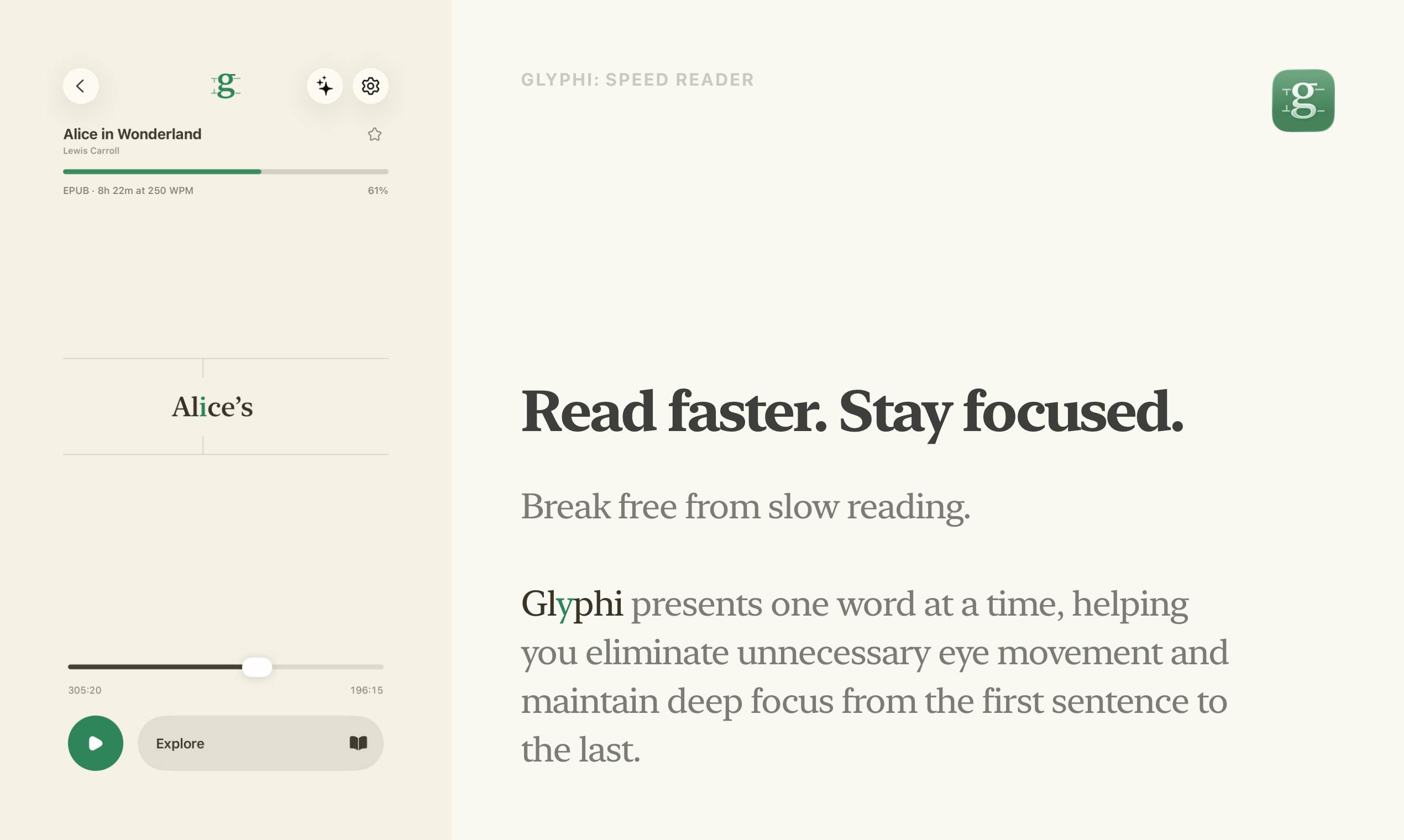
RSVP is not an entirely new concept. Its core principle is this: during traditional reading, the eyes must constantly move to locate the next word (known as "saccades"), and these eye movements consume significant time. RSVP technology presents text one word at a time at a fixed position on screen, theoretically eliminating saccades and significantly increasing reading speed. Glyphi takes this paradigm — long studied in academic circles — and packages it into a polished product for everyday users.
RSVP technology can be traced back to cognitive psychology experiments in the 1970s, originally used to study the limits of human visual attention and short-term memory. In traditional reading, the average saccade lasts 20-30 milliseconds, each fixation lasts 200-250 milliseconds, and regressions — where the eyes return to previously read text — account for 10-15% of total reading time. By eliminating this eye movement overhead, RSVP can theoretically boost reading speed from the average person's 200-300 WPM to 500-700 WPM or even higher. In 2013, Spritz brought this technology into the public spotlight, sparking a wave of speed-reading enthusiasm, but interest waned following controversies about declining comprehension rates. Glyphi's emergence represents a new round of attempts to productize this technology.
Why RSVP Speed Reading Deserves Renewed Attention
Many RSVP applications have appeared in the past, but most remained at a "demo-level" experience, lacking deep adaptation to real reading scenarios. Glyphi differentiates itself by building a complete content import and ecosystem loop, rather than merely providing a word-flashing window.
Glyphi's Full-Format Import and Deep Customization
One of Glyphi's most practical features is its broad compatibility with content sources. Users can import books, EPUB e-books, PDF documents, web articles, and even entire web pages. This means whether it's academic literature, novels, or daily news, everything can be processed within the same speed-reading system.
It's worth noting that supporting multi-format import seems simple but actually involves complex document parsing engineering. EPUB is essentially a packaged format based on HTML/CSS — text extraction is relatively straightforward, but it requires correctly handling chapter structures, footnotes, citations, and other metadata. PDF, on the other hand, is a format that prioritizes visual presentation, where text may be stored in non-linear fashion, and scanned PDFs even require OCR (Optical Character Recognition) to extract text. Additionally, elements like multi-column layouts, tables, and image captions can all disrupt the text flow order. For RSVP reading, the accuracy and sequential correctness of text extraction directly impacts the experience — if paragraph order is scrambled or footnotes get mixed into body text, users will completely lose comprehension during word-by-word presentation. Glyphi's ability to cover these formats indicates considerable effort invested in its document parsing engine.
At the reading experience level, Glyphi offers rich customization options:
- Adjustable reading speed: Users can set words per minute (WPM) based on content difficulty and proficiency
- Smart pause control: Inserts pauses at key points like punctuation and paragraph breaks to aid comprehension and digestion
- Color and layout customization: Allows personalized color schemes and typography to reduce visual fatigue
WPM is the standard metric for measuring reading speed. The average adult's silent reading speed is approximately 200-300 WPM, trained speed readers can reach 600-1000 WPM, and world speed-reading champions claim to achieve several thousand WPM. However, cognitive science research shows a near-inverse tradeoff between reading speed and comprehension (speed-accuracy tradeoff). A review paper published by Keith Rayner et al. in 2016 found that text comprehension drops significantly when reading speed exceeds approximately 600 WPM. Therefore, Glyphi's adjustable WPM feature has practical significance — users can dynamically adjust speed based on text complexity, setting high WPM when browsing news and lowering it when reading academic papers to ensure comprehension.
This granular control is crucial. One major criticism of RSVP reading is the "inability to re-read" — in traditional reading, we can look back at previous text at any time, but word-by-word presentation makes this action difficult. Through thoughtful pause settings and speed adjustment, Glyphi attempts to find the balance between reading speed and comprehension depth.
Seamless Apple Ecosystem Integration and iCloud Sync
Glyphi deeply integrates with the Apple ecosystem. Through iCloud sync, users can seamlessly continue their reading progress across iPhone, iPad, Mac, and other devices. This continuity is particularly important for long articles and book reading — read a few pages on your phone during commute, then continue on Mac at home, with progress automatically synced.
From a technical implementation perspective, iCloud sync relies on the CloudKit framework underneath, allowing developers to store structured data (such as reading progress, bookmarks, and user settings) in the user's private iCloud database. Unlike simple file sync, reading progress synchronization requires precisely recording the user's position in the text (typically down to character offset or paragraph index), along with associated state information like WPM settings and highlighted annotations. Apple's Handoff technology also enables instant relay between devices — for example, while reading on iPhone, a corresponding Glyphi icon appears in the Mac's Dock bar, and clicking it continues from the exact position where you left off. This seamless experience is one of the core competitive advantages of Apple's closed ecosystem.
For heavy Apple users, this native-level multi-device collaboration experience is often more attractive than cross-platform solutions with fragmented sync experiences. Of course, this also means Android and Windows users are temporarily left out.
Privacy-First On-Device AI Summary Feature
In an era where AI features have become nearly standard, Glyphi's approach is noteworthy. It incorporates on-device AI capabilities that can generate summaries for imported content without uploading anything to the cloud.
On-device AI means model inference runs entirely on the user's device without relying on cloud servers. This capability depends on the Neural Engine integrated into Apple's custom silicon. Starting with A11 Bionic, Apple has included dedicated machine learning accelerators in every chip generation, with the latest M4 chip's Neural Engine reaching 38 TOPS (trillion operations per second). Apple's Apple Intelligence framework, announced at WWDC 2024, further provides developers with standardized on-device model calling interfaces supporting tasks like text summarization and semantic understanding. Glyphi's on-device summary feature is likely built on the Core ML framework or Apple Intelligence API, using quantized compact language models (with parameters in the billions range) to complete inference locally on the device.
This design has two layers of significance:
Data Privacy Protection as a Core Selling Point
When users might be importing personal notes, sensitive documents, or purchased books, keeping content on-device fundamentally eliminates data breach risks. Compared to solutions that send text to remote servers for processing, on-device AI has inherent privacy advantages. Against the backdrop of increasingly strict GDPR (General Data Protection Regulation) and various national data protection laws, "data never leaves the device" is not just a technical choice but a compliance strategy. This feature is especially critical for enterprise users importing internal documents for speed reading.
Aligning with Apple's On-Device Intelligence Direction
Apple has been aggressively advancing on-device machine learning in recent years (Apple Intelligence being a prime example). Glyphi's adoption of on-device AI summarization both aligns with Apple's technology ecosystem and leverages the computational power improvements of next-generation chips. The emergence of such applications validates, to some extent, the feasibility of on-device AI in consumer scenarios. However, on-device models still lag behind cloud-based large models in parameter scale and reasoning capability — summary quality may not match top-tier models like GPT-4, but for lightweight tasks like extracting article highlights and generating reading outlines, they are more than adequate.
Use Cases and Limitations of RSVP Speed Reading
Looking at Product Hunt data, Glyphi is currently in its early stage — 78 votes and a #13 ranking suggest initial recognition within a niche user group, but it hasn't yet achieved large-scale impact.
Speed reading tools occupy a space where demand is real but conversion rates are questionable. The research community has long debated whether RSVP can truly improve "effective reading" (maintaining comprehension while increasing speed). For technical documentation and content requiring careful deliberation, word-by-word flash display may not be suitable; but for news browsing, light novels, and other information-acquisition-focused scenarios, it can genuinely boost efficiency. Notably, RSVP reading places higher demands on working memory — since readers cannot look back, they need to maintain more contextual information in short-term memory, which creates particularly noticeable experience differences between native language and foreign language reading.
Glyphi's smart positioning lies in not marketing itself as a "universal reader," but rather serving Apple users who pursue reading efficiency while highly valuing data privacy, supported by four pillars: full-format import, deep customization, ecosystem sync, and privacy-focused AI.
Conclusion: Who Is Glyphi Built For
Glyphi represents a product approach worth watching: cleverly combining a mature academic concept (RSVP), platform ecosystem advantages (Apple + iCloud), and cutting-edge technology trends (on-device AI) into a small but finely polished tool. It may not revolutionize everyone's reading habits, but for knowledge workers who process large volumes of information and value privacy, Glyphi offers a new option that balances efficiency with security. At a time when AI features are increasingly "cloud-ified," its on-device privacy approach is especially worth emulating by similar products.
Related articles

Chain of Thought Isn't Just for AI: How Humans Can Use CoT to Improve Thinking Quality
Chain of Thought isn't just a prompt trick for large models. Starting from a Hacker News discussion, this article analyzes why CoT works for human thinking too, breaks down actionable ways to transfer it, and highlights the key differences between human CoT and machine CoT.
Cloudflare Teams Up with OpenAI: Closi…
Cloudflare Teams Up with OpenAI: Closing the Loop from Vulnerability Discovery to Defense with AI
Cloudflare uses OpenAI Daybreak to investigate security vulnerabilities and generate reviewable remediation plans, while developers use Codex to boost coding efficiency and quality.

Orca Multi-Agent Orchestration in Practice: A Guide to Parallel Collaboration with Claude and Codex
Orca is Stable AI's free open-source agent workbench supporting 34 agents like Claude Code and Codex in parallel. Learn its Git worktree isolation, multi-model orchestration, and mobile management.