GM's $220 Million Settlement: An Industry Warning from the Driving Data Sales Scandal

GM pays $220 million to settle 36-state allegations over illegal driving data sales and commits to obtaining express user consent.
GM has agreed to pay $220 million to settle with a bipartisan coalition of 36 U.S. state attorneys general over allegations that it illegally sold driver and location information to data brokers. The agreement requires GM to limit the driving data it collects and obtain users' "express consent" before collecting or sharing sensitive information. Driving data can reveal private details such as residence, workplace, frequently visited places, and driving habits, and may be used for commercial purposes such as insurance pricing. The case is a warning to the auto industry and tech companies that data privacy regulation is tightening and violations are costly. Users should proactively read privacy policies, limit data sharing, and protect their rights through complaints and other channels.
GM has agreed to pay $220 million to settle allegations that it illegally sold driver and location information to data brokers. According to Reuters, the agreement resolves complaints from a coalition of 36 U.S. state attorneys general and requires GM to limit the driving data it collects and obtain users' "express consent." This case is not only a landmark moment for data privacy in the automotive industry, but also a wake-up call for every tech company that relies on user data.
The Core of the Case: $220 Million and a 36-State Coalition
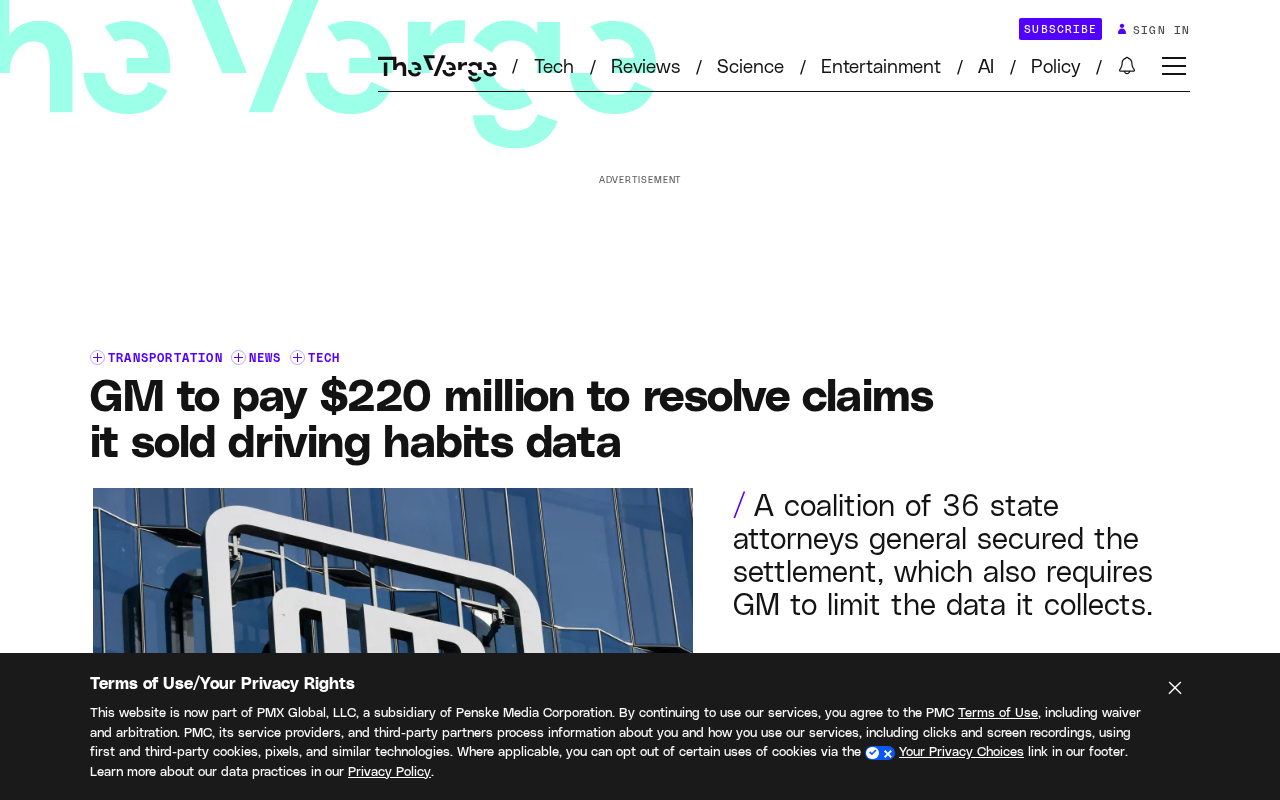
The core facts of this settlement are clear and forceful. GM was accused of selling driving behavior and location data to data brokers without adequately informing users; such data could be used for insurance pricing, risk assessment, and other purposes. A bipartisan coalition of 36 attorneys general filed complaints, ultimately reaching a $220 million settlement.
Key terms of the agreement include: GM must limit the scope of driving data it collects, and must obtain users' "express consent" before collecting or sharing such sensitive information. This means GM can no longer obtain data authorization through vague privacy policies or pre-checked boxes—users will have clearer control.
This is not an isolated case. In recent years, with the spread of connected vehicles, the volume of data generated by cars has surged—from driving habits to real-time location to in-car voice interactions, each item can become a source of commercial monetization. GM's settlement effectively draws a red line for the entire industry: data monetization cannot come at the expense of users' right to know and right to choose.
"Express consent" is a key concept in data privacy law, distinct from implied or presumed consent. It requires data controllers to clearly and prominently explain data uses to users before collecting or using personal information, and to obtain users' active, specific affirmative indication (e.g., checking a non-pre-checked box, signing an authorization form). U.S. state privacy laws (such as California's CCPA) and the EU's GDPR both emphasize that express consent must be obtained for sensitive data or sharing beyond reasonable expectations, and companies must retain consent records for regulatory review.
Driving Data: Why Is It So Sensitive?
Driving data is sensitive because it can sketch the most private trajectories of a person's life. Your residence, workplace, frequently visited hospitals, religious sites, friends' addresses, and even acceleration and braking habits can all be precisely recorded. Once this information falls into the hands of data brokers, it could be used for targeted marketing, insurance discrimination, or even worse purposes.
According to Reuters, GM was accused of selling this data to data brokers without users' knowledge. The harm of such conduct lies in depriving users of control over their own information. Imagine your insurer raising your premium because you frequently brake hard, while you have no idea how that data was obtained. This information asymmetry is exactly what privacy protection regulations seek to correct.
From a technical perspective, a modern car is like a mobile data collector. Onboard sensors, GPS, Bluetooth connections, and even in-car cameras continuously generate data. Automakers have the ability to collect this data, but how it is stored, used, and shared must follow the principles of transparency and consent. GM's settlement reaffirms this principle.
A data broker is a commercial entity that specializes in collecting, integrating, selling, or sharing consumers' personal information, and typically does not interact directly with consumers. They obtain data from businesses, public records, sensors, and other channels to form detailed user profiles, then sell them to insurers, marketing agencies, and others. Because the data broker industry has long existed in a regulatory gray area, consumers are often unaware. In recent years, several U.S. states (such as Vermont and California) have enacted laws requiring data brokers to register and disclose their data practices, but there is still no unified federal regulation.
Implications for the Auto Industry and Tech Companies
The GM case sends a clear signal to the entire tech industry: data privacy regulation is tightening, and the cost of violations is high. A $220 million penalty is no small sum, and more importantly, it requires companies to change their data collection and usage processes.
For automakers, this means re-examining relationships with data brokers and establishing stricter user authorization mechanisms. For other tech companies that rely on user data—such as smart home, wearable devices, and mobile apps—this should also serve as a warning. User data is not a free resource, but an asset that must be managed on a foundation of trust.
From a broader perspective, this settlement also reflects regulators' attention to the data broker industry. Data brokers often buy and sell personal information without users' knowledge, forming a massive gray market. GM's settlement may prompt more states to enact stricter data privacy laws, requiring companies to bear more responsibility in data transactions.
A State Attorney General is the highest law enforcement official in a U.S. state, responsible for enforcing state consumer protection and privacy laws. In the data privacy field, attorneys general can bring civil lawsuits against violating companies, seeking fines, injunctions, and settlement agreements. Multistate bipartisan coalitions often act jointly against companies operating across states to enhance enforcement effectiveness and negotiating leverage. Such settlements typically include remediation requirements, periodic reporting obligations, and fines, and have quasi-regulatory effect; companies should treat them as compliance benchmarks.
How Can Users Protect Their Driving Data?
Although regulation is improving, users themselves also need to be vigilant. First, carefully read the vehicle's privacy policy to understand what data is collected and how it is shared. Second, look for data-sharing options in vehicle settings; you can often choose to turn off or limit data uploads. Third, pay attention to privacy updates released by automakers to stay informed of policy changes.
In addition, users can protect their rights through legal means. If you find that your data has been misused, you can file a complaint with your state attorney general's office. The GM settlement shows that collective action can have real impact. The joint complaint by 36 attorneys general ultimately led to a massive settlement and changes to the agreement terms.
Conclusion: A Turning Point for Data Privacy
The GM $220 million settlement is a turning point for data privacy protection in the automotive industry. It reminds us that in the era of connected vehicles, data collection must be built on transparency and consent. For companies, compliance is not only a legal requirement but also the key to winning user trust. For users, understanding their rights and actively exercising them is the first line of defense for protecting personal information.
As technology advances, data privacy challenges will only become more complex. But the GM case proves that when regulators, companies, and users work together, the industry can move in a more responsible direction. This settlement not only resolves past allegations but also sets a benchmark for future data governance.
Related articles

The Truth About AI Coding: Code Output Soars, So Why Is Delivery Still Hard to Speed Up?
Engineering leaders from Databricks, Uber, and Google Maps discuss AI coding's real impact: code output soars but delivery bottlenecks shift, code review faces rethinking, and enterprises begin fine-grained token governance.

A New Paradigm for Text Editing in Compose: TextFieldState Replaces the Old API
Jetpack Compose introduces the TextFieldState API to fix dropped characters and cursor jumps from async input. The old value/onValueChange callbacks will be deprecated in 1.13. This article covers InputTransformation, OutputTransformation, four state hoisting patterns, and new formatted text editing capabilities.

Remote Compose: A New Document-Driven Paradigm for Cross-Platform UI on Android
Remote Compose transmits compact binary documents instead of screen pixels, enabling efficient UI rendering on remote surfaces like Wear OS and widgets. This article covers its document creation API, expression animations, size optimization techniques, and Wear OS progress.