Gnomon: A Postgres Data Version Control Tool Built for AI Agents
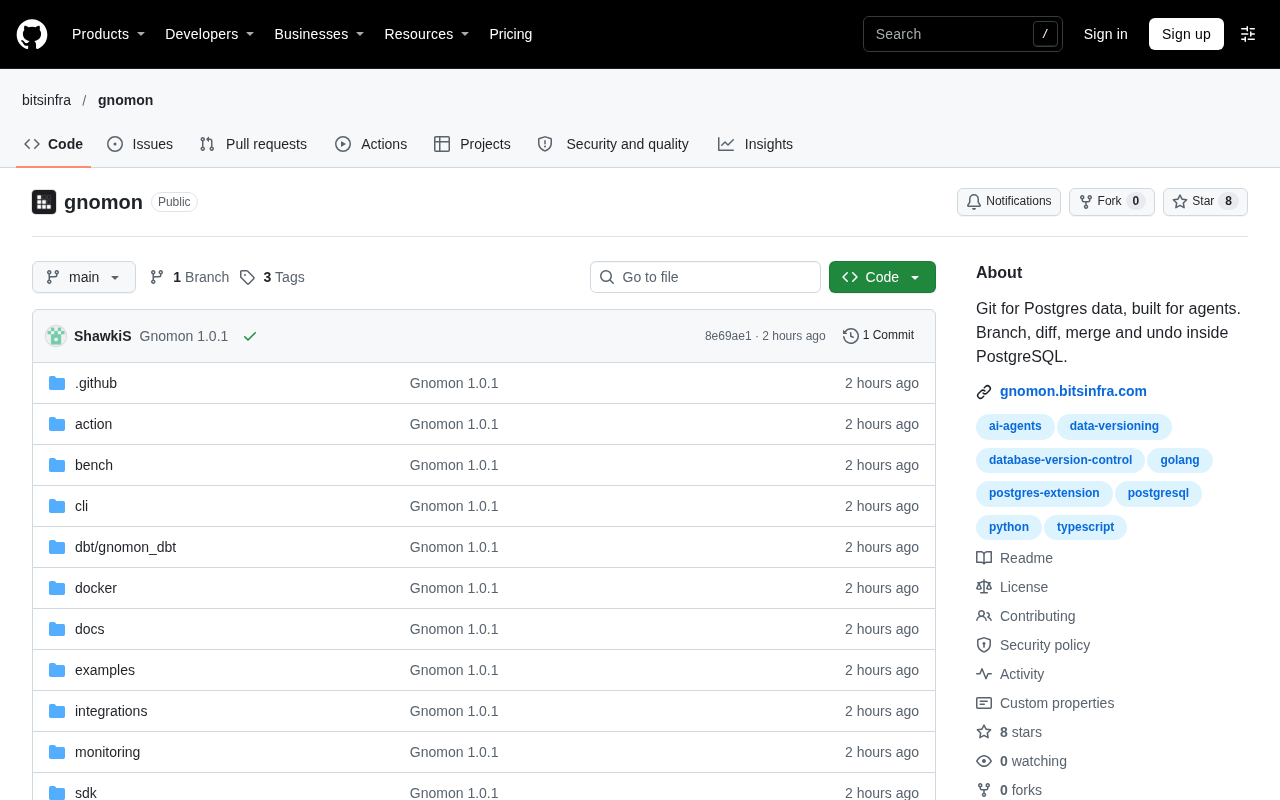
Gnomon brings Git-like version control to Postgres data, purpose-built for AI Agents.
Gnomon is a project positioned as "Git for Postgres data," explicitly "built for agents." It aims to bring commit, history viewing, and rollback capabilities from code collaboration into database data management, solving the pain points of developers who have long relied on manual backups and SQL scripts. The article notes that Postgres's built-in WAL and PITR are primarily oriented toward operations-level disaster recovery rather than developers' daily fine-grained data management—exactly the gap Gnomon fills. Its "built for agents" positioning addresses the traceability and security needs of AI Agents autonomously operating on data, making every change recordable, reviewable, and rollback-able. Hacker News discussion shows the project is still early-stage; the community recognizes its approach but still has questions about storage overhead and workflow integration.
When Databases Meet Version Control
In software development, Git has become the cornerstone of code collaboration. But when it comes to the data itself within a database, version control remains a thorny problem. Developers typically rely on manual backups, SQL scripts, or third-party tools to manage data changes, lacking the intuitive commit, rollback, and branching capabilities that Git provides.
Gnomon aims to change this. According to its introduction on Hacker News, it is "Git for Postgres data," and explicitly "built for agents." This means it doesn't simply apply Git concepts to databases—it was designed from the ground up with AI Agent use cases in mind.
Gnomon. Git for Postgres data, built for agents
This positioning is worth pondering. As AI Agents increasingly participate in data operations, how to let Agents modify data safely and traceably has become an urgent problem to solve. Gnomon seems to be targeting exactly this pain point.
Core Positioning: Agent-Oriented Data Version Control
The core value of Gnomon lies in providing Git-like version control capabilities for Postgres data. This typically means developers can commit data changes just like committing code, view history, and roll back to previous versions when needed.
But more importantly, there's the "built for agents" philosophy. When AI Agents execute tasks, they may perform read and write operations on the database. If an Agent's modifications go wrong, recovery is difficult without version control. Gnomon provides a safety net for Agent operations through version control—every data change can be recorded, reviewed, and rolled back.
According to discussions on Hacker News, this design approach has been recognized by some developers. They believe that as Agent autonomy increases, traceability at the data level will become critical.
Why Postgres Needs Dedicated Data Version Control
As one of the most popular open-source relational databases, Postgres has a massive user base. However, data version control is not a built-in feature of the database itself. Although Postgres provides mechanisms like WAL (Write-Ahead Logging) and PITR (Point-in-Time Recovery), these are more oriented toward operational disaster recovery rather than developers' day-to-day data management.
Gnomon fills exactly this gap. It makes data changes manageable just like code changes. For teams using Postgres, this means finer-grained control over data state, especially in scenarios like testing, development, and Agent training.
Comments on Hacker News also reflect that many developers have real needs for database version control, but existing solutions are often too cumbersome or inflexible. Gnomon's lightweight positioning could be an advantage.
WAL (Write-Ahead Logging) is the core mechanism by which Postgres ensures data durability and crash recovery: any data modification is appended to the WAL log before being written to disk. PITR (Point-in-Time Recovery) builds on WAL archiving and base backups to restore the database to a precise moment in the past. Both are designed for disaster recovery and operational assurance, focusing on "whether the entire database state can be returned to a certain point in time," typically at the whole-database level and aimed at DBAs. Data version control, by contrast, is oriented toward developers' daily collaboration: committing, comparing, branching, and rolling back by table, by row, or by logical dataset, accompanied by commit messages and review workflows. Understanding this distinction helps clarify that tools like Gnomon are not reinventing the wheel, but rather supplementing operations-level recovery capabilities with a fine-grained data change management layer for developers and Agents.
A New Paradigm for Data Management in the Agent Era
The "built for agents" label hints at Gnomon's judgment about the future of work. As AI Agents become part of the development workflow, they need to be able to operate on data autonomously while also being constrained and audited. Version control provides a natural constraint mechanism: each Agent modification is a commit that humans can review, approve, or reject.
Judging from the discussion activity on Hacker News (Points: 13 | Comments: 10), Gnomon is still in its early stages, but the concept has attracted attention. Some commenters noted that Agent-database interaction requires finer-grained control, not just global read/write permissions. Gnomon's version control approach may provide a foundation for this.
However, some voices have raised questions about its practicality: Will data version control bring additional storage overhead? Is integration with existing workflows smooth? These questions can only be answered once the product matures.
When AI Agents interact with databases, the common approach is to grant them a database connection or a set of read/write permissions, but this is coarse-grained access control that cannot answer questions like "what data did the Agent specifically change, why, and can it be undone?" Data version control provides a complementary mechanism: encapsulating each Agent write operation as an identifiable changeset that records the operator, time, and context, thereby supporting post-hoc auditing and rollback by changeset. This does not conflict with role-based access control (RBAC)—permissions determine whether an Agent can write, while version control determines whether writes are traceable and reversible. For scenarios requiring Agents to autonomously execute multi-step tasks, this "change-as-commit" model also allows humans to intervene and review at critical junctures.
Summary
Gnomon proposes an interesting direction: bringing Git's version control philosophy into Postgres data management, optimized specifically for AI Agent scenarios. Although information is currently limited, it touches on the key issues of data governance in the Agent era—traceability and security. For developers interested in the intersection of AI and databases, this is a project worth watching.
In the database field, there are several common approaches related to "data version control" worth considering: first, snapshots and cloning (such as database branching based on copy-on-write technology), which is suitable for quickly creating test environments but has high storage and synchronization costs; second, change data capture (CDC) and audit logs, which focus on recording rather than rollback-capable version management; third, application-level event sourcing, which models state changes as immutable event streams but requires architectural changes to the application. If Gnomon can provide commit and rollback semantics without changing existing Postgres usage patterns, its key challenges lie in how to efficiently represent data differences, control storage bloat, and integrate with existing workflows like migration scripts and ORMs. These are precisely the reasons the community has raised questions about its storage overhead and integration costs.
Related articles

Why Microsoft CEO Nadella Still Backs Nvidia After Jensen Huang's Departure
Microsoft CEO Nadella publicly expresses confidence in Nvidia interim CEO Colette Kress. This article analyzes Nvidia's power transition after Jensen Huang's departure, Microsoft's compute dependency, and the trust logic of the AI supply chain.

Nadella: Critical Infrastructure Is 'Unpatchable' as AI Cybersecurity Arms Race Escalates
Microsoft CEO Nadella addresses AI cyberattack fears, saying much critical infrastructure is unpatchable, downplaying the Outlook outage, and analyzing AI's dual role in cybersecurity.

Musk Backs Jensen Huang: Firing Him Is Like Cutting Jordan
Musk says Jensen Huang is loyal to the U.S. and likens firing him to cutting Michael Jordan—highlighting politicization anxieties in the AI chip industry and defending talent value.