Go 1.27 Improves HTTP/1 Connection Reuse, Further Boosting Network Performance

Go 1.27 corrects HTTP/1 connection reuse logic, transparent to default net/http users and beneficial without code changes.
Go 1.27 improves the connection reuse determination logic in net/http for HTTP/1 scenarios, aligning client decisions on idle connection reuse with protocol semantics. It focuses on interpreting response headers, message boundaries, and connection states, correcting deviations in certain cases. For most services using the default http.Transport, the change is transparent—no need to modify Transport settings or adjust MaxIdleConns—and upgrading yields a more reasonable reuse strategy, reducing unnecessary TCP/TLS handshakes, lowering latency, and alleviating TIME_WAIT buildup and port exhaustion risks. The article also advises services with strong dependencies on connection behavior, such as customized DialContext or special proxy handling, to run regression tests after upgrading.
Every subtle adjustment Go makes in the networking space can affect the throughput of a large number of backend services. Go 1.27's improvements to HTTP/1 connection reuse are exactly the kind of low-level optimization worth paying attention to.
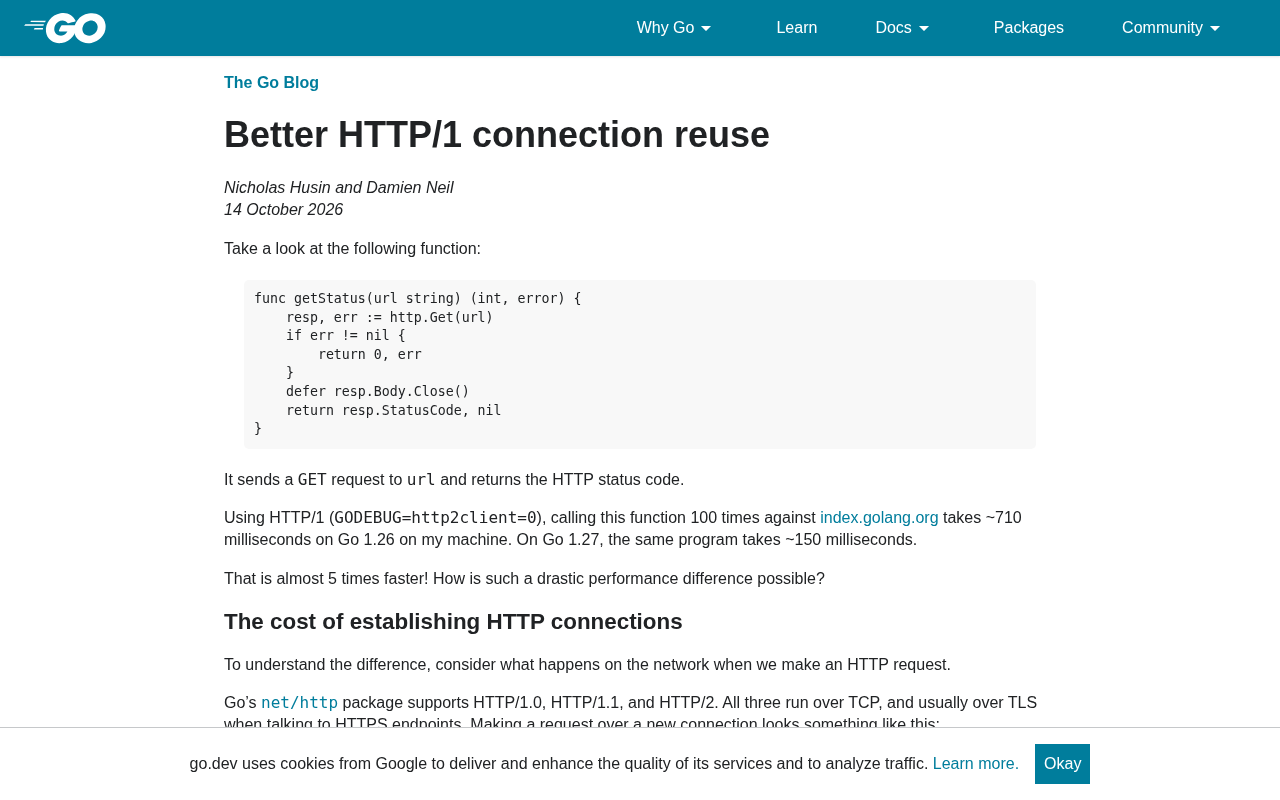
Why HTTP/1 Connection Reuse Deserves Attention
Go's net/http standard library has long been the default choice for building high-concurrency services. In HTTP/1.1 scenarios, connection reuse (keep-alive) can significantly reduce the overhead of TCP handshakes and TLS handshakes, making it a key mechanism for improving performance.
However, connection reuse is not simply a matter of "keeping the connection." How the client connection pool decides whether an idle connection can be reused involves a series of judgments: response headers returned by the server, the request method, the connection state, and so on. If the reuse strategy is too conservative, connections will be established frequently; if too aggressive, connections may be reused when they shouldn't be, introducing hard-to-troubleshoot behavioral differences.
Go 1.27's improvement centers precisely on this decision logic. It makes the standard library more accurate when deciding whether to reuse an HTTP/1 connection, delivering more stable performance gains in real-world services.
The Core Direction of the Improvement
Based on Go's official changelog and community discussions, this adjustment focuses on the conditions for connection reuse.
More Accurate Determination of Connection Reusability
In HTTP/1.1, the server can signal through response headers whether a connection should be reused. Go 1.27 corrects how such signals are interpreted in certain scenarios, making the client's decisions to keep or discard connections in the pool closer to protocol semantics. This means services relying on the default http.Transport may see behavioral improvements without any code changes.
To understand the significance of this improvement, it's necessary to first clarify the protocol semantics of connection reuse in HTTP/1.1. In HTTP/1.1, connections are persistent by default; unless a response explicitly carries Connection: close, the client should consider the connection still reusable. This convention seems simple, but the actual determination involves multiple dimensions: whether the response has a Content-Length or uses Transfer-Encoding: chunked (which determines whether message boundaries can be correctly identified, otherwise the connection cannot be safely reused), whether the status code is 204/304 or another response without a message body, and whether the request method is CONNECT or Upgrade or another special case. If any one of these judgments is off, the client may reuse a connection before the message body is fully read, causing subsequent requests to read misaligned byte streams. Go 1.27 corrects exactly these boundary determinations, bringing the client's conclusion about "whether a connection can be safely returned to the idle pool" more in line with the RFC 7230 specification.
Impact on Long-Connection Services
For applications that frequently call downstream HTTP services, connection reuse efficiency directly affects latency and resource consumption. A more reasonable reuse strategy can reduce unnecessary connection establishment and lower the risk of TIME_WAIT buildup and port exhaustion.
The TIME_WAIT buildup mentioned here is one of the most typical side effects in high-frequency connection establishment scenarios. According to the TCP state machine, the party that actively closes a connection enters the TIME_WAIT state and by default remains there for 2 times the MSL (usually about 60 seconds) before being fully released. If the client keeps creating new connections because the reuse determination is too conservative, a large number of sockets in TIME_WAIT will accumulate in a short time, occupying local ports. When the four-tuple (source IP, source port, destination IP, destination port) is exhausted, new connections cannot be established, manifesting as connection timeouts or connect: cannot assign requested address. In addition, if each new connection is layered with TLS, it introduces extra handshake round trips and CPU overhead. Therefore, improving the reuse hit rate is not only a means of reducing latency but also key to controlling socket resources and port pressure.
Practical Impact and Migration Advice
For most projects using the default net/http configuration, this change is transparent. You don't need to modify Transport settings or adjust parameters like MaxIdleConns; you can benefit simply by upgrading the Go version.
However, if your service has a strong dependency on connection behavior—for example, if you've customized DialContext or applied special handling at the proxy layer—it's advisable to run a regression test after upgrading to observe whether the connection count or latency distribution shows unexpected changes. Performance-related changes often only reveal subtle differences under load-testing conditions.
The parameters mentioned in the article, such as MaxIdleConns and MaxIdleConnsPerHost, are the core knobs that http.Transport uses to control connection pool behavior; understanding their default values helps assess the impact of this change. MaxIdleConnsPerHost defaults to only 2, meaning that even if a connection is reusable, if concurrent requests to the same host exceed this limit, the extra requests will still create new connections. In other words, the protocol-level reusability determination and the connection pool's capacity policy are two independent stages: the former decides "whether this connection can stay," while the latter decides "how many can stay." Go 1.27's change optimizes the former; if load testing still shows a low connection reuse rate, you may need to investigate the latter as well. For services that have customized DialContext, be aware that they may bypass the default pooling logic, thereby weakening the effect of improvements at the standard library level.
Summary
Go 1.27's improvement to HTTP/1 connection reuse is a microcosm of the standard library's continuous refinement of the network stack. It introduces no new APIs and requires no code refactoring by developers, yet it may subtly improve service performance. For backend systems that use HTTP/1 as their primary communication protocol, this upgrade is worth including in version planning.
One-line Summary
Go 1.27 corrects the HTTP/1 connection reuse determination logic, transparent to default net/http users and beneficial without code changes.
Paragraph Summary
Go 1.27 improves the connection reuse determination logic in net/http for HTTP/1 scenarios, making the client's decision on whether an idle connection can be reused more aligned with protocol semantics. The improvement focuses on interpreting server response headers, message boundaries, and connection states, correcting deviations in certain scenarios. For the vast majority of services using the default http.Transport, this change is transparent—no need to modify Transport settings or adjust parameters like MaxIdleConns—and upgrading yields a more reasonable reuse strategy, reducing unnecessary TCP/TLS handshakes, lowering latency, and alleviating TIME_WAIT buildup and port exhaustion risks. The article also recommends that services with strong dependencies on connection behavior, such as those with customized DialContext or special handling at the proxy layer, run a regression test after upgrading to observe whether connection counts and latency distributions show unexpected changes.
Related articles

Chain of Thought Isn't Just for AI: How Humans Can Use CoT to Improve Thinking Quality
Chain of Thought isn't just a prompt trick for large models. Starting from a Hacker News discussion, this article analyzes why CoT works for human thinking too, breaks down actionable ways to transfer it, and highlights the key differences between human CoT and machine CoT.
Cloudflare Teams Up with OpenAI: Closi…
Cloudflare Teams Up with OpenAI: Closing the Loop from Vulnerability Discovery to Defense with AI
Cloudflare uses OpenAI Daybreak to investigate security vulnerabilities and generate reviewable remediation plans, while developers use Codex to boost coding efficiency and quality.

Orca Multi-Agent Orchestration in Practice: A Guide to Parallel Collaboration with Claude and Codex
Orca is Stable AI's free open-source agent workbench supporting 34 agents like Claude Code and Codex in parallel. Learn its Git worktree isolation, multi-model orchestration, and mobile management.