Go Concurrency Essentials: The Core Logic from Goroutines to Channels

A comprehensive guide to Go's concurrency model, from goroutines and channels to the GMP scheduler and context.
This article provides an in-depth walkthrough of Go's built-in concurrency model, starting from the CSP-inspired philosophy of "sharing memory by communicating." It covers goroutines' lightweight nature and the M:N GMP scheduling mechanism, unbuffered vs. buffered channel semantics, and select-based multiplexing. It then surveys practical concurrency patterns — Worker Pool, Fan-out/Fan-in, and Pipeline — and explains how the context package enables graceful cancellation and timeout control across goroutines while preventing resource-draining goroutine leaks.
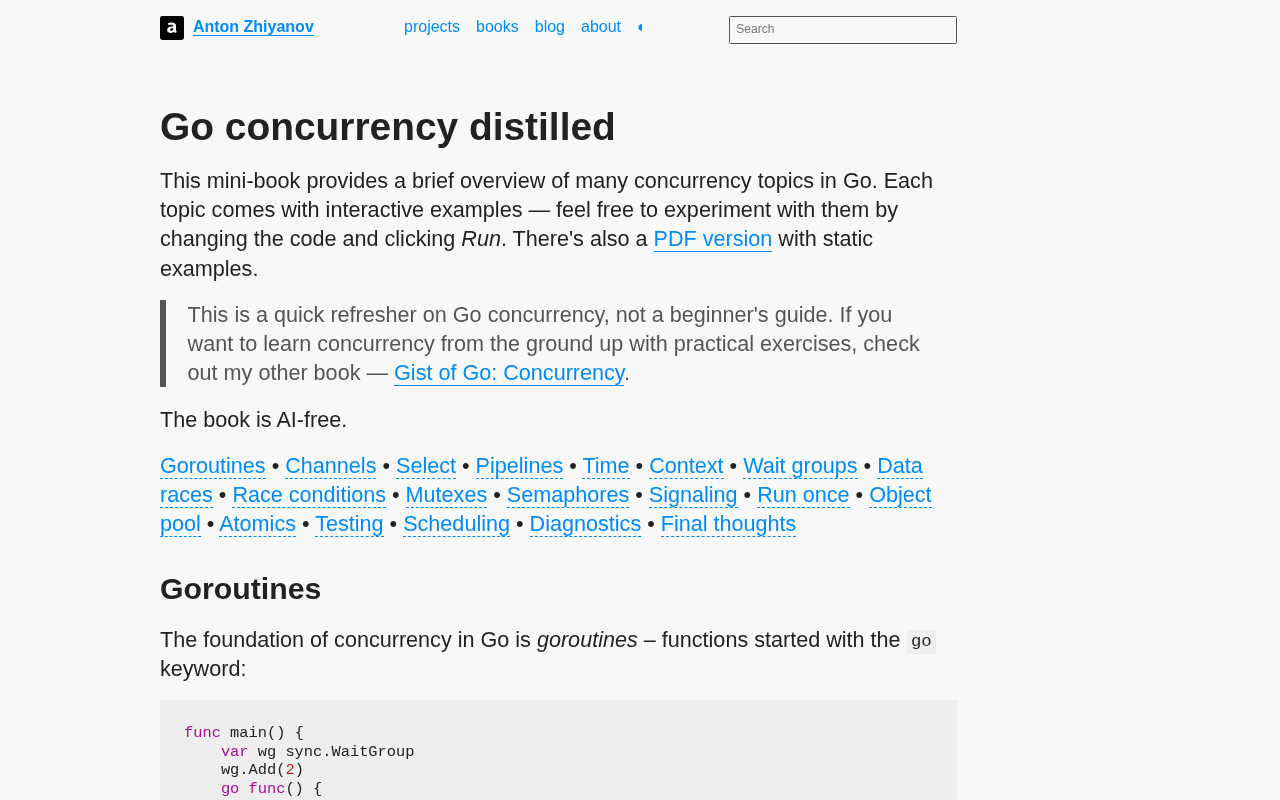
One of Go's most celebrated features is its built-in concurrency model. Unlike other languages that rely on complex threading libraries or third-party frameworks, Go provides a clean and powerful set of concurrency primitives through goroutines and channels. A recent technical article titled Go Concurrency Distilled gained 204 upvotes and 63 comments on Hacker News, reigniting the developer community's interest in Go's concurrency model.
The Design Philosophy Behind Go's Concurrency Model
Go's concurrency design follows a widely quoted mantra: "Don't communicate by sharing memory; share memory by communicating." This phrase captures the fundamental difference between Go and traditional concurrent programming paradigms.
In conventional languages, multithreading typically relies on mutexes, condition variables, and similar mechanisms to coordinate access to shared data — an approach that easily leads to hard-to-debug issues like deadlocks and race conditions. Go instead encourages passing data between independent execution units via channels, allowing ownership to transfer naturally as data moves, which reduces the need for explicit locking.
This design is rooted in Tony Hoare's CSP (Communicating Sequential Processes) theory. Go brings this theory to life as a first-class language feature, dramatically lowering the barrier to writing concurrent code.
CSP theory was proposed by British computer scientist Tony Hoare in 1978, originally as a mathematical formalism for describing interactions between processes in concurrent systems. Its core idea: independently running processes share no state, and instead collaborate by synchronously sending and receiving messages over named channels. This model naturally avoids race conditions caused by shared state, since at any given moment a piece of data belongs to exactly one process. Beyond Go, Erlang's Actor model, Clojure's core.async, and parts of Rust's concurrency libraries all draw inspiration from CSP to varying degrees — but Go is one of the few mainstream languages to bake it directly into the language syntax at such a fundamental level.
Goroutines: Lightweight Units of Execution
Goroutines are the foundational building block of Go concurrency. They are essentially lightweight threads managed by the Go runtime. Launching a goroutine is as simple as placing the go keyword before a function call — the syntax couldn't be more minimal.
Unlike OS threads, which typically consume several MB of stack space, a goroutine starts with only a few KB of stack and can grow or shrink dynamically on demand. This means a Go program can comfortably run tens of thousands — or even hundreds of thousands — of goroutines simultaneously without exhausting memory.
The Scheduling Mechanism
The Go runtime uses an M:N scheduling model, mapping M goroutines onto N OS threads. The scheduler efficiently multiplexes large numbers of goroutines across a small pool of OS threads. When a goroutine blocks on I/O or a channel operation, the scheduler automatically hands the underlying thread to another ready goroutine, enabling high-throughput concurrency.
This user-space scheduling avoids the overhead of frequent kernel-mode context switches — a key reason why Go excels in high-concurrency network service scenarios.
The Go scheduler's concrete implementation is known as the GMP model: G stands for goroutine, M for OS thread (machine), and P for logical processor. The number of Ps defaults to the machine's CPU core count and can be adjusted via the GOMAXPROCS environment variable. Each P maintains a local goroutine run queue, and an M must hold a P to execute goroutines. When a P's local queue is empty, the scheduler steals half the tasks from another P's queue (work stealing) to maintain load balance across cores. This design allows Go programs to automatically utilize all available cores on multi-core machines while keeping scheduling latency in the microsecond range — far below the cost of OS thread context switches.
Channels: The Communication Bridge Between Goroutines
A channel is a typed conduit in Go used for communication and synchronization between goroutines. Through a channel, one goroutine can safely send data to another without explicit locking.
Channels come in two varieties — unbuffered and buffered:
- Unbuffered channel: A send operation blocks until a receiver is ready, enforcing a strict synchronous handshake.
- Buffered channel: Sends don't block as long as the buffer isn't full, making it suitable for decoupling the pace of producers and consumers.
The select Statement
When you need to wait on multiple channel operations simultaneously, the select statement provides powerful multiplexing. Similar to select/epoll in network programming, it monitors multiple channels and executes whichever branch becomes ready first. Combined with a default branch, it enables non-blocking channel operations; paired with time.After, it implements timeout control.
Common Concurrency Patterns
Once you've mastered the primitives, real expertise shows in how you combine them to solve real-world problems. The Go community has distilled several classic patterns:
- Worker Pool: Launch a fixed number of worker goroutines that consume tasks from a task channel, controlling concurrency and preventing unbounded resource consumption.
- Fan-out / Fan-in: Distribute work to multiple goroutines for parallel processing (fan-out), then collect the results into a single channel (fan-in).
- Pipeline: Break a processing workflow into multiple stages, connecting each stage via channels so data flows through like water in a pipeline.
What these patterns share is the use of channels to describe data flow rather than locks to protect state — resulting in concurrent code that is cleaner and easier to maintain.
Context and Graceful Cancellation
Modern Go concurrency programming is inseparable from the context package. It provides a standardized mechanism for propagating cancellation signals, timeouts, and request-scoped values across goroutines. When a request needs to be terminated, a context cancellation signal can cascade to notify all related goroutines to stop, preventing goroutine leaks.
Goroutine leaks are a subtle yet common pitfall in Go concurrency: if a goroutine blocks on a channel indefinitely with no one to wake it up, it can never exit — and over time, accumulated leaks drain system resources. Using context wisely and applying channel operations with timeouts are effective defenses against this problem.
context.Context is an interface. The standard library provides four constructor functions: context.Background() and context.TODO() create root contexts, while context.WithCancel(), context.WithTimeout(), and context.WithDeadline() derive child contexts with cancellation capabilities from a parent. Cancellation signals propagate down the context tree — when a parent context is cancelled, all derived child contexts are cancelled in sync. Goroutines sense this signal by listening to the channel returned by ctx.Done() and should exit proactively. Notably, Go's context design convention requires that it be passed explicitly as a function parameter, never stored in struct fields — a rule that keeps call-chain visibility clear and auditable.
Closing Thoughts
Go's concurrency model is so widely admired because it builds an expressive concurrent programming paradigm from just a handful of language features: go, chan, and select. Understanding the lightweight nature of goroutines, the communication semantics of channels, and the underlying CSP philosophy is the prerequisite for writing good concurrent Go code.
For developers who want to go deeper, merely knowing how to use the go keyword is far from enough. What matters more is cultivating the mindset of organizing concurrency through communication, and staying vigilant against the classic traps of race conditions, deadlocks, and goroutine leaks. The article that sparked lively discussion in the tech community is precisely a concise distillation of this core logic.
Related articles

Chain of Thought Isn't Just for AI: How Humans Can Use CoT to Improve Thinking Quality
Chain of Thought isn't just a prompt trick for large models. Starting from a Hacker News discussion, this article analyzes why CoT works for human thinking too, breaks down actionable ways to transfer it, and highlights the key differences between human CoT and machine CoT.
Cloudflare Teams Up with OpenAI: Closi…
Cloudflare Teams Up with OpenAI: Closing the Loop from Vulnerability Discovery to Defense with AI
Cloudflare uses OpenAI Daybreak to investigate security vulnerabilities and generate reviewable remediation plans, while developers use Codex to boost coding efficiency and quality.

Orca Multi-Agent Orchestration in Practice: A Guide to Parallel Collaboration with Claude and Codex
Orca is Stable AI's free open-source agent workbench supporting 34 agents like Claude Code and Codex in parallel. Learn its Git worktree isolation, multi-model orchestration, and mobile management.