Go-dev-auth: A Deep Dive into a Zero-Dependency Go Authentication Library

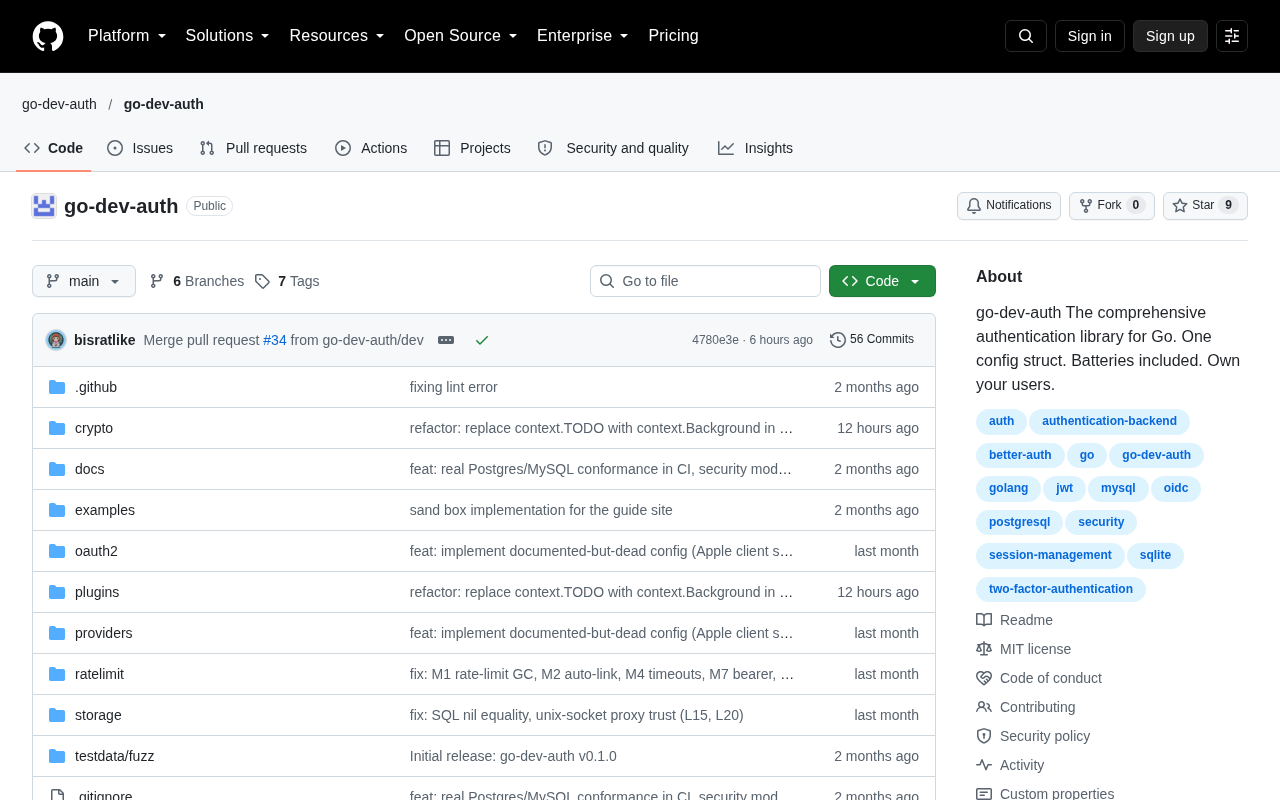
Go-dev-auth is a zero-dependency Go auth library built entirely on the standard library, prioritizing control and auditability.
Go-dev-auth is a Go authentication library that debuted on Hacker News, distinguished by its complete zero-dependency design — relying solely on Go's standard library. Against a backdrop of growing supply chain security concerns, zero-dependency solutions significantly reduce attack surface, lower audit costs, and eliminate risks from upstream library abandonment or breaking changes. The library is expected to cover password hashing, session/token management, constant-time comparison, and secure random number generation. Teams prioritizing control will find it worth evaluating, but should first review its security audit status, test coverage, and maintenance commitments.
A Go Auth Library Built Around "Zero Dependencies"
On Hacker News's Show HN section, a project called Go-dev-auth has been catching the attention of the developer community. Its core pitch is refreshingly straightforward — it's a zero-dependency authentication library for Go.
Dependency bloat has become a widespread headache in modern software development. What looks like a simple authentication feature can drag in dozens of transitive dependencies, introducing supply chain security risks, inflated build sizes, and version conflicts. Go-dev-auth aims to sidestep these issues at the root by relying exclusively on Go's standard library to implement a complete authentication solution.
Why "Zero Dependencies" Matters Especially in the Go Ecosystem
The Go community has long championed the engineering philosophy of "less is more." A powerful standard library and a unified toolchain have led many developers to minimize external dependencies whenever possible. For security-critical modules like authentication, reducing third-party dependencies means:
- A smaller attack surface: Every external package you bring in means handing a portion of your security trust to a third-party maintainer.
- More manageable audit costs: Zero-dependency code is far easier to review in full — your team can know exactly what every line does.
- Longer maintainability: You're insulated from upstream libraries being abandoned or introducing breaking changes, making long-term maintenance more stable.
These are the fundamental reasons why zero-dependency design is especially valued in security-sensitive contexts.
What Problems Does an Authentication Library Typically Need to Solve?
While the original information is limited on specific API and feature details, we can reasonably infer that a general-purpose authentication library would likely cover the following areas:
Credential Management and Password Handling
This includes foundational capabilities like password hashing (e.g., salted hashing built on the standard library) and credential verification, ensuring user passwords are never stored in plaintext.
Sessions and Tokens
Whether using a session-based or token-based approach (such as JWT-style tokens), an auth library needs to handle issuing, validating, and expiring identity state. Zero dependency means all of this logic must be self-implemented using the standard library's cryptography and encoding primitives.
JWT (JSON Web Token) is currently the most popular stateless token scheme. Its structure consists of three parts — Header, Payload, and Signature — joined by dots after Base64URL encoding. Standard implementations rely on signing algorithms like HMAC-SHA256 or RSA. Go's standard library ships with
crypto/hmac,crypto/sha256, andencoding/base64, making it theoretically possible to implement full JWT issuance and validation without any third-party packages. The challenge with a zero-dependency approach is that developers must handle edge cases themselves — token expiration (expclaim), refresh mechanisms, and revocation lists — all of which mature JWT libraries invest significant effort to address.
Security Details
Constant-time comparison, secure random number generation, and protection against timing attacks are engineering details that any authentication library must take seriously. These are often what separates a "toy project" from something that's genuinely production-ready.
A timing attack is a side-channel attack that infers sensitive information by measuring how long an operation takes. For example, a naive string comparison returns early as soon as it finds the first mismatched character. An attacker can statistically analyze response time differences across many requests to guess the correct key or password hash byte by byte. Go's standard library provides
ConstantTimeComparein thecrypto/subtlepackage, which ensures comparison operations take the same amount of time regardless of outcome — an essential practice for any auth library when verifying credentials. For random number generation, always usecrypto/randrather thanmath/rand; the latter is a pseudo-random number generator and is not suitable for security contexts.
What This Means for Developers in Practice
For Go developers evaluating their options, this kind of project offers a trade-off worth considering. Zero dependencies bring simplicity and control, but they also mean you need to verify whether the library's feature set fully covers your business requirements — lightweight libraries may make trade-offs on feature breadth compared to larger, more mature frameworks.
Before deciding to adopt it, it's worth focusing on a few key questions: Has the code undergone a security audit? What's the test coverage like? How active is the community and how committed are the maintainers? And do the cryptographic approaches it implements align with current best practices? Authentication is the first line of defense for system security — every library choice here deserves careful scrutiny.
Summary
Go-dev-auth represents a pragmatic engineering tendency within the Go community: solving a core problem with the smallest possible dependency footprint. For teams that prioritize control and audit-friendliness, zero-dependency libraries like this are worth evaluating. That said, given the limited public information available at this time, developers should thoroughly read through the source code and documentation before adopting it in production, and make their decision based on their specific use case.
Related articles

Chain of Thought Isn't Just for AI: How Humans Can Use CoT to Improve Thinking Quality
Chain of Thought isn't just a prompt trick for large models. Starting from a Hacker News discussion, this article analyzes why CoT works for human thinking too, breaks down actionable ways to transfer it, and highlights the key differences between human CoT and machine CoT.
Cloudflare Teams Up with OpenAI: Closi…
Cloudflare Teams Up with OpenAI: Closing the Loop from Vulnerability Discovery to Defense with AI
Cloudflare uses OpenAI Daybreak to investigate security vulnerabilities and generate reviewable remediation plans, while developers use Codex to boost coding efficiency and quality.

Orca Multi-Agent Orchestration in Practice: A Guide to Parallel Collaboration with Claude and Codex
Orca is Stable AI's free open-source agent workbench supporting 34 agents like Claude Code and Codex in parallel. Learn its Git worktree isolation, multi-model orchestration, and mobile management.