Go Will Reject Certificate Chains Containing Eight Untrusted SPKIs: A Security Policy Deep Dive

Go will reject eight specific SPKI certificate chains; developers need to check compatibility.
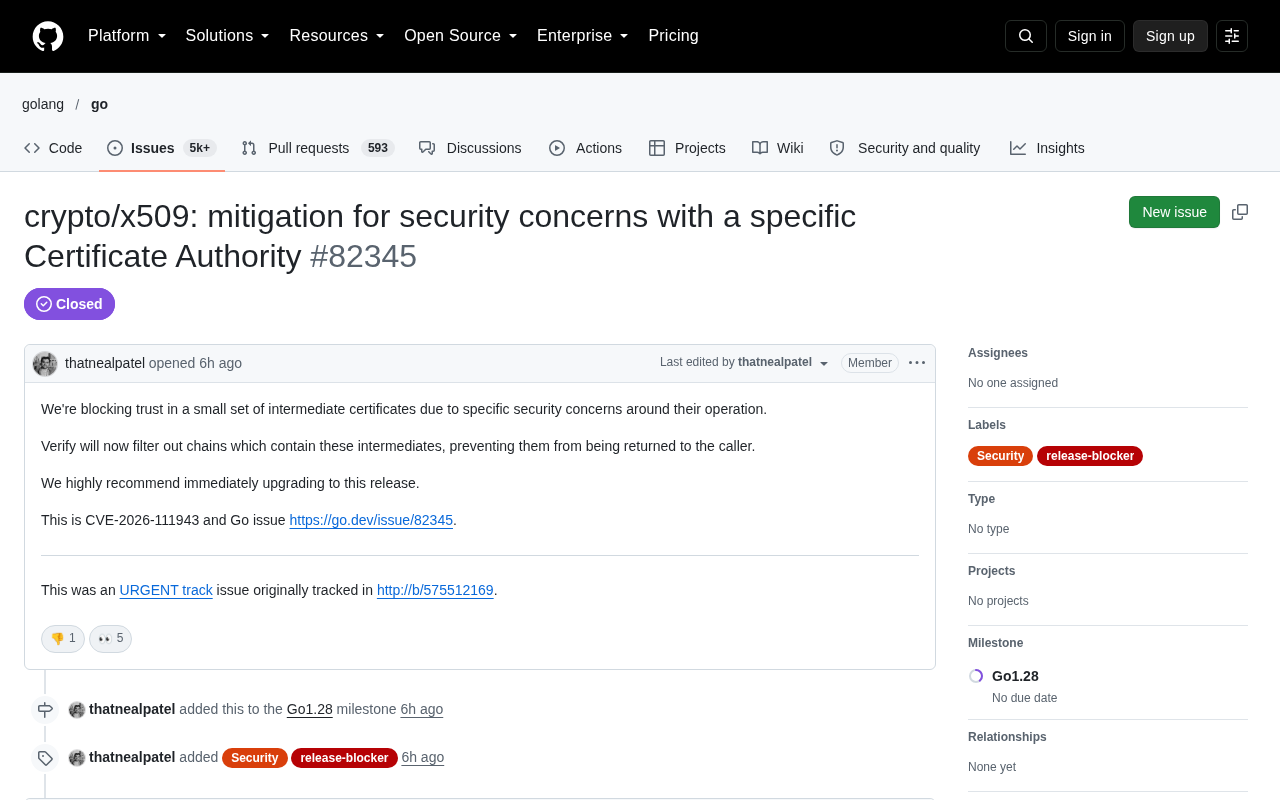
Go's official security policy is updated: future versions will reject certificate chains containing eight specific SPKIs. SPKI is the structure in a certificate that carries public key information, and blacklisting its hash enables precise control over trust boundaries—even if the rest of the chain is legitimate, it will be rejected by crypto/x509 once a public key hash matches. This may cause TLS connections relying on older certificates to fail. Developers should check whether server certificate chains reference the relevant SPKIs, simulate the policy in test environments to verify compatibility, and follow the crypto/x509 changelog. The policy reflects Go's proactive defense philosophy, with security benefits outweighing short-term compatibility costs.
Go's official security policy is getting an important update: future versions will reject certificate chains that contain eight specific SPKIs (Subject Public Key Info). This change stems from a strengthening of the certificate trust model, designed to block potential risks in advance. For developers who rely on the Go standard library for TLS communication, understanding its impact and countermeasures is essential.
What Is SPKI and Why It's Blacklisted
SPKI is the structure within a certificate that carries public key information, and it is typically referenced by trust anchors or policies in hashed form. Adding a specific SPKI to a rejection list means that even if the rest of the certificate chain appears legitimate, as long as the public key hash of any certificate in the chain matches the blacklist, the entire chain will be rejected by Go's crypto/x509 package.
According to the Hacker News discussion, the eight SPKIs involved are associated with known untrusted or security-compromised certificate authorities. Rather than simply relying on CA names or root certificates, the Go team pinpoints the public key level, which allows for more granular control over trust boundaries.
SPKI (Subject Public Key Info) is a standard field in X.509 certificates, following the ASN.1 SubjectPublicKeyInfo structure, and contains the public key algorithm identifier and the public key itself. In trust policies, the full SPKI is usually not stored directly; instead, its hash (such as SHA-256) is used as a fixed identifier for the public key, a technique known as "public key pinning." When validating a certificate chain, Go's crypto/x509 package computes the SPKI hash of each certificate in the chain and compares it against a built-in blacklist, terminating validation upon a match. This rejection mechanism based on public key hashes is more precise than rejection based on CA names or root certificates, because a single CA may issue certificates with multiple different public keys, and attackers may also abuse certificates through cross-signing or other means. By pinning SPKI hashes, Go can proactively block known-risky public keys without relying on external trust stores—even if the CA that owns those public keys is still trusted in the system root certificate store.
Practical Impact on Developers
The most direct impact is this: when using the Go standard library to initiate TLS connections or validate certificate chains, if the peer's certificate chain contains any of these eight SPKIs, validation will fail and return an error. This may interrupt service calls that depend on older certificates.
Developers need to check whether their own server certificate chains reference the relevant SPKIs. For client programs, it is advisable to simulate this policy in a test environment to confirm compatibility with critical third-party services. If incompatibilities are found, contact the certificate provider to update the certificate chain.
During certificate chain validation, Go's crypto/x509 package starts from the end-entity certificate and builds and validates upward level by level to a trusted root certificate. Validation includes signature checks, validity period checks, name constraints, and trust chain construction. When the SPKI hash of any certificate in the chain matches the rejection list, validation fails immediately and returns an x509.CertificateInvalidError or similar error, and the error message usually indicates the reason the certificate was rejected. This failure is deterministic and does not depend on the operating system's root certificate store, because Go maintains its own independent trust logic. When developers use standard library components such as tls.Dial and http.Client without customizing VerifyPeerCertificate or InsecureSkipVerify, they will be directly affected by this policy. Therefore, before upgrading Go versions, it is recommended to simulate this rejection behavior through unit tests or integration tests to ensure that the certificate chains of critical third-party services do not contain rejected SPKIs.
Background and Security Significance
Certificate trust is a cornerstone of internet security. The Go team regularly maintains root certificates and trust policies, and rejecting specific SPKIs this time is an embodiment of proactive defense. Unlike relying solely on the operating system's root certificate store, Go has built-in independent trust logic, enabling it to respond more quickly to risks discovered by the community.
Some voices in the discussion also pointed out that such hardcoded blacklists require continuous maintenance and may cause unexpected interruptions for some users. But the majority view is that the security benefits outweigh the short-term compatibility costs.
The crypto/x509 package in the Go standard library has a built-in trust policy for root certificates and intermediate certificates, independent of the root certificate stores maintained by operating systems or browsers. This design enables Go to respond quickly to violations or security incidents by certificate authorities (CAs) without waiting for operating system updates. Historically, Go has repeatedly removed or rejected specific root certificates by releasing new versions, for example after discovering improper issuance behavior by certain CAs. Rejecting specific SPKIs this time is a continuation of this proactive defense strategy, but pinpointing the public key level means that even if a CA as a whole remains trusted, its specific public key can be individually marked as untrusted. This fine-grained control helps contain the attack surface caused by key compromise or erroneous issuance, but it also requires the Go team to continuously maintain the blacklist and may bring compatibility challenges to users who rely on older certificate chains.
How to Respond and Migration Recommendations
- Review certificate chains: Use
opensslor Go tools to check the public key hash of each certificate in the chain and confirm whether any match the blacklist. - Update dependencies: Ensure that the CA certificates in use are the latest versions and avoid using intermediate certificates that have been flagged.
- Monitor Go release notes: Keep an eye on the crypto/x509 changelog and adjust in a timely manner.
- Validate in a test environment: Add certificate chain validation tests to CI to detect incompatibilities early.
Overall, this change is a microcosm of the continuous hardening of Go's security ecosystem. Developers should view it as an opportunity to improve the security of their own services, rather than merely a compatibility obstacle.
One-line Summary
Go will reject eight specific SPKI certificate chains; developers need to check compatibility.
Paragraph Summary
Go's official security policy has been updated: future versions will reject certificate chains containing eight specific SPKIs. SPKI is the structure in a certificate that carries public key information, and blacklisting its hash enables precise control over trust boundaries—even if the rest of the certificate chain is legitimate, it will be rejected by the crypto/x509 package as soon as a public key hash matches. This may cause TLS connections that rely on older certificates to fail. Developers should check whether server certificate chains reference the relevant SPKIs, simulate the policy in a test environment to verify compatibility, and follow the crypto/x509 changelog. This policy reflects Go's proactive defense philosophy, with security benefits outweighing short-term compatibility costs.
Related articles

JobRunner MCP Server: AI Agents Can Now Fix Failed Java Jobs
JobRunner launches an open-source MCP server enabling AI agents to view cluster status, diagnose failures, and recover Java jobs—incident response from any cloud coding environment or existing agent.

MLAI Digital Launches 9 Security Agents: MCP Server Safeguards the Full Lifecycle of Agentic AI
MLAI Digital launches Security MCP Server with nine built-in specialized security agents covering vulnerability discovery, attack simulation, prompt injection detection, API and infrastructure assessment, and accelerated remediation—embedding security validation across the full Agentic AI lifecycle from development to production.

Running Isaac Lab on H100 GPUs: Exploring Better Approaches
Exploring optimization methods for running Isaac Lab on NVIDIA H100 GPUs, including MIG configuration, mixed precision, TensorRT acceleration, and community experience to improve robotics simulation and reinforcement learning efficiency.