Godot Debugging in Practice: The Fatal Difference Between queue_free and free — All AI Assistants Got It Wrong

Indie dev tracks down a Godot queue_free() vs free() resource cleanup bug that stumped all AI assistants
Indie game developer Lao Wu encountered resource cleanup errors on forced exit in Godot. Three major AI coding assistants all gave incorrect diagnoses, pointing to unreleased CollisionShape shapes. Using command-line debugging tools and pre-embedded logs, Lao Wu discovered the root cause: the thread pool used queue_free() instead of free(). The former relies on the frame loop for deferred execution, and its queue is never consumed during forced exit. Switching to the immediately-executing free() resolved the issue.
Introduction
When mainstream AI coding assistants like DeepSeekAd, Doubao, and Gemini all give the wrong answer, how does an indie game developer rely on solid low-level expertise to track down a deeply hidden resource cleanup bug? This article comes from a real-world debugging session shared by indie game developer Lao Wu, showcasing the complete investigation of a Godot engine bug that stumped him for two days.
The Symptom: Resource Cleanup Anomaly on Forced Exit
While developing a new framework, Lao Wu discovered a peculiar issue: everything worked fine when closing the game via "safe exit," but errors appeared when using "force close." This subtle difference became the key clue for the investigation.
The core issue was an anomaly during system resource cleanup. Forced exit and safe exit follow different lifecycle paths, and the error occurred specifically during forced exit, where certain nodes' resources weren't being properly released.
The Low-Level Difference Between Forced Exit and Safe Exit: At the operating system level, a "safe exit" typically means the program receives an exit signal and completes its full destruction flow — the Godot engine sequentially triggers _exit_tree() callbacks, clears the scene tree, executes all pending operations in the queue_free() queue, and finally releases core engine resources. A "force close" (such as terminating the process via Task Manager or calling OS.kill()) sends a SIGKILL signal directly to the process, forcing the OS to reclaim process memory while completely skipping the engine's normal destruction flow. This is why the same code behaves differently under the two exit methods — the difference isn't in the code logic itself, but in whether the runtime environment gives the engine the opportunity to "clean up."
How All AI Coding Assistants Failed
Lao Wu provided the complete code and error messages to Doubao, DeepSeek, and Gemini separately. The three AI assistants gave strikingly identical answers — all pointing to the CollisionShape's shape property, claiming that objects created with new weren't being reclaimed.
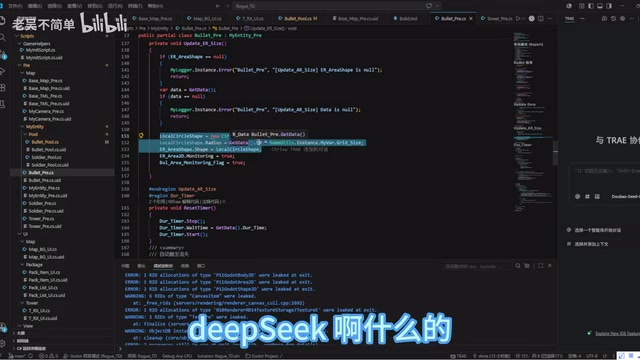
The AIs suggested he manually free the shape on exit, or use various cleanup methods. Lao Wu repeatedly tried these suggestions, even trusting the AI's judgment to make extensive modifications, but the problem persisted.
Why Did the AI Coding Assistants Get It Wrong?
This case exposed a core weakness of current AI coding assistants: insufficient depth in understanding engine-level API semantics. AI can recognize code patterns and give "seemingly reasonable" suggestions, but for issues like distinguishing queue_free() from free() — which requires understanding Godot's engine lifecycle mechanics — AI lacks genuine "understanding."
Looking deeper, current mainstream Large Language Models (LLMs) fundamentally rely on statistical pattern matching based on massive code corpora for code comprehension. For issues like CollisionShape's shape property leaking, the training data contains numerous similar cases of "objects created with new but never reclaimed," so the model gives answers in this direction with extremely high confidence. However, the difference between queue_free() and free() falls under Runtime Semantics, requiring understanding of frame loops, scene tree lifecycles, and other dynamic behaviors rather than static code structure. LLMs lack the ability to truly model program runtime state, which is the fundamental reason they systematically fail on such problems. The fact that three different models gave the same wrong answer reflects a shared bias in training data distribution, not independent judgment.
The Real Bug-Hunting Process
Using Godot's Command-Line Tools for Detailed Logs
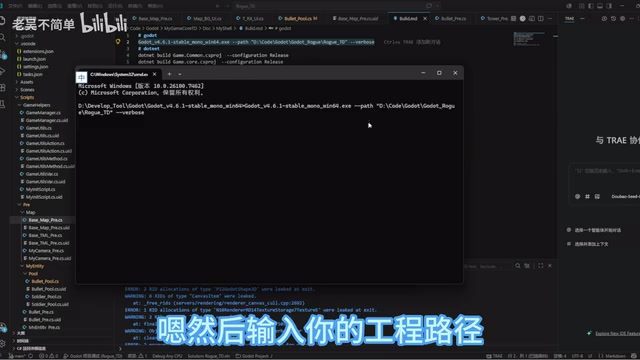
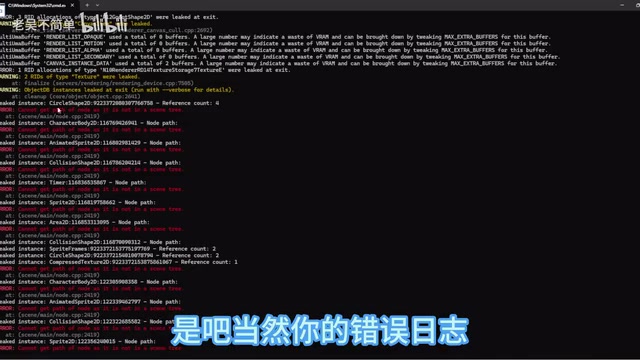
Lao Wu used Godot's built-in command-line debugging tools, running the engine with a specified project path to obtain detailed error log information. Launching Godot via command line (e.g., godot --path /your/project) provides more complete low-level output than the editor's built-in console, including the engine's internal error stacks, resource IDs, and memory address information.
More importantly, Lao Wu had pre-embedded print statements for node names and IDs in his code — this "preventive logging" strategy allowed the abstract IDs in error logs to be mapped to specific business objects. This practice reflects the engineering discipline of a seasoned developer: reserving information channels for debugging before problems arise, rather than scrambling to add logs after errors occur. These logs contained the IDs of the erroring nodes, and combined with key information pre-printed in the code (node names and IDs), he ultimately traced the problem to resource cleanup in the bullet class.
The Key Discovery: The Fatal Difference Between queue_free() and free()
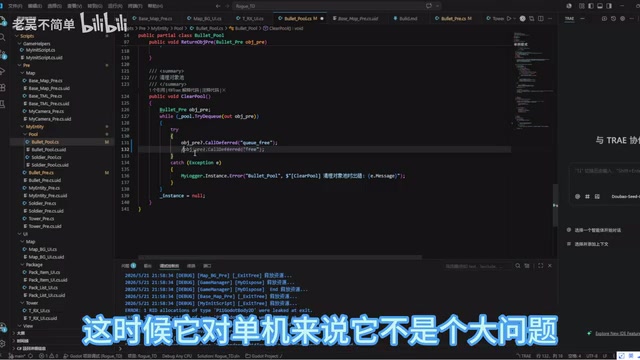
The root cause turned out to be a single line of code:
queue_free(): Waits until the end of the current frame before executing the deletionfree(): Immediately releases the resource from memory
To understand this difference, you need to know Godot's node lifecycle mechanism. Godot uses a SceneTree architecture where all game objects are organized as Nodes. The engine's core run loop is driven by frames, with each frame sequentially executing physics updates, logic updates, and rendering. queue_free() relies on this frame loop mechanism — it adds the deletion request to a pending queue that is uniformly cleaned up after all logic in the current frame has finished executing, thus avoiding null pointer or iterator invalidation issues caused by deleting nodes mid-frame. This design is very safe during normal gameplay, but a forced exit directly interrupts the frame loop, causing queued deletion operations to never be consumed, resulting in resource leaks and errors. free(), on the other hand, executes immediately without depending on the frame loop, so it correctly handles forced exit scenarios.
Resource Management Complexity Under Thread Pool Architecture
Lao Wu's framework uses a Thread Pool to manage frequently created and destroyed objects like bullets. This is a variant of the Object Pool pattern common in game development, designed to reduce the performance overhead of frequent memory allocation. However, the lifecycle of objects in a thread pool is decoupled from the scene tree's frame loop — pooled objects can be returned or destroyed at any time, not necessarily aligned with frame boundaries. Using queue_free() in this architecture is particularly dangerous: an object might be marked for deletion mid-frame, but actual deletion is delayed until frame end, during which other code accessing that object could cause problems; and forced exit turns this delay into a permanent wait. This also illustrates that the choice of resource release strategy in object pool design needs to deeply match the engine's lifecycle mechanism.
The Final Solution
Changing the release method for objects in the thread pool from queue_free() to free() made the problem disappear immediately. A single line of code fixed a bug that had been a headache for two days.
Why Was This Godot Resource Cleanup Bug So Hard to Track Down?
The insidiousness of this bug lies in several aspects:
- Special trigger conditions: Only appears on forced exit; safe exit works perfectly fine
- No apparent functional impact: The system ultimately reclaims resources on program exit anyway, so no issues are visible in the short term
- Understanding barrier in API documentation: Requires carefully reading the Godot official documentation about "executed after the current frame ends"
Related articles
 Expert Opinions
Rethinking Scaling Laws: Parameters Are Not the Only Answer
Deep analysis of Scaling Law evolution from Kaplan to Chinchilla to the MoE era, exploring why blindly stacking parameters is a mistake, and how GLM-5.3 proves scaling has multiple knobs.
When AI Treats Humans as Subagents: Ro…
When AI Treats Humans as Subagents: Role Reversal and Hidden Risks in Human-AI Collaboration
Exploring the paradigm shift where humans become "subagents" in AI Agent architectures. Analyzes human node design in LangChain and AutoGen, and the risks of ceding control and cognitive atrophy.
 Expert Opinions
The Lazy Person's Productivity Theory: Why Being 'Lazy' Actually Drives Peak Performance
Explore the engineering philosophy behind 'lazy people are most productive': how constructive laziness drives automation, AI tools amplify efficiency, and systems thinking eliminates wasted effort.