Godwit: An Open-Source AI-Native Email Client with a Built-In Smart Assistant

Godwit is an open-source desktop email client supporting any IMAP/SMTP, with a built-in AI assistant and selectable models.
Godwit is an open-source desktop email client launched on Product Hunt, positioned as "AI-native": its AI assistant Wit is embedded in the core email workflow from the start, able to read emails, generate summaries, translate, and help draft replies. Unlike most commercial clients that bolt AI onto an existing architecture, Godwit lets users choose the underlying model, allowing them to weigh privacy, cost, and performance themselves. It supports any IMAP/SMTP account, so Gmail, Outlook, and self-hosted mail servers can all connect without lock-in to a specific ecosystem. The project received 69 upvotes, 5 comments, and a 12th-place ranking on Product Hunt, showing some interest but no large-scale discussion yet. Its differentiation lies in the combination of "user-selectable models + generic protocols + open code," making it suitable for technical users who value data sovereignty, though as an early-stage project its stability and AI output quality still need validation.
The email client space has long been dominated by a handful of commercial products, and open-source alternatives often lag behind when it comes to intelligence. Godwit, which recently appeared on Product Hunt, aims to change that — it's an open-source desktop email client that supports any IMAP/SMTP account and comes with a built-in AI assistant called Wit that can read, summarize, translate, and draft emails, with the underlying model selectable by the user.
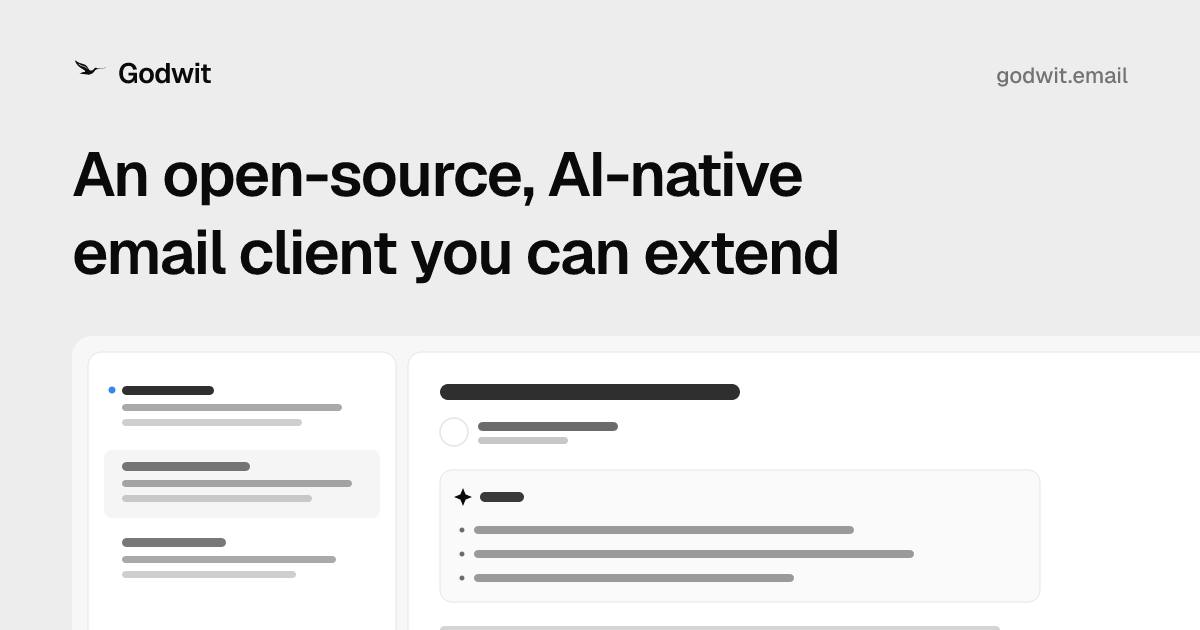
Open source + AI-native: Godwit's positioning
Godwit's core proposition is "AI-native" rather than "AI bolted on." Most traditional email clients graft AI features onto an existing architecture, whereas Godwit treats its AI assistant Wit as a first-class citizen from the ground up. According to its Product Hunt page, Wit can read email content, generate summaries, perform translations, and help draft replies.
Another key differentiator is model choice. Godwit lets users choose the underlying model themselves, which means users can decide who provides the AI capability based on privacy requirements, cost budget, or performance preferences. For users who care about data sovereignty, this is an appealing point.
The distinction between "AI-native" and "AI bolted on" essentially comes down to whether AI participates in the product's core workflow design. The bolted-on approach typically adds a sidebar or button to an existing interface, sends selected text to a model, and displays the result — AI is an optional plugin, and turning it off leaves the product's functionality unaffected. The native approach, by contrast, embeds AI output directly into how information is organized: summary previews in the email list, draft suggestions in the reply box, instant rendering of cross-language emails. The latter places higher demands on context management, latency control, and graceful degradation on failure, and depends more on flexibility in model selection. For users, a good way to judge whether a product is truly "native" is to check whether it remains fully usable when AI is unavailable, and whether AI results appear along the natural path of reading and writing rather than at a separate entry point that requires extra clicks.
Feature breakdown: what Wit can do
Based on the official description, Wit's capabilities cover several high-frequency email scenarios:
- Reading and summarizing: quickly distilling the key points of long emails, reducing the time cost of reading word by word.
- Translation: getting translations directly during cross-language email communication, with no need to switch tools.
- Drafting: helping generate reply drafts based on context, reducing repetitive work.
These features are not rare, but being integrated into an open-source client without being tied to a single model provider is a relatively uncommon combination on the market today.
Compatibility: no lock-in to an email provider
Godwit supports any IMAP/SMTP account, which means Gmail, Outlook, and self-hosted mail servers can all connect. For users of niche email services or company-hosted mailboxes, this generic protocol support is more practical than clients tied to a specific ecosystem.
As a desktop client, Godwit currently targets desktop use cases. Its open-source nature means the code can be audited and self-deployed, which is an important consideration for privacy-sensitive users and organizations when deciding whether to adopt it.
IMAP (Internet Message Access Protocol) and SMTP (Simple Message Transfer Protocol) are the two most fundamental protocols in the email system: the former is responsible for a client reading, syncing, and managing mail from a server (the mail itself is stored on the server, supporting consistent state across multiple devices), while the latter is responsible for delivering mail composed in the client. Both are public IETF standards supported by virtually every email provider. Because the protocols are standardized, a client only needs to implement the protocol stack once to connect to Gmail, Outlook, Fastmail, or even a company's self-hosted Postfix/Dovecot server, without having to develop a separate API adapter layer for each provider. The trade-off is that IMAP/SMTP themselves don't include provider-specific enhanced capabilities (such as Gmail's label system or calendar invitation parsing), so a generic client may offer a less refined experience than an official one — but in exchange it gains broader compatibility and lower migration costs.
Market feedback and observations
On Product Hunt, Godwit received 69 upvotes and 5 comments, ranking 12th. This result shows it has attracted some attention but has yet to generate large-scale discussion. As an early-stage project, its actual experience, stability, and AI output quality still need to be validated by more users.
What's worth watching is the intensifying competition in the niche of open-source AI email clients. Godwit's differentiation lies in the combination of "user-selectable models + generic protocols + open code," rather than any single feature.
Product Hunt rankings and vote counts reflect community enthusiasm on launch day, not long-term adoption. Votes on the platform come mainly from product hunters and early adopters; a vote count in the tens usually means the product made that day's leaderboard but didn't achieve breakout reach, while a low comment count suggests limited in-depth trial and accumulated feedback. When evaluating such early-stage projects, more informative signals include: commit activity and issue response speed in the code repository, whether runnable installers and clear documentation are provided, privacy disclosures regarding data storage and model calls, and the density of discussion in community channels (such as Discord or GitHub Discussions). These indicators are better predictors of whether a project can keep iterating than its rank on launch day.
Who should try it
If you want an email client with AI assistance but aren't willing to hand your email data entirely to a closed commercial product, Godwit offers an option worth evaluating. For developers and technical users, open source means you can review the data-processing logic yourself and even modify it as needed.
Of course, early-stage open-source projects usually come with incomplete features and insufficient documentation. Before switching your primary mailbox, it's advisable to try it with a secondary account first and see whether the accuracy of AI summaries and drafting meets your expectations.
One-line Summary
Godwit is an open-source desktop email client that supports any IMAP/SMTP and includes an AI assistant with selectable models.
Paragraph Summary
Godwit is an open-source desktop email client launched on Product Hunt, positioned as "AI-native": its AI assistant Wit is embedded in the core email workflow from the start, able to read emails, generate summaries, translate, and help draft replies. Unlike most commercial clients that bolt AI onto an existing architecture, Godwit lets users choose the underlying model, allowing them to weigh privacy, cost, and performance themselves. It supports any IMAP/SMTP account — Gmail, Outlook, and self-hosted mail servers can all connect — with no lock-in to a specific ecosystem. The project received 69 upvotes, 5 comments, and a 12th-place ranking on Product Hunt, indicating some interest but no large-scale discussion yet. Its differentiation lies in the combination of "user-selectable models + generic protocols + open code," making it suitable for technical users who value data sovereignty, though as an early-stage project its stability and AI output quality still need validation.
Related articles

DeepSeek Harness in Detail: DIY Your Own Software Like Building with LEGO
What is DeepSeek Harness? Using the metaphor of a car assembly platform, this article explains this equipment system of freely combinable functional modules, analyzes its spatiotemporal composability technical foundation, and shows how ordinary users can DIY exclusive software that does not exist on the market at extremely low cost.

DeepSeek Harness Step-by-Step Tutorial: Master DSH and Its Plugin Ecosystem in 50 Minutes
DeepSeek Harness step-by-step install tutorial: from Node.js environment setup to client installation, covering three plugin install methods — chat, marketplace, and command line — plus practical uses of local file access and plugin extensions.

DeepSeek Open-Sources Super-agent Architecture: A Turning Point for Proactive AI
DeepSeek's open-source Super-agent architecture proposes a new proactive AI paradigm: a central Agent dispatches tasks, sub-Agents execute autonomously, and humans only decide and accept. This article analyzes the watershed between passive and proactive AI, and the implementation logic of proactive Agents in scenarios like short-video lead generation.