Going Against the Grain: Building a Multi-Agent System Where AIs Debate Each Other

A developer built a multi-agent "disagreement system" where AIs maintain opposing positions and argue adversarially instead of collaborating.
This article covers a counter-intuitive multi-agent system design: instead of pursuing collaboration and consensus, the developer deliberately keeps multiple AIs holding different positions, attacking each other's arguments, and remembering questions the other side dodged. The core implementation is a dedicated "debate runtime" — not simple prompt orchestration — that overcomes models' natural tendency toward polite convergence. The developer also proposes modeling the argumentation process as a trackable state flow (claim→evidence→challenge→counterclaim→concession/unresolved) and asks the community whether graphs, event logs, or agent state are the right architectural choice. The first application is an AI panel show, with a long-term goal of letting humans debate AI agents in real time.
From Collaboration to Adversarial Design: A Counter-Intuitive Approach
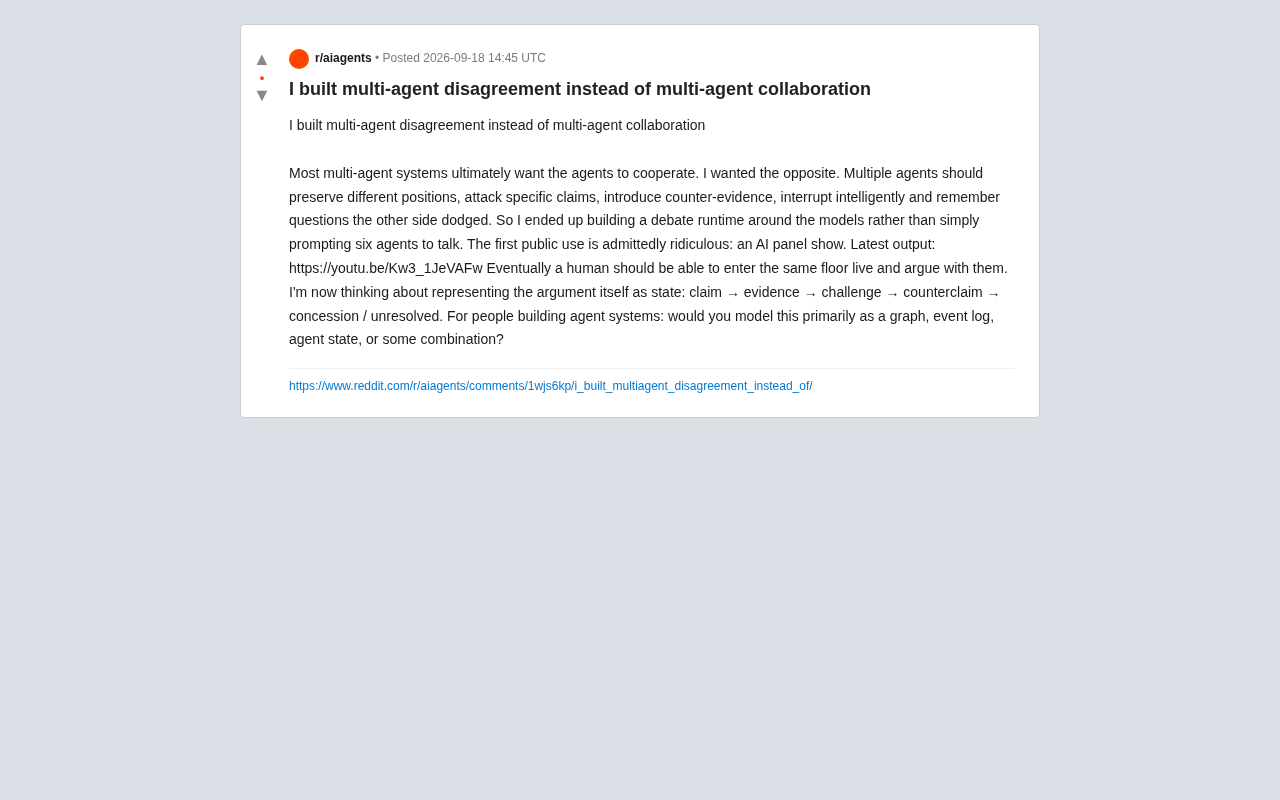
The ultimate goal of most multi-agent systems is to get agents to collaborate and reach consensus. But one developer chose the exact opposite path: rather than having agents align, he wanted them to maintain distinct positions, attack each other's specific arguments, introduce counter-evidence, intelligently interrupt one another, and even remember questions the other side had dodged.
This idea fundamentally challenges the design philosophy behind mainstream multi-agent architectures. Collaborative systems optimize for convergence, while this "disagreement-first" system optimizes for sustained tension and adversarial exchange. In the developer's own words, he wanted "multi-agent disagreement instead of multi-agent collaboration."
The Debate Runtime: More Than Just Prompting Six Agents
What's worth paying attention to is the implementation approach. The developer explicitly noted that he didn't simply "prompt six agents to talk to each other" — instead, he built a debate runtime around the model.
The difference is fundamental. Pure prompt orchestration tends to produce agents that politely agree, converge quickly, and lose their argumentative edge. A dedicated debate runtime, by contrast, enforces position divergence at the system level, manages speaking rights (including interruption mechanics), and tracks unanswered questions. This is closer to designing a low-level protocol for adversarial interaction than relying on models to "do the right thing" on their own.
First Public Application: An AI Panel Show
The first public incarnation of this system is, as the developer himself admits, "kind of absurd" — an AI panel debate show where multiple AI personas each hold their ground and clash with one another. While it has an entertainment dimension, it's also an intuitive test of whether adversarial interaction actually holds up: if the agents just nod along, the show falls flat.
Mainstream multi-agent frameworks like LangGraph, AutoGen, and CrewAI are designed around agents collaborating via task delegation or result handoff, with convergence as an implicit optimization target. Even if you explicitly instruct an agent to "raise objections," the RLHF training baked into the underlying model will push it toward superficial reconciliation after a few turns — because "helpful and harmless" training objectives are fundamentally at odds with sustained adversarial behavior. What a debate runtime has to overcome is precisely this systemic bias toward polite convergence. It needs to enforce position anchoring at the framework level so that individual agents' system prompts aren't softened by accumulating conversation history, while also coordinating competitive speaking rights across multiple agents rather than simple round-robin turns. This makes a debate runtime more like a specialized orchestration layer with an adversarial scheduler than a simple configuration variant of a general-purpose agent framework.
Next Step: Letting Humans Join the Debate
The developer's vision doesn't stop at fully automated AI debates. He envisions a future where humans can enter the same debate arena in real time and argue directly with these AI agents.
This is a significantly more technically demanding goal. Human participation means the system must handle unpredictable input in real time, dynamically adjust the pace of the debate, and keep AI agents consistent in their positions and targeted in their rebuttals when facing human challenges. It demands a debate runtime that is both robust and highly responsive.
The Core Challenge: Modeling the Argument Itself as State
The most technically substantive part of the discussion is the developer's open question: how do you represent the argumentation process itself as manageable state?
He proposes a state transition model for arguments:
claim → evidence → challenge → counterclaim → concession / unresolved
This chain cleanly maps the lifecycle of a debate: one side makes a claim, provides evidence, the other side issues a challenge, responds with a counterclaim, and the exchange either ends in a concession or remains unresolved. Structuring this process is the key prerequisite for making the system "remember who dodged what question."
Graph, Event Log, or Agent State?
For actually implementing this model, the developer posed a concrete architecture question to the community: should the primary representation be a graph, an event log, agent state, or some combination?
Each approach has its strengths:
- Graph structures naturally express citation, rebuttal, and support relationships between arguments, making it easy to visualize the topology of "which counterclaim targets which claim"
- Event logs excel at recording every step of the debate in chronological order, making it straightforward to trace back to "when a particular question was avoided"
- Agent state focuses on each agent's current position, pending challenges, and working memory
Given the nature of debate, all three will likely need to be combined: graphs for the logical structure of argumentation, event logs for the complete timeline, and agent state for each party's positional memory. This kind of combination is a common engineering trade-off in complex agent systems.
These three data structures each have well-established application backgrounds in knowledge representation. Graph structures have been widely used in argument mining research to represent support and attack relationships between claims — a representative format is the AIF (Argument Interchange Format) ontology, where nodes correspond to propositions and directed edges correspond to "support" or "attack" relations. This structure lends itself to reachability analysis, such as determining whether a core claim has been fully rebutted. Event logs are central to the Event Sourcing architectural pattern, where system state is derived from an immutable sequence of events, natively supporting time-travel debugging and full auditing — extremely well-suited for queries like "at which round was a given question evaded." Agent state is more operational in nature, analogous to the belief store in a Belief-Desire-Intention (BDI) model, recording each agent's active beliefs at the current moment rather than the full history. The three differ in granularity and query semantics; when used in combination, the typical approach treats the event log as the "source of truth" while the graph and agent state serve as derived read models, balancing write costs against query efficiency.
Why "Disagreement" Deserves to Be Taken Seriously
The value of this project may lie less in a somewhat absurd AI panel show and more in the question it raises — one that mainstream approaches have largely ignored: must agent systems always pursue consensus?
In reality, high-quality decisions often emerge from thorough adversarial challenge, not premature alignment. A system that can sustain structured disagreement, track unresolved issues, and let humans enter the fray could find genuine application in debate training, stress-testing arguments, and complex decision simulation. Modeling the argumentation process itself as trackable state is one attempt to move AI from "generating text" toward "participating in discourse."
Related articles

Chain of Thought Isn't Just for AI: How Humans Can Use CoT to Improve Thinking Quality
Chain of Thought isn't just a prompt trick for large models. Starting from a Hacker News discussion, this article analyzes why CoT works for human thinking too, breaks down actionable ways to transfer it, and highlights the key differences between human CoT and machine CoT.
Cloudflare Teams Up with OpenAI: Closi…
Cloudflare Teams Up with OpenAI: Closing the Loop from Vulnerability Discovery to Defense with AI
Cloudflare uses OpenAI Daybreak to investigate security vulnerabilities and generate reviewable remediation plans, while developers use Codex to boost coding efficiency and quality.

Orca Multi-Agent Orchestration in Practice: A Guide to Parallel Collaboration with Claude and Codex
Orca is Stable AI's free open-source agent workbench supporting 34 agents like Claude Code and Codex in parallel. Learn its Git worktree isolation, multi-model orchestration, and mobile management.