Goldman Sachs Revokes Claude Code: The Battle Over Permission Boundaries for AI Coding Tools

Goldman Sachs revoking front-office AI coding permissions reflects deep trade-offs in risk, cost, and governance for agentic tools.
Goldman Sachs narrowed access to Claude Code and GitHub Copilot from traders and bankers to engineers and the strats group—a clear policy reversal. The official rationale is a combined trade-off between productivity and risk management, but no data was published. The article argues the actual drivers include agentic tools acting autonomously rather than merely advising, the review and hardening burden of every citizen developer prototype, regulatory obligations like model risk management and record-keeping, and cost discipline from token consumption. It contrasts Revolut's self-hosted open-source model route, noting its cost advantages warrant caution but its sandbox, allowlist, and human-in-the-loop guardrails are worth borrowing. The conclusion: enterprises should distinguish between people who need answers and people who need actions, and provide the front office a governed fast channel to avoid shadow technology problems.
Why Did Goldman Sachs Revoke Traders' AI Coding Permissions?
According to Bloomberg, Goldman Sachs has notified its traders and bankers that they can no longer use Anthropic's Claude Code or Microsoft's GitHub Copilot at work; these two tools are now restricted to engineers. The internal guidance was updated in October, and Bloomberg reported it on November 2. For several months prior, front-office staff had been allowed to use these coding assistants—this marks a clear policy reversal, not a consistent rule.
Goldman Sachs has roughly 12,000 engineers who retain access, and the cross-functional group known as "strats"—spanning trading, quantitative research, and software engineering—is also exempt from the new rules. Most of the remaining front-office staff have lost access. The dividing line is clear: people whose roles involve writing software, or who sit between the trading desk and the codebase, keep the assistants; bankers building small tools on their own no longer have them.
According to people familiar with the matter, traders had used these tools to monitor client trading flows, model market movements and positions, and even generate written and graphical content. One observer who has long maintained production systems noted that the phrase "traders building tools on their own to monitor client flows" is enough to make risk departments nervous. The official explanation from a Goldman Sachs spokesperson is that after evaluating factors such as productivity and risk management during the experimental period, the bank decided to put the tools in the hands of those best positioned to use them over the long term.
The Trade-off Between Productivity and Risk: No Public Scorecard
Goldman Sachs has not published any data, so we cannot know for certain whether traders were insufficiently productive; we can only confirm that productivity and risk were weighed together, and the final answer was to narrow access. This stands in stark contrast to a few months earlier, when the bank's CIO Marco Argenti publicly praised non-technical employees' "vibe programming"—the vision then was that bankers could use AI tools to build rough prototypes, then hand them to engineers for cleanup and hardening.
Sounds great, but every handoff means an engineer takes over software they did not design and whose libraries they did not choose, and becomes permanently responsible for testing and support. The hidden cost is this: when 12,000 engineers plus thousands of front-office staff are all producing prototypes, the bottleneck is no longer writing code but reviewing, hardening, and deciding what is worth keeping. On Monday morning someone shows up with a weekend-built spreadsheet replacement that touches real client data, and then the questions become: does it go through change control, who audits it, who gets woken up at 4 a.m. when it goes down. In a bank, these questions also connect to regulators.

Banks have specific obligations around model risk management, data handling, and record-keeping. A coding agent that can read files, run commands, and connect to internal systems is a completely different animal from a chatbot that answers questions. A chat assistant gives you text, and a human decides what to do; an agentic coding tool takes actions on the machine. When the overseer cannot read the code, the human in the loop is more of a bystander than a supervisor.
Model Risk Management is a core concept in the banking regulatory system, originating from regulatory guidance such as the Federal Reserve's SR 11-7, which requires banks to identify, validate, continuously monitor, and govern all quantitative models they use. Here, "model" refers not only to traditional credit scoring or risk pricing models but also to any algorithmic tool used for decision-making. When a trader uses Claude Code to build a small tool to monitor client trading flows, that tool may technically constitute a "model" that needs to be added to the model inventory, independently validated, and documented with assumptions and limitations. The problem is that traditional model risk management processes are designed for a small number of large, expert-built models; faced with hundreds of prototypes rapidly built by non-technical staff, validation resources simply cannot cover them. This is the deeper regulatory logic behind Goldman Sachs narrowing access: it is not that the tools themselves are problematic, but that the governance framework cannot scale at the same speed.
Agentic Coding Tools differ from ordinary code completion tools in their autonomy and capacity for action. Early GitHub Copilot was mainly inline completion, with humans maintaining clear control at every step; tools like Claude Code can autonomously read files, execute terminal commands, modify codebases, run tests, and iterate based on results. This "perceive-decide-act" loop means the tool can change system state without real-time human confirmation. In a regulated financial environment, this raises several concrete questions: are actions auditable, can commands be rolled back, and might the tool access unauthorized data sources. Revolut's sandbox-plus-allowlist approach is precisely an engineering response to these questions—constraining the agent's action space to a pre-approved set of commands, preserving autonomy while limiting blast radius. Understanding this distinction is key to understanding Goldman Sachs' decision: what is banned is not "AI assistance" but "AI acting autonomously when no one can read what it is doing."
Cost Discipline and an Alternative: Revolut's Self-Hosted Route
Agentic tools are not cheap to run: reading large contexts, looping, retrying—a curious trader exploring ideas can quickly burn through expensive tokens. Bloomberg noted that JPMorgan Chase said in July that it wanted employees to match models to tasks, particularly not using expensive models for simple work like summarizing analyst reports. This is a cost-discipline message dressed in productivity clothing.
Another fintech company went in the opposite direction. According to a conference talk summarized by Startup Hub, Revolut reportedly migrated about 2,000 engineers from usage-based commercial models to self-hosted open-source models, running GLM 4.5 on 56 NVIDIA B200 chips, and claimed a significant drop in AI coding costs. The talk also mentioned notable improvements in coding time and clear reductions in delivery cycles. These numbers should be treated with caution: a conference talk is not an audited financial statement, and the cost figures reportedly exclude cloud spending, staff time, and observability—which are precisely where the real money goes.

What is interesting is the guardrails Revolut described: every agent run has a human in the loop, inside a sandbox with an allowlist that permits commands like adding files to version control and blocks broader destructive commands. This is real engineering discipline. Revolut gave the tools to engineers who can read the agent's behavior, and Goldman Sachs has just made the same decision. Neither company said that bankers without software training should run autonomous agents against internal systems.
Self-hosted open-source models refer to enterprises deploying model weights on their own infrastructure rather than calling commercial models via API on a per-token basis. GLM 4.5 is an open-source large language model released by Zhipu AI that can run on proprietary GPUs. The economic logic of this route is: upfront fixed costs (GPU purchase or rental, operations staff, inference optimization), after which marginal costs are diluted as usage increases, making it suitable for engineering teams with high call volumes. But hidden costs cannot be ignored: model inference requires dedicated MLOps capabilities, and optimizing GPU utilization, upgrading model versions, and failover are all ongoing engineering burdens. In addition, the performance of self-hosted models typically lags behind frontier commercial models, potentially requiring more retries on complex coding tasks and thus raising actual consumption. Whether Revolut's claimed cost reduction holds depends on whether its call volume is large enough to amortize fixed investment, and how large the excluded cloud and labor costs are—which is precisely why conference talk data is hard to take at face value.
The Shadow Technology Problem and Governance Paths
Some of traders' work—modeling positions, tracking client flows—is real. If you take away the tools without providing safer alternatives, you only push them back to spreadsheets and email—a classic shadow technology problem. Ban useful tools without providing a compliant path, and people will not stop needing that capability; they will quietly find worse versions on personal laptops, with even lower visibility.
The wise move is to give the front office a governed channel: internal assistants, request-based builds (engineers working with bankers), but it must be faster than submitting a ticket and waiting a month. The practical lesson for technical teams is: distinguish who is allowed to let AI take actions, not just give answers. These are two fundamentally different risk categories, and most companies still lump them into a single bucket called "AI tools."

Goldman Sachs executive John Waldron earlier this year described the bank as a "human assembly line" suitable for automation. Restricting access does not mean slowing automation; it means wanting automation built by experts. If the bank believes AI can amplify the capabilities of skilled engineers, then engineers become force multipliers, and traders become clients describing problems rather than people writing fixes. For two years the narrative has been that AI makes technical skills less important; Goldman Sachs is quietly betting the opposite: technical skills are what make these tools safe enough and valuable enough to deploy at scale. The hard part of software was never typing; it is understanding systems, failure modes, and the people who depend on them.
Shadow IT refers to software, tools, or services that employees use without IT department approval. In the AI era, this problem is evolving: in the past it was employees privately using cloud storage or collaboration tools; now it is employees calling large models with personal accounts, running coding agents locally, and pasting client data into unapproved chat interfaces. The risks of shadow AI are more insidious than traditional shadow IT—data flows are opaque, output quality is unaudited, and model behavior is not reproducible. The classic consequence of banning tools without providing alternatives is that demand does not disappear; it goes underground, with lower visibility and harder governance. The lesson from the Goldman Sachs case is that governance path design must consider "friction cost": if the compliant channel is slower and more cumbersome than working around it, employees will choose the workaround. The value of governed internal assistants and fast request-based build channels lies not only in safety but in the fact that they must be "fast enough" to truly replace shadow channels.
Broader Lessons for Enterprises
Goldman Sachs is not an AI skeptic; it builds its own internal assistants and has defined models from OpenAI, Anthropic, and Google. The company is not retreating from technology but deciding which version of technology belongs in whose hands. Goldman Sachs is also the lead underwriter for Anthropic's planned IPO—helping sell the company to investors while telling most employees they cannot use its flagship product, but these two judgments can be separated.
For CIOs, what is needed is an honest self-assessment: who is using agentic tools, touching what, at what cost; then distinguish between people who need answers and people who need actions, and give each group a governed path that is genuinely simpler than working around it. Also measure engineers' review burden—if every citizen developer prototype piles into the queue, you are not saving engineering time but shifting it, and that cost must appear on the same sheet as product cost.
The reversal by Goldman Sachs' CIO is not evidence that AI coding tools have failed, but rather a decision by one of the world's most sophisticated buyers, after seeing the full bill including risk and support, that access must follow responsibility.
One-line Summary
Goldman Sachs revoking front-office AI coding permissions reflects the deep trade-offs of agentic tools in risk, cost, and governance.
Paragraph Summary
Goldman Sachs narrowed access to Claude Code and GitHub Copilot from traders and bankers to engineers and the strats group—a clear policy reversal. The official rationale is a combined trade-off between productivity and risk management, but no data was published. The article argues that the actual drivers include: agentic tools can act autonomously rather than merely give advice, and when overseers cannot read the code, the human in the loop is effectively a bystander; every citizen developer prototype creates review and hardening burdens; banks face regulatory obligations such as model risk management and record-keeping; and token consumption brings cost discipline. The article contrasts Revolut's self-hosted open-source model route, noting that its cost advantages should be treated with caution, but its engineering guardrails—sandboxing, allowlists, and human in the loop—are worth borrowing. The ultimate conclusion is that enterprises should distinguish between people who need answers and people who need actions, and provide the front office with a governed fast channel to avoid shadow technology problems.
Related articles
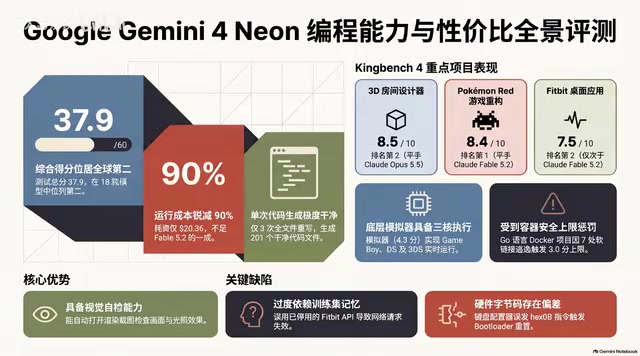
Gemini 4 Neon Hands-On: Value King or Confident Catastrophe?
Gemini 4 Neon review: 1M-token context, four thinking levels, 201 files in one KingBench4 pass at one-tenth Fable 5.2's cost—but it hallucinates fake data, leaves 7 symlink escapes, and bricks keyboards.

Google Gemini 4 Neon Hands-On: 6 3D Works That Impress and Fail
Hands-on with Google Gemini 4 Neon on a 3060 laptop: 6 3D works tested. Sunshower Fishing Harbor and mechanical keyboard impress; soft-body physics and faces fall short.
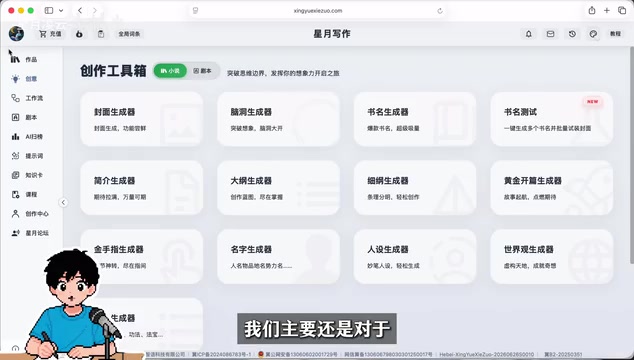
Gemini 4 Neo Web Novel Writing Test: Faint AI Flavor, Textured Dialogue
Bilibili creator's first-look review of Gemini 4 Neo for Chinese web novel writing: testing a Three Kingdoms transmigration opening with faint AI flavor, emotionally textured dialogue, and strong crisis building, plus comparison of 4A/4H/4C models and full workflow demos.