Goodbye Goldfish Memory: A 2026 Review and Selection Guide for Standalone AI Memory Tools

A Reddit discussion reveals the drivers, three hurdles, and selection framework behind the rise of standalone AI memory tools.
Based on a Reddit post about "AI memory tools that sit outside the chatbot," the article notes that built-in memory is locked into a single product ecosystem, causing memory to fail when users switch models and driving demand for a standalone memory layer callable by multiple AIs. It categorizes standalone memory tools into general-purpose memory layers and vertical-scenario tools, and outlines three key hurdles: cross-model compatibility requiring stable interfaces and differentiated memory injection strategies; memory writing and forgetting strategies determining quality, with accuracy more important than capacity; and privacy and data ownership involving encryption, export, and deletion mechanisms. For selection, it recommends evaluating use case, integration cost, and data export mechanisms. It concludes that the category is still in an early chaotic stage—ordinary users can wait and see, while heavy multi-tool users should pay attention early.
Large models' context windows keep getting bigger, but the pain point of "forget everything once the chat ends" hasn't really gone away. A Reddit user kicked off a round of testing and discussion on "AI memory tools that are independent of chatbots," and the core demand is straightforward: they want memory to break free from any single product's session window and become a standalone layer that multiple AIs can call on. What lies behind this is users' awakening sense of "memory sovereignty"—the reluctance to reintroduce themselves from scratch every time they switch assistants.
Why the "standalone memory layer" suddenly became a must-have
Over the past year, mainstream chatbots have rolled out built-in memory features one after another, but built-in solutions have an inherent limitation: memory is locked inside a single product ecosystem. The preferences, project background, and writing style you accumulated with assistant A become completely useless when you switch to assistant B. For heavy users who use multiple AI tools simultaneously, this sense of fragmentation is very obvious.
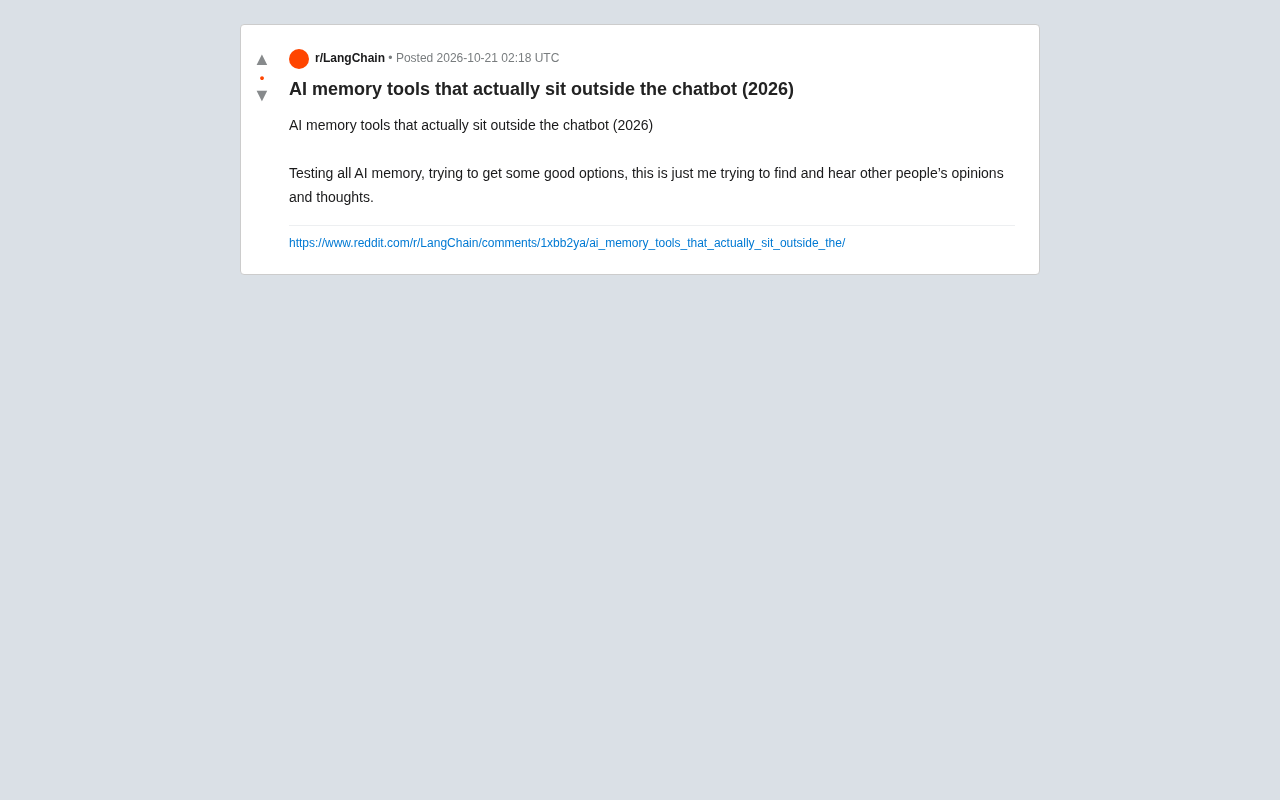
This is exactly the starting point of the original Reddit post. The poster explicitly stated that this round of testing was not intended to recommend purchases, but to collect real experiences and hear what others think. This kind of "crowdsourced selection" precisely shows that the market hasn't reached a consensus yet—standalone memory tools are still in an early, chaotic stage, and no single product can cover everything.
From a technical route perspective, standalone memory tools roughly fall into two categories: one is general-purpose memory layers that connect to different models via API and are responsible for storing and retrieving user profiles and historical facts; the other is vertical-scenario tools, such as solutions focused on code project context or research material management. The trade-off between the two lies in the balance between generality and depth.
What hurdles standalone memory tools must clear
Pulling memory out of the chat window sounds simple, but in practice it has to solve problems at three levels.
Cross-model compatibility is the first threshold
If a standalone memory layer only serves one model, then it's essentially no different from built-in memory. What's truly valuable is a memory service that can be called by multiple LLMs. This requires the tool to provide a stable interface and, during retrieval, to inject memory into the context in a format the model can understand. Different models vary greatly in context window size and instruction-following ability, so the memory injection strategy must be adjusted accordingly.
Context Window is the prerequisite for understanding memory injection strategy. It refers to the total number of tokens a model can process in a single inference, including input prompts and output content. Window sizes vary dramatically across models, ranging from a few thousand tokens to over a million. After retrieving relevant historical facts, the memory layer needs to stitch this content into the prompt, which directly consumes window quota. Models with small windows must inject memory more concisely, and may even need to summarize and compress it; models with large windows can retain more original context. Therefore, when the same set of memory data is directed at different models, the injection format and trimming strategy must be designed separately—otherwise you either waste the window or squeeze out key information from the current conversation.
Writing and forgetting memory are equally important
A good memory tool doesn't just "remember"—it "remembers correctly." What should be stored, what should be discarded, and how conflicting information should be merged—these strategies determine memory quality. If you stuff everything in, noise will drown out the signal during retrieval; if you filter too aggressively, you'll lose key background. Many users in the original discussion were concerned about exactly this—the accuracy of memory deserves more attention than its capacity.
Retrieval-Augmented Generation (RAG) is the technical paradigm most commonly borrowed by standalone memory layers: user historical facts and preferences are converted into vectors and stored in a vector database, and during conversation the most relevant entries are retrieved by semantic similarity and then injected into the model context. This process determines the upper limit of a memory tool's retrieval quality. But RAG itself doesn't solve the problem on the writing side—what content is worth vectorizing, and which sentences in multi-turn conversations represent stable preferences rather than temporary emotions, still require additional extraction and deduplication logic. In addition, vector similarity retrieval tends to recall old memories that are semantically similar but factually conflicting, so conflict resolution and time-decay mechanisms are often the key difference between memory tools and ordinary RAG applications.
Privacy and data ownership
Memory often contains personal preferences, work content, and even sensitive information. Being independent of chatbots means data is stored in third-party services, so users will naturally care more about encryption methods, export capabilities, and deletion mechanisms. This is also an aspect that is easily overlooked during selection but must never be skipped.
Memory Sovereignty refers to the user's control over their own AI memory data, including where the data is stored, who can read it, and whether it can be migrated and completely deleted. When memory moves from inside a chat product to a third-party service, this concept becomes concrete: users need to confirm whether the provider supports end-to-end encryption, whether it offers structured export (such as JSON or standard formats), and whether deletion requests truly remove backups. A lack of export capability means migration costs are artificially raised and users are effectively locked in; a lack of deletion transparency may allow sensitive information to linger for a long time. When evaluating standalone memory tools, these mechanisms reflect a provider's attitude toward user data more than a feature list does.
A practical judgment framework for selection
Combining the direction of the original post's discussion, a pragmatic evaluation approach can be laid out instead of blindly chasing the newest thing.
First, clarify your own use case: if you mainly work within a single ecosystem, built-in memory may be enough; if you switch between multiple models, or want memory to follow the project, then standalone tools are worth the investment. Then evaluate the integration cost, including API stability, documentation quality, and whether additional development is required. Finally, look at the exit mechanism—whether memory data can be fully exported determines whether you'll be held hostage by a single provider.
The value of posts like this on Reddit that "ask for recommendations and opinions" lies in presenting real-world pitfalls, not the feature lists on official marketing pages. The poster also emphasized that this is just a process of collecting opinions, and conclusions should be judged by users according to their actual needs.
Final thoughts
Standalone AI memory tools currently feel more like a category in the making than a mature market. Their real significance is not replacing chatbots' memory features, but turning "memory" into an asset that users can carry, migrate, and control. For users who frequently switch AI tools, it's reasonable to start paying attention to this direction now; but for ordinary users, waiting until the ecosystem becomes clearer before choosing is not too late.
Reference source: Reddit community discussion post "AI memory tools that actually sit outside the chatbot (2026)"; the content is personal testing and opinion solicitation, not a commercial review.
Related articles

JobRunner MCP Server: AI Agents Can Now Fix Failed Java Jobs
JobRunner launches an open-source MCP server enabling AI agents to view cluster status, diagnose failures, and recover Java jobs—incident response from any cloud coding environment or existing agent.

MLAI Digital Launches 9 Security Agents: MCP Server Safeguards the Full Lifecycle of Agentic AI
MLAI Digital launches Security MCP Server with nine built-in specialized security agents covering vulnerability discovery, attack simulation, prompt injection detection, API and infrastructure assessment, and accelerated remediation—embedding security validation across the full Agentic AI lifecycle from development to production.

Running Isaac Lab on H100 GPUs: Exploring Better Approaches
Exploring optimization methods for running Isaac Lab on NVIDIA H100 GPUs, including MIG configuration, mixed precision, TensorRT acceleration, and community experience to improve robotics simulation and reinforcement learning efficiency.