Google AI Development Course Day 1 Deep Dive: From Vibe Coding to Agentic Engineering

Google's Day 1 AI course builds a complete mental model from Vibe Coding to Agentic Engineering.
This article distills the core content of Day 1 from Google's new five-day AI development course, structured around four reinforcing concepts. Vibe Coding and Agentic Engineering form a spectrum measured by validation density and human judgment — no Tests or Evals means you're still in Vibe Coding territory. Context Engineering matters more than Prompt Engineering, using six context types split into Static and Dynamic, with Agent Skills enabling Progressive Disclosure to deliver multi-domain capability at minimal token cost. The correct Agent formula is Model + Harness — most failures stem from configuration, not the model itself. Finally, the Factory Model redefines the developer's role, and Token Economics frames early engineering investment as a CAPEX that lowers long-term OPEX.
When 85% of professional developers are already using AI Coding Agents and 41% of new code is written by AI, the industry still can't agree on what terms like "Vibe Coding" and "Agentic Engineering" actually mean. Some see Vibe Coding as the future; others dismiss it as a garbage-code factory. Google's recently launched five-day AI development course is the first to formalize the consensus the industry has been converging on into a proper framework — and Day 1 alone is 51 pages. This article breaks down the core content from Day 1, helping you build a complete mental model for AI-driven development.
Vibe Coding vs. Agentic Engineering: Not a Switch, But a Spectrum
Vibe Coding is a term coined by Karpathy to describe a fundamentally new way of programming: go entirely by feel, tell the AI what you want in natural language, never look at the code, and when errors pop up, just paste the error message back to the AI and let it fix itself. The term went viral because it precisely captured a style of AI-assisted development that many people were already doing — it just never had a name.
But virality comes with a cost: overuse. Does a senior engineer using AI to build a well-specified feature count as Vibe Coding? Does a team running Agents to execute a planned architecture? Once a term covers everything, it explains nothing. So Karpathy added another term — Agentic Engineering — to describe the disciplined end of the spectrum.
Google's course opens with a core claim: these two aren't a binary choice, they're a spectrum. That spectrum has three positions: Vibe Coding, Structured AI-Assisted Coding, and Agentic Engineering. What determines where you fall isn't whether you use AI — it's how much structure, validation, and human judgment surrounds the AI's output.

The course slides include a comparison table: on intent specification, Vibe Coding uses casual natural-language prompts while Agentic Engineering uses formal Specs, architecture documents, and Memory Files; on validation, the former relies on "looks like it works" while the latter uses automated tests, CI/CD Gates, and LLM Judges; on error handling, the former pastes errors back to the AI, while the latter has the Agent self-diagnose within defined boundaries, with humans only handling architectural-level issues.
There's no right or wrong position on the spectrum — it depends on the context and the cost of failure. Vibe Coding a weekend prototype is perfectly reasonable; if it breaks, you start over and no one gets hurt. But a Production API handling financial transactions demands Agentic Engineering. The biggest dividing line between the two extremes is validation — Tests validate deterministic behavior, Evals validate non-deterministic behavior (did the Agent take the right path? did it pick the right tools? did the output meet the bar?). Google is unequivocal: without both of these, no matter how polished your prompts are, you're still doing Vibe Coding.
Vibe Coding was first introduced by Andrej Karpathy — former OpenAI research scientist and former head of Tesla Autopilot — on X in February 2025. Karpathy described it as a style of programming where you're "fully leaning into the vibes, forgetting that the code even exists" — the developer's role shifts from writing code to describing intent, letting AI handle all implementation details. The concept spread quickly, partly because it captured the experience of countless non-professional developers who had been using ChatGPT, Claude, and similar tools to "build working things by feel."
CI/CD Gates (Continuous Integration/Continuous Delivery gates) are a key validation mechanism on the Agentic Engineering end: before code is merged or deployed, automated checks run — tests, static analysis, security scans — and only when all pass does the process advance. LLM Judges are an emerging evaluation method that uses another language model to assess the quality of AI-generated output, commonly used in scenarios where hard rules can't determine correctness — such as "does the Agent's response match the expected style" or "is the tool-calling sequence reasonable."
Context Engineering: The Skill That Matters More Than Prompt Engineering
If you want to move toward the Agentic Engineering end of the spectrum, the skill to develop isn't writing prettier prompts — it's Context Engineering. Think of it as onboarding a new employee: when someone joins, you don't just hand them a single sentence saying "build the feature." You give them the task, the project background, and the team's standards. AI is the same: the quality of its code output is strongly correlated with the quality of the context you provide.
Context breaks down into six types: Instructions (defining the role and boundaries), Knowledge (domain expertise), Memory (short-term and long-term state), Examples (behavioral demonstrations), Tools (callable tool definitions), and Guardrails (hard constraints). These fall into two categories: Static Context is loaded every time — reliable but expensive, because it burns tokens regardless of the question — while Dynamic Context is loaded on demand — cheaper and more scalable, but with the risk that it doesn't get fetched when it should.
Deciding what goes in Static and what goes in Dynamic is itself a critical architectural decision — one that should be reviewed and version-controlled just like code. The most powerful pattern for managing Dynamic Context is Agent Skills: rather than cramming all specialized knowledge into the System Prompt, keep the Agent general-purpose by default and have it load a Skill when needed to become a task-specific expert. This mechanism is called Progressive Disclosure: when the Agent starts, it only sees one line of Metadata per Skill, and only loads the full instructions when the task matches. The result is an Agent that can carry dozens of specialized capabilities while only paying the token cost for the one currently in use.
Two things about Skills are worth emphasizing: first, Skills compound — build one you use every day, iterate on it through use, and a month later it'll be far more capable than when you started. Second, Skills should be written to be Agent-friendly and human-maintainable. Don't write a Skill that's ten thousand lines long; if the output goes sideways, you'll never find which piece of it led the Agent astray.
Prompt Engineering refers to the practice of carefully crafting input text to guide language models toward more desirable outputs, and was once considered the most important new skill of the AI era. However, as Agent systems grow in complexity, the impact of any single prompt's quality on overall output diminishes — failures in a multi-step Agent task are more often caused by missing context or unclear tool definitions than by poorly worded sentences. Context Engineering shifts focus from "the input in a single conversation" to "everything the system sees across the entire task lifecycle," including System Prompts, memory management, tool documentation, example selection, and token budget allocation. It's a systemic discipline closer to software architecture than prompt craft.
MCP (Model Context Protocol) is an open protocol introduced by Anthropic in late 2024, designed to standardize how AI models connect to external tools and data sources. It's one of the key infrastructure pieces that makes Dynamic Context and Agent Skills practical in real-world deployments.
The Factory Model: A Developer's Output Is No Longer Code
The entire software development lifecycle (SDLC) is being compressed by AI, but the compression is wildly uneven. Implementation (writing code) has gone from weeks to hours, but requirements gathering, architectural decisions, and quality validation still largely run at human speed. So this isn't the old process running faster — it's a new process: phase boundaries blur, iteration cycles go from weeks to minutes, and Spec quality becomes the new bottleneck.

Industry surveys cite AI-driven productivity gains of 25% to 39%, but a METR study found that senior engineers actually slowed down by 19% on certain tasks when using AI — because the time went to validation and correction. These numbers don't contradict each other. Together, they show that AI doesn't eliminate implementation work; it rewrites "implementation" as "review, guidance, and verification." The most underestimated area is maintenance — that legacy code that only the original author could understand and nobody dared touch? AI can now read entire codebases, understand their patterns, and make changes while respecting existing architecture.
Tying these changes together, Google introduces the Factory Model: think of the entire development process as a factory. You're the factory manager — not hand-assembling every component, but designing the production line and overseeing quality. A developer's primary output is no longer code; it's the system that produces code — including Specs and Context, the Agents doing the implementation, the tests and quality gates verifying correctness, the Feedback Loops routing failures back for correction, and the Guardrails constraining behavior. What you give the Agent is Success Criteria, not step-by-step instructions.
Agent = Model + Harness: Most Failures Aren't the Model's Fault
Many people treat the Model as the system itself — when a new model drops, they assume the Agent got smarter; with an older model, they assume it got dumber. Google argues this is wrong. The correct formula is: Agent = Model + Harness. A bare model is not an Agent. It needs a Harness to give it state, the ability to execute tools, Feedback Loops, and enforceable constraints before it becomes an Agent. Much of the behavioral difference you experience when using Claude Code, Cursor, or Codex is determined by the Harness.
A Harness has six components: Rule Files (defining who the Agent is and what it must never do), Tools (callable Functions, MCP Servers, and their documentation), Sandbox (where code runs and what it can access), Orchestration (sub-Agent scheduling, model routing, handoff rules), Hooks (deterministic code that runs at fixed lifecycle points — like automatically intercepting hardcoded credentials before a commit), and Observability (logs, traces, Evals, cost monitoring).
Google offers two case studies proving the Harness matters: on Terminal-Bench 2.0, one team moved from outside the top 30 to the top 5 without changing the model at all — only the Harness. In LangChain's experiments, the same model gained 13.7 points just by adjusting the System Prompt, Tools, and Middleware. Most Agent failures trace back to configuration — a missing tool, a rule that's too vague, a missing Guardrail, or a Context polluted with noise. Build the habit: when an Agent messes up, don't just fix the bug and move on. Spend five extra minutes asking yourself "what could I change in my Rules, Workflows, or Skills to prevent this from happening again?" Write the lesson back into the Harness. Errors become assets instead of costs. The key insight: you can't control the Model, but the Harness is the one thing you can — and it's the most worthwhile place to invest.
Terminal-Bench 2.0 is a benchmark designed to evaluate AI Agents' ability to perform complex tasks in real terminal environments — including file system operations, code debugging, and multi-step shell script execution. It reflects real-world engineering performance more faithfully than pure code-generation benchmarks. The ranking differences on this leaderboard serve as a natural experiment: when different teams using the same underlying model achieve wildly different scores, the importance of Harness design becomes quantifiable.
The Hooks mechanism deserves special mention: it allows developers to insert deterministic code (ordinary program logic, not AI-generated) at specific lifecycle points in the Agent workflow — for example, automatically scanning for hardcoded API keys before the Agent commits code, or checking rate limits before the Agent calls an external API. This design pattern — "deterministic code standing guard over non-deterministic AI behavior" — is one of the core risk-control strategies in Agentic Engineering.
Token Economics: Invest Early, Pay Less Later
Is the upfront time cost of building a Harness and writing Evals really worth it? Google answers this through Token Economics, framing it in terms of CAPEX (upfront investment) and OPEX (operating costs).
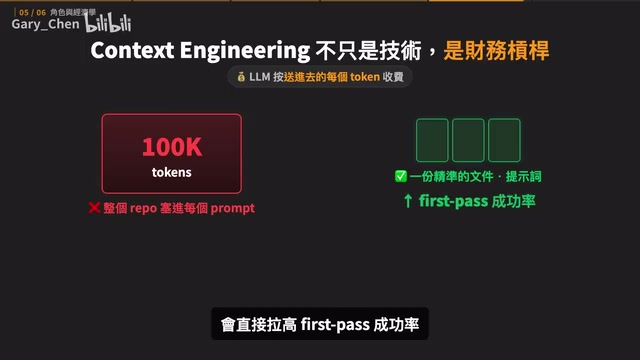
Vibe Coding looks incredibly cheap — upfront investment is near zero — but it hides three operating costs that compound over time. First, token burn rate: with no organized Context, you're dumping everything in and repeatedly asking the model to fix things; low success rates mean every loop burns money. Second, a maintenance tax: code lacking structural consistency will produce bugs six months later that take engineers days to reverse-engineer. Third, security remediation: fixing a vulnerability in Production costs several times more than catching it at the design stage.
Agentic Engineering reverses this equation: spend engineering time upfront designing API schemas, building test suites, and organizing Context — high CAPEX — but the marginal cost per feature drops dramatically because the AI is running inside a well-governed factory. Context Engineering isn't just a technical practice; it's a financial lever. LLMs charge per token you send, and precise Context directly raises your First Pass success rate. Get it right the first time, and you eliminate the entire cost of trial-and-error loops.
CAPEX (Capital Expenditure) and OPEX (Operating Expenditure) are corporate finance concepts: CAPEX refers to one-time investments in long-term assets (like building a factory or buying equipment), while OPEX refers to ongoing costs of daily operations (like utilities and labor). Applying this framework to AI development provides a tool for evaluating technical decisions across time. Writing a full test suite takes days of engineering time (high CAPEX), but it lets every subsequent AI iteration be validated quickly (low OPEX). Skipping tests and going straight to Vibe Coding seems to save time (low CAPEX), but you pay increasingly high verification and rework costs with every feature expansion or bug fix (high OPEX). First Pass success rate — the proportion of AI-generated code that's usable on the first try — is the key metric connecting both sides. Every improvement in Context quality shows up directly in this rate, which in turn determines the trajectory of the entire project's token bill.
Action Recommendations and the Developer's New Role
When the system can operate on its own, the human role shifts between Conductor and Orchestrator. In Conductor mode, you watch code appear line by line and correct it in real time — suitable for complex logic and unfamiliar codebases. In Orchestrator mode, you define goals, dispatch tasks to Agents running in parallel in the background, and come back periodically to review — suitable for well-defined tasks. Being an effective Orchestrator requires four skills: Specification (defining tasks precisely enough that they can't be misunderstood), Decomposition (breaking work into chunks an Agent can handle in a single session), Evaluation (quickly judging whether output meets the bar), and System Design (designing constraints, tests, and Feedback Loops).
For individual developers: build and maintain your Agents.md/Claude.md — every time an Agent does something you don't want to see again, add a rule; write tests and Evals before generating code (this is your contract with the AI); review every line of code before it ships; don't let go of fundamentals like debugging and system design, because AI amplifies your expertise, it doesn't replace it.
For engineering managers: treat AI development as an engineering investment, not a productivity feature. Adopting Coding Agents without pairing them with Evals, Observability, and architectural standards will produce fast code with no quality. Treat the Harness as a shared team asset — System Prompts, Skills, and Eval suites all belong in version control, go through review, and need owners. Human-AI hybrid teams will become the norm; shift hiring criteria from implementation ability toward judgment — the engineers who can direct Agents effectively are the most valuable ones.
The course slides end with a line that captures it all: "Generation is solved. Verification, Judgment, and Direction are the new craft." The Harness you build for your workflow is a compounding asset living in version control. As models keep improving, your system rises with them. This course runs five days: Day 2 covers Agent tools, MCP, and A2A; Day 3 covers Skills, memory, and Context optimization; Day 4 covers Security and Evaluation; Day 5 covers Spec-Driven Production-grade development.
Related articles

How Big Can Stars Really Get? The Physical Limits of the Largest Stars
Red supergiants are the largest stars by volume, with radii up to 2,000 times the Sun, engulfing the inner solar system. But there is no precise upper limit on stellar size—models predict up to 15,000 solar radii. The most massive blue stars are far smaller than red supergiants—biggest and heaviest are two different things.

Apple HomeView Smart Display Full Feature Breakdown: Wall-Mount or Desktop, $299
Apple launches HomeView, a $299 smart display with wall-mount and desktop options, 12MP camera for facial recognition, smart home control, music playback, and recipe step-by-step cooking. Full breakdown of watch faces, apps, privacy, and cooking integration.

Where Did the Promised New Studio Go? Craft Computing Answers After Five Years
Craft Computing's host responds to viewer questions: the new studio promised five years ago was shelved as construction costs soared from $30,000 to $75,000, and was replaced by a 168-square-foot garage conversion.