Google AI Marketing Tools Explained: A Deep Dive into Google Ads and Analytics Agentic Features

Google launches AI agentic features in Ads and Analytics to automate campaign optimization and data insights.
Google has introduced new AI and agentic experiences across Google Ads and Google Analytics, enabling automated ad campaign optimization, natural language goal-setting, and proactive data insights. These tools mark a shift from passive AI assistance to autonomous digital agents that can understand objectives and execute tasks independently, reshaping how marketers work and compete.
Marketing Enters the Agentic Era
Google recently announced a series of new AI and Agentic experiences coming to Google Ads and Google Analytics, designed to help marketers streamline workflows and improve decision-making efficiency. This move signals that digital marketing is rapidly transitioning from traditional manual operations to a new intelligent era with AI as its core driving force.
For marketing teams that deal with massive amounts of data and constantly adjust campaign strategies every day, these new tools represent more than just efficiency gains—they free human effort from tedious, repetitive tasks, allowing teams to focus on more strategically valuable creative and insight-driven work.
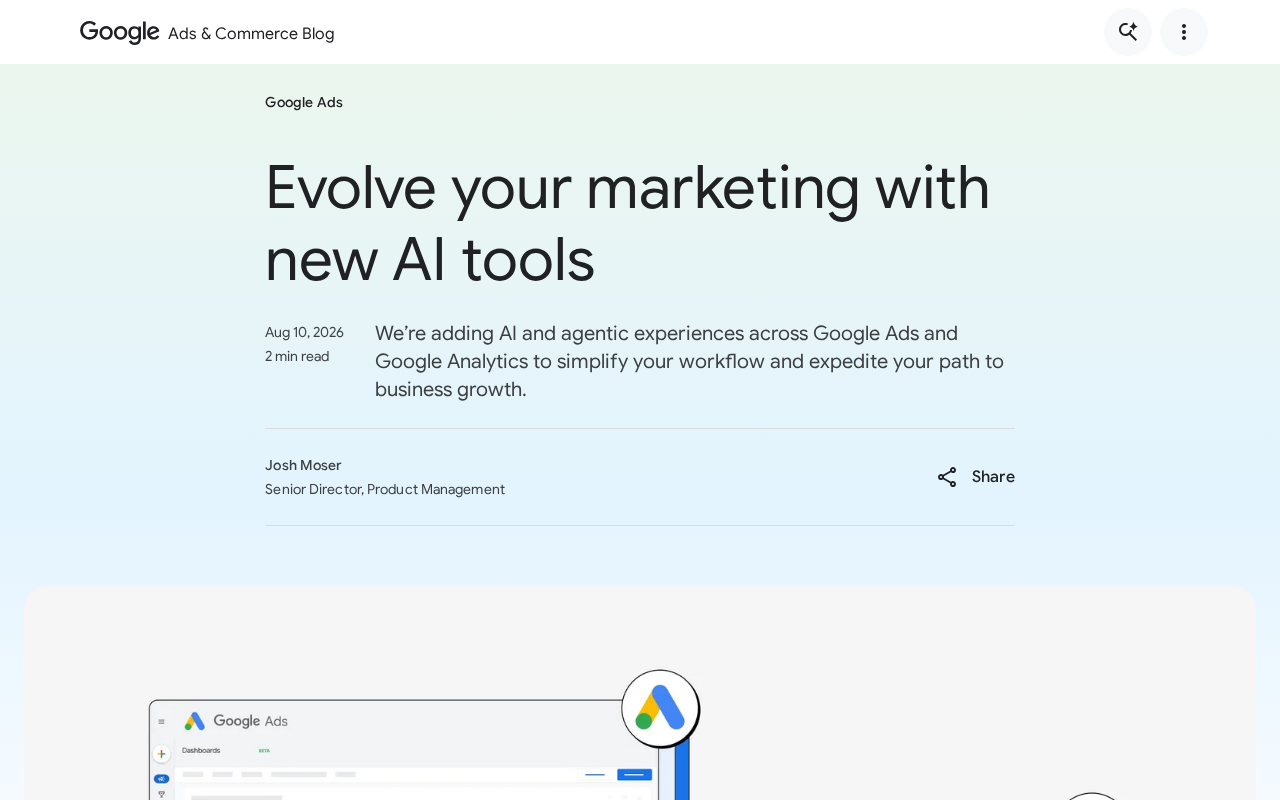
How AI Is Reshaping Advertising and Analytics Workflows
From Tools to Agents: A Paradigm Shift
The most noteworthy concept in this update is "Agentic Experiences." Unlike traditional AI-assisted features, agents are no longer passive tools that simply respond to user commands. Instead, they are "digital assistants" capable of proactively understanding objectives, breaking down tasks, and autonomously executing operations within defined parameters.
In Google Ads, this means advertisers can describe their marketing goals through more natural conversational interactions, and the system can automatically generate campaign recommendations, optimize bidding strategies, and even assist in creating ad creatives. This interaction model dramatically lowers the platform's learning curve, enabling small and medium businesses to access the same level of sophisticated campaign management that previously required large, specialized teams.
Automated Insights in Data Analytics
On the Google Analytics side, the new AI capabilities focus on letting data "speak for itself." Marketers no longer need to manually build complex reports or configure filter conditions—AI can proactively identify anomalous fluctuations, growth opportunities, and potential risks in the data, presenting key insights in easily understandable language.
The value of this "proactive analysis" lies in shortening the path from data to decision. Trends that previously took data analysts hours or even days to uncover can now surface automatically within minutes, helping teams respond to market changes more quickly.
Deeper Implications for the Marketing Industry
An Efficiency Revolution and the Transformation of Marketing Roles
Google's suite of updates fundamentally reflects the direction of the entire MarTech industry: elevating AI from a "nice-to-have" supplementary feature to core infrastructure that permeates the entire marketing workflow.
This transformation inevitably redefines the role of marketing professionals. As AI takes on foundational tasks like data processing, creative generation, and strategy optimization, human marketers' core competitive advantage will increasingly lie in brand strategy, creative direction, and the ability to evaluate AI outputs. In other words, marketers won't be replaced by AI—but marketers who are skilled at using AI will replace those who aren't.
Ecosystem Integration as a Competitive Moat
Here's a notable detail: Google is deploying AI capabilities simultaneously across both its advertising and analytics product lines, creating a complete closed loop of "campaign delivery—measurement—optimization." This deep cross-product integration is Google's core advantage over single-point tool vendors—data flows within the same ecosystem, allowing AI models to access more comprehensive context and deliver more precise recommendations.
For advertisers, this is both a convenience and a deeper platform lock-in. How to enjoy ecosystem benefits while maintaining flexibility in data strategy will become a new challenge that marketing decision-makers need to balance.
Conclusion: Embrace Change, Evolve Proactively
Google's message to "evolve your marketing with new AI tools" sends a clear signal: AI is no longer optional in marketing—it's essential. For companies and teams that want to stay ahead of the competition, getting familiar with and mastering these agentic tools early will be a critical step in the future of digital marketing competition.
Any new technology requires time to prove its real-world effectiveness. While actively experimenting, marketers should also remain rational—AI provides leverage for efficiency and insights, but true marketing wisdom still belongs to those who know how to ask the right questions and make sound judgments.
Related articles

Chain of Thought Isn't Just for AI: How Humans Can Use CoT to Improve Thinking Quality
Chain of Thought isn't just a prompt trick for large models. Starting from a Hacker News discussion, this article analyzes why CoT works for human thinking too, breaks down actionable ways to transfer it, and highlights the key differences between human CoT and machine CoT.
Cloudflare Teams Up with OpenAI: Closi…
Cloudflare Teams Up with OpenAI: Closing the Loop from Vulnerability Discovery to Defense with AI
Cloudflare uses OpenAI Daybreak to investigate security vulnerabilities and generate reviewable remediation plans, while developers use Codex to boost coding efficiency and quality.

Orca Multi-Agent Orchestration in Practice: A Guide to Parallel Collaboration with Claude and Codex
Orca is Stable AI's free open-source agent workbench supporting 34 agents like Claude Code and Codex in parallel. Learn its Git worktree isolation, multi-model orchestration, and mobile management.