Google AI Search Is Reshaping Online Publishing: Traffic Rules and the Challenge to Survive

Google AI Search generates summaries directly on results pages, dismantling the old contract in which digital publishing depended on search traffic.
The Verge newsletter The Stepback notes that the full rollout of Google AI Search is structurally disrupting the online publishing model that relies on search traffic. AI summaries provide answers directly on results pages without requiring clicks, causing publisher exposure and visits to evaporate, with information aggregation sites hit hardest. A deeper problem is multi-source attribution: publishers struggle to measure their own contributions, weakening their bargaining power. The industry has three response paths—blocking and litigation, licensing cooperation, and pivoting to direct audiences—but each has costs and none can fully fill the traffic gap. Long term, eroded incentives for content production could create a vicious cycle: falling revenue cuts content investment, and shrinking high-quality sources in turn lowers the value of AI summaries. The old distribution order is ending; the new one is not yet settled.
When the Search Box Is No Longer Just a List of Links
For the past two decades, the digital publishing industry has been built on a simple bargain: creators produce content, Google indexes and distributes traffic, and ad revenue flows back into production. But the full rollout of Google AI Search is unilaterally rewriting that bargain. The latest issue of The Verge's weekly newsletter The Stepback turns its attention to this upheaval, noting that the online publishing model built on search traffic is facing a structural shock.
This is not a routine algorithm update. AI Search generates summary answers directly on the results page, so users can get information without clicking into any website. For readers this is an efficiency gain; for publishers it means the evaporation of exposure opportunities—when the answer is already displayed at the top of the search page, the motivation to click a link is greatly weakened.
AI Search refers to search engines using large language models to directly generate comprehensive summary answers on the results page, rather than merely returning a list of links. Typical examples include Google's AI Overviews (formerly SGE) and Microsoft Bing's Copilot integration. The technical approach is usually retrieval-augmented generation (RAG): first retrieve relevant web page snippets from the index, then have the model integrate, rewrite, and generate an answer. Compared with traditional search, the interaction logic of AI Search shifts from "keyword matching → click a link → read on your own" to "ask in natural language → get the answer directly," with users able to complete information acquisition while staying on the search page. This shift poses a fundamental challenge to the content ecosystem that depends on click traffic, because the summary itself is the endpoint rather than a gateway to websites.
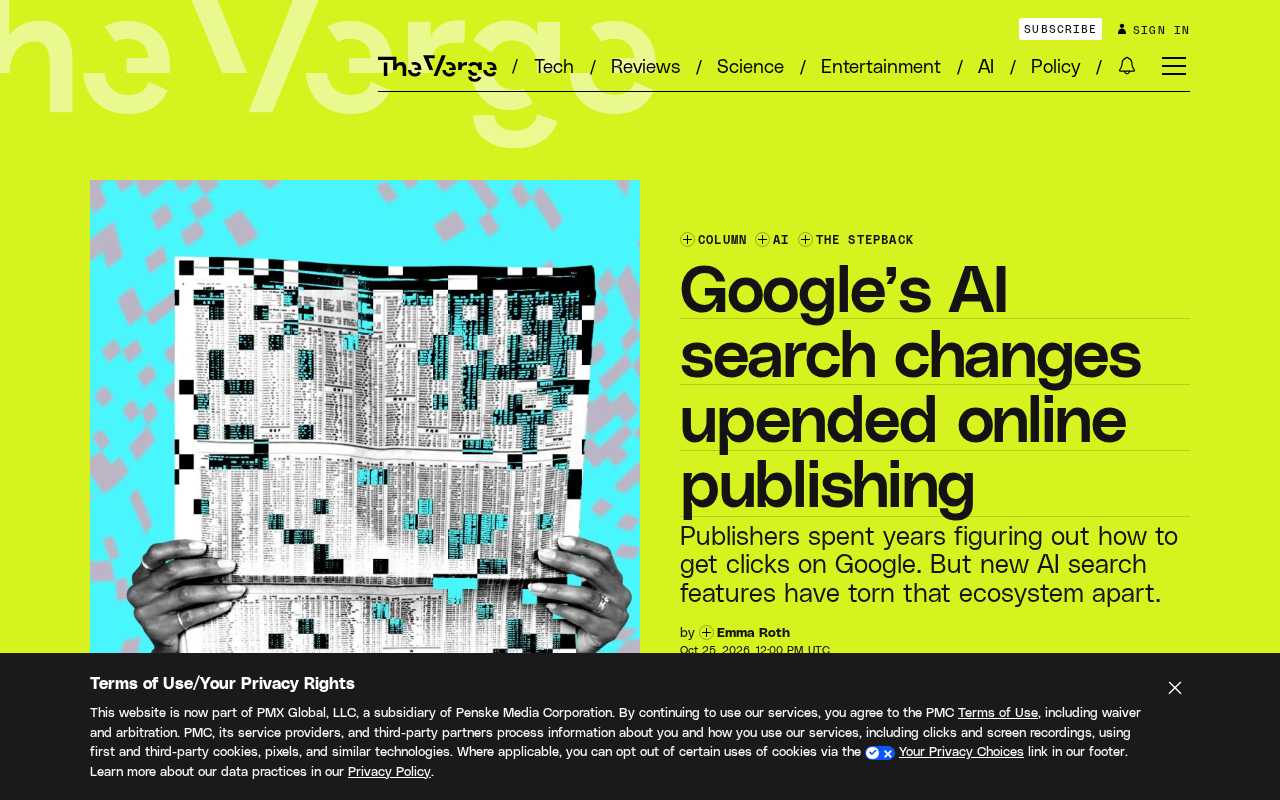
The Collapse of the Traffic Contract
In the traditional search model, ranking high means traffic, and traffic means ad impressions and subscription conversions. AI Search changes a key link in this chain: even if content is cited in an AI summary, the direct visits publishers receive may be far lower than before.
The Stepback describes the digital publishing industry as one that has long depended on search referrals, and this dependence becomes a vulnerability in the face of AI search results pages. Sites whose core business is information aggregation, breaking news, and basic Q&A are hit especially directly—the value they provide is precisely the part that AI summaries are most easily able to replace.
The deeper problem lies in attribution. When an AI summary synthesizes multiple sources to generate an answer, the contribution of any single source is difficult to measure clearly, making it hard for publishers both to negotiate with platforms on that basis and to prove the commercial value of their content to advertisers.
Content attribution in this context refers to tracking and measuring the degree to which a piece of content contributes to the final answer. In traditional search, attribution is relatively clear: which link a user clicks, how long they stay, and whether they convert can all be recorded through analytics tools. But in the AI summary scenario, the model synthesizes multiple sources into one coherent piece of text, and the proportion of any single source that is cited, as well as its substantive impact on the answer, is difficult to quantify. Existing citation markings (such as footnote links) are often sparse and incomplete and cannot reflect true contributions. This leaves publishers lacking verifiable data support when negotiating licensing rates with platforms and proving content value to advertisers, further exacerbating the asymmetry in bargaining position.
Publishers' Dilemma
Faced with this shock, the publishing industry has roughly several response paths, but each comes with costs.
Blocking and litigation: Some media outlets choose to block Google's crawlers or file copyright lawsuits, trying to gain negotiating leverage with a hardline stance. This path can improve short-term bargaining power, but it also means voluntarily giving up a still-massive traffic gateway.
Cooperation and licensing: Another group of publishers chooses to reach content licensing agreements with AI platforms, trading licensing fees for the legality of content use. This provides certain revenue, but the terms of the agreements are often opaque and may entrench the platform's dominant position.
Pivoting to direct audiences: More small and medium-sized publishers are shifting their focus to email subscriptions, paid memberships, and community operations, trying to reduce their single dependence on search. The Stepback itself is a microcosm of this trend—reaching readers directly in the form of a subscription-based newsletter.
These three paths are not mutually exclusive, and most publishing organizations are betting on all of them at once, but none can fully fill the gap left by declining search traffic.
Copyright litigation and content licensing are two legal paths for publishers responding to AI summaries. On litigation, multiple media outlets have sued AI companies for scraping content without permission for model training, with core disputes including the boundaries of fair use, the legality of scraping, and market substitution effects. On licensing, some platforms have introduced content licensing agreements, paying publishers based on usage or a fixed fee. However, licensing agreements usually come with confidentiality clauses, have opaque fee structures, and may include exclusivity or most-favored-nation clauses, which in the long run may strengthen the platform's bargaining advantage. The two paths are not mutually exclusive, but litigation is lengthy and costly, and licensing revenue is currently not enough to make up for the advertising losses caused by declining search traffic.
Long-Term Concerns for the Content Ecosystem
In the short term, AI Search improves the efficiency of information acquisition; in the long term, it may erode the incentive basis for content production. If original reporting and in-depth investigations cannot obtain reasonable returns through search traffic, the number of organizations willing to invest in high-cost content production will decrease, and the high-quality sources that AI models can ultimately learn from and summarize will also shrink accordingly.
This is a self-reinforcing cycle: AI summaries weaken publishers' revenue, declining revenue leads to reduced content investment, and deteriorating content quality in turn reduces the value of AI summaries. Breaking this cycle requires platforms, publishers, and regulators to find a new balance in licensing mechanisms, traffic allocation, and copyright protection.
The Stepback's observation points to a clear conclusion: the old era in which the online publishing industry depended on search referrals is ending, and a new distribution order has not yet taken shape. For content creators, understanding the speed and direction of this shift is more urgent than waiting for a definite answer.
One-line Summary
Google AI Search generates summaries directly on the results page, dismantling the old contract in which the digital publishing industry depended on search traffic.
Paragraph Summary
The Verge newsletter The Stepback notes that the full rollout of Google AI Search is structurally disrupting the online publishing model that depends on search traffic. AI summaries provide answers directly on the results page, so users do not need to click links, causing publishers' exposure and visits to evaporate sharply, with information aggregation sites hit most directly. The deeper problem is the difficulty of multi-source attribution, which leaves publishers unable to measure their own contributions and weakens their bargaining power. The industry has seen three response paths—blocking and litigation, licensing cooperation, and pivoting to direct audiences—but each has costs and none can fully fill the traffic gap. In the long run, eroded incentives for content production may create a vicious cycle: declining revenue leads to reduced content investment, and the shrinking of high-quality sources in turn lowers the value of AI summaries. The old distribution order is ending, and the new one has not yet taken shape.
Related articles

The Founder's Dual Perspective: Aim for the Stars While Sweeping the Streets
Starting from a YouTube startup advice clip, this article explores how founders can balance a grand vision with basic execution, analyzing the dual perspective of 'aiming for the stars' and 'back to basics' in the context of AI startups.

AI Can Write Code but Can't Run Systems? A Founder Breaks Down the Real Bottlenecks of Ops Automation
AI coding is getting stronger, so why is ops automation struggling? Grepr CEO and investor discuss syntax vs. semantics and code vs. real-world distribution, revealing how AI SRE should enter the market.

Is a Million-Dollar SaaS Not Enough? Startup Logic Has Changed in the AI Era
Former Plaid CTO shuts down a near-million-dollar tax product to pivot to AI assistant Town. Insights on startup logic in the AI era: network effects, neutral models, agent economy.