Google Android Partner Turned 1.3 Million TV Boxes into a Botnet

Google says partner Videostrong implanted a backdoor in 1.3 million TV boxes to form a botnet, prompting Google to remove it and end the partnership.
Google disclosed that Android manufacturing partner Shenzhen Videostrong secretly implanted a backdoor in 1.3 million TV boxes, turning them into a remotely controllable botnet for DDoS attacks and other malicious activity. Google removed the backdoor and banned the company from producing or selling certified Android devices. The incident highlights supply chain risks: even Google-certified partners may plant malicious code in factory firmware, and certification review is not a line-by-line firmware audit.
Incident Overview: Android TV Boxes Become a Botnet
Google recently disclosed that one of its Android manufacturing partners—Shenzhen Videostrong Technology Co.—secretly implanted a backdoor in 1.3 million TV boxes, turning these devices into a botnet. Google stated that it has removed the backdoor and "severed" its partnership with the manufacturer, banning it from producing or selling certified Android devices.
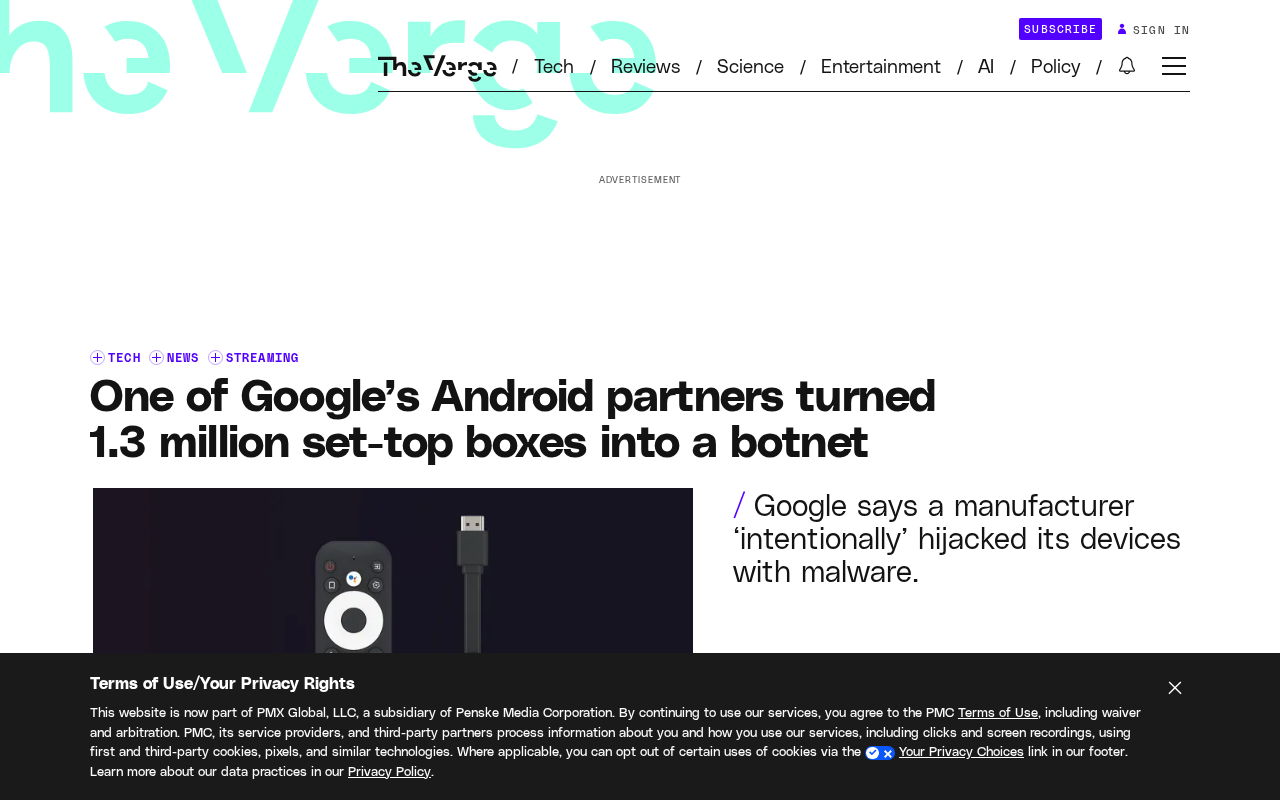
This incident reveals security risks in the smart device supply chain: even partners certified by Google may implant malicious code into devices. For ordinary users, this means the TV boxes in their homes could unknowingly be used to launch cyberattacks.
How Did the Backdoor Work?
According to Google, the backdoor was secretly built into the devices, allowing attackers to remotely control these TV boxes. Although specific technical details have not been made public, such botnets typically exploit the devices' network connectivity to form large numbers of devices into a "botnet" used for distributed denial-of-service (DDoS) attacks, spam campaigns, or other malicious activities.
As a manufacturer based in Shenzhen, Videostrong's TV boxes may be sold in global markets. After discovering the backdoor, Google quickly took removal measures and cut ties with the company. This action indicates that Google's security requirements for certified partners are being strengthened.
Botnet is a network composed of a large number of Internet-connected devices infected by malware that can be remotely and centrally controlled. "Bot" comes from "robot," referring to a controlled program that automatically executes commands. Attackers issue tasks to these devices through command-and-control (C2) servers; common uses include distributed denial-of-service (DDoS) attacks, bulk spam sending, cryptomining, data theft, or acting as a relay for malicious traffic. The value of a botnet lies in scale: a single TV box has limited bandwidth and computing power, but millions of devices making requests simultaneously can be enough to paralyze a target service. Because IoT devices are usually online for long periods, receive delayed firmware updates, and are rarely actively monitored by users, they have become prime targets for botnets. In this incident, the backdoor was preinstalled in factory firmware, so devices could be "recruited" once activated and connected to the Internet, with users having almost no way to notice.
A Wake-Up Call for Supply Chain Security
This incident is not isolated. In recent years, smart device supply chain attacks have occurred frequently—from routers to cameras and now TV boxes—and attackers are increasingly inclined to exploit vulnerabilities in IoT devices. Google's certification program is supposed to ensure that devices meet security standards, but this incident shows that malicious behavior by partners can still bypass review.
For consumers, choosing well-known brands and certified devices remains important, but this incident also reminds us that no device is absolutely secure. Regularly updating firmware and monitoring abnormal network traffic are effective measures to reduce risk.
Android certified devices and Google Mobile Services (GMS) are key background for understanding the consequences of this incident. Google implements compatibility certification for manufacturers that want to preinstall apps such as Google Play and Gmail, granting GMS authorization through processes such as CTS (Compatibility Test Suite). Certification means the device can legally use Google mobile services, and it also means the manufacturer must comply with relevant security and compatibility specifications. Google's "severing" of ties with Videostrong is essentially revoking or refusing its GMS authorization, making it unable to continue producing or selling certified devices with Google services. It should be noted, however, that certification review mainly focuses on compatibility and functional performance and is not equivalent to a line-by-line audit of factory firmware, which explains why a preinstalled backdoor could remain undiscovered for a relatively long time. For Android devices that do not preinstall GMS, Google's leverage is more limited.
Google's Response and Industry Impact
Google has removed the backdoor and banned Videostrong Technology from producing certified Android devices. This decisive action sends a clear signal to other manufacturers: security violations will face severe consequences. However, the incident has also raised questions about Google's partner review mechanism—why could the backdoor lurk in 1.3 million devices for so long?
Industry analysts believe the incident may prompt Google to strengthen audits of partners and drive higher security standards across the entire Android ecosystem. For other smart device manufacturers, this is also a warning: supply chain security is not only a technical issue but also a matter of trust.
What Should Users Do?
If you own a TV box from Videostrong Technology, it is recommended that you stop using it immediately and consider switching to another brand. At the same time, check firmware updates for other smart devices in your home to ensure they are running the latest versions. For enterprise users, IoT devices on the network should be reviewed, suspicious traffic isolated, and intrusion detection systems deployed.
Security experts remind us that botnet activity is often difficult to detect, but abnormal network traffic or degraded device performance may be signs. Staying vigilant and updating promptly are basic strategies for dealing with such threats.
Firmware updates and IoT device isolation are two basic protections that ordinary users can implement. Firmware is the low-level software embedded in device hardware, and manufacturers fix vulnerabilities through firmware updates; however, IoT devices often lack automatic update mechanisms, so users need to manually check versions in the management interface. A more effective approach is network isolation: on the router, place smart devices such as TV boxes and cameras into a separate guest network or VLAN, restrict their access to computers and NAS devices on the internal network, and monitor their outbound connections. If a device is found to have sustained large outbound traffic while idle, it may be a sign of botnet control. In addition, changing default device management passwords and closing unnecessary remote management ports can also reduce the risk of exploitation.
One-line Summary
Google disclosed that partner Videostrong implanted a backdoor in 1.3 million TV boxes to form a botnet; it has removed the backdoor and terminated the partnership.
Paragraph Summary
Google disclosed that its Android manufacturing partner Shenzhen Videostrong Technology secretly implanted a backdoor in 1.3 million TV boxes, turning these devices into a remotely controllable botnet used for DDoS attacks and other malicious activities. Google has removed the backdoor and banned the company from producing or selling certified Android devices. The incident exposes deep risks in the smart device supply chain: even Google-certified partners may implant malicious code in factory firmware, and certification review is not equivalent to line-by-line firmware auditing. The article explains how the backdoor operated, historical lessons in supply chain security, and Google's response measures, and recommends that affected users stop using the relevant devices, check firmware updates, and isolate IoT device network traffic. The incident may prompt Google to strengthen partner audits and drive higher security standards in the Android ecosystem.
Related articles

AI Can Read Neural Network Weights Directly: Do Models Already Exceed Expectations?
A Reddit developer experiment shows language models can directly read neural network weights and infer their function. Astra, Opus 5.5, and Muse Spark 1.3 all passed the test, sparking discussion on model generalization and training sources.

India's Microdrama Market Explodes: EloElo Secures $80M Investment from NBCUniversal
EloElo secures $80M from NBCUniversal to boost StoryTV, its microdrama platform with over 33M monthly active users, as India's microdrama market draws global capital.

Acoustic Detection of Multi-Rotor UAVs: Fusing Handcrafted Features with Pre-Trained Embeddings
Study reveals data leakage from random splits in UAV acoustic detection, proposes source-disjoint protocol with stacked ensemble of handcrafted features and YAMNet embeddings, achieving 95.29% accuracy for low-cost drone detection.