Google Announces It Will Shut Down Google Assistant on Smart Speakers Next Year

Google will discontinue Assistant on smart home devices next year and shut down the Nest app in 2027, consolidating under Google Home.
Google announced major smart home software changes: it will discontinue Google Assistant on smart home devices next year, and the Nest app will officially close on January 25, 2027, requiring users to migrate to the Google Home app. The changes aim to consolidate the ecosystem and unify the management entry point, but they significantly affect existing users—Nest users must adapt to a new interface, smart speaker users will lose their voice assistant experience, and no alternative has been announced. The article sees this as part of an industry consolidation trend that also carries risks of user churn and trust issues, and advises users to familiarize themselves with Google Home early and watch for official migration announcements.
According to an RSS source, Google is making major changes to its smart home software. Starting next year, the company will shut down the Nest app in favor of promoting the Google Home app, and will discontinue Google Assistant on its smart home devices. The news was announced officially by Google, marking a notable pivot in its smart home strategy.
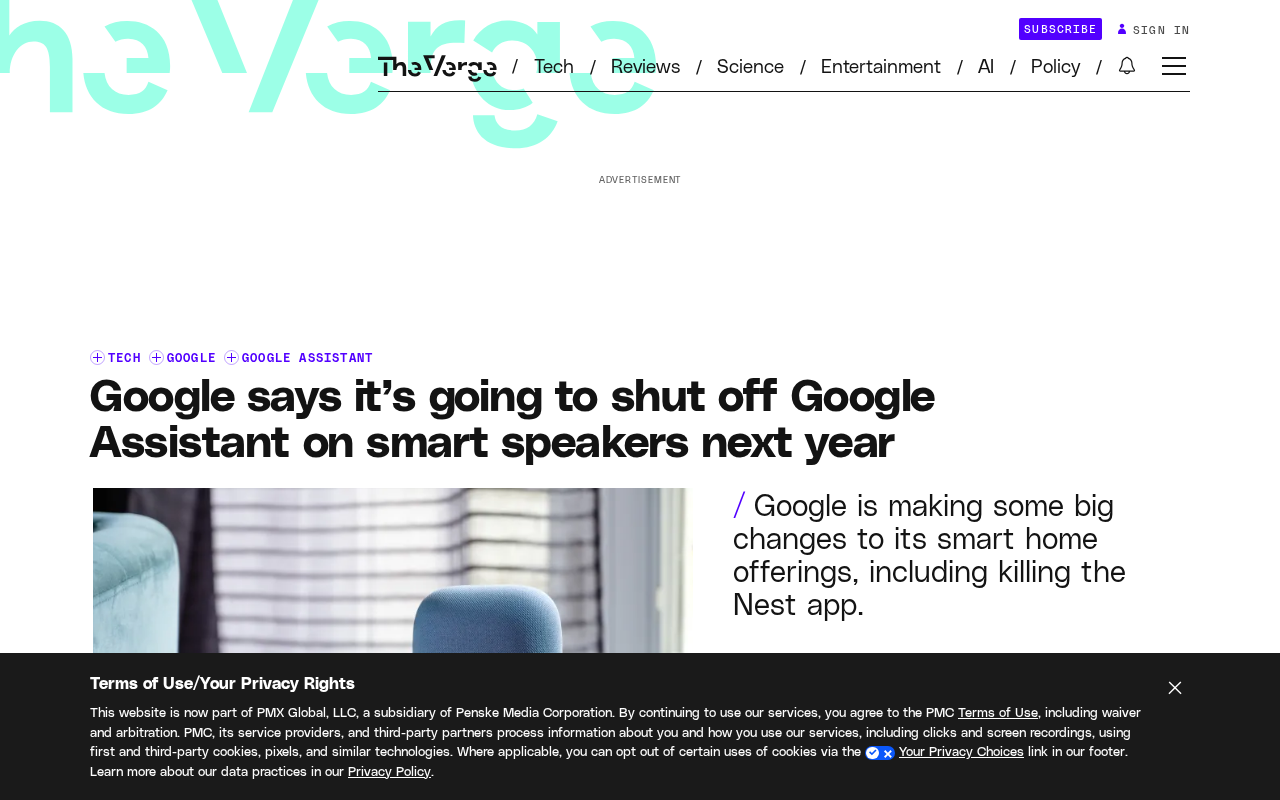
Two Key Changes: The Nest App and Google Assistant
According to the original report, the Nest app will officially shut down on January 25, 2027. This means users will no longer be able to manage their Nest devices through the Nest app and will need to migrate to the Google Home app. At the same time, Google Assistant will be retired on smart home devices and will no longer provide voice assistant services.
These two changes are not isolated events but part of Google's effort to consolidate its smart home ecosystem. The Nest app was once the core management hub for products such as Nest thermostats and cameras, while Google Assistant served as the center of voice control. Adjusting both at the same time shows Google's determination to unify its smart home experience.
Google Assistant is a voice assistant launched by Google in 2016, first appearing with the Pixel phone and the Google Home smart speaker. Built on Google's search and natural language processing capabilities, it supports voice queries, device control, schedule management, and other scenarios, and has gradually expanded to smart displays, headphones, and in-car systems. In the smart home space, Google Assistant has long served as the center of voice control, allowing users to turn lights on and off, adjust thermostats, or check camera feeds via voice commands. Understanding its role helps grasp the impact of this retirement on users' interaction habits: once the voice entry point disappears, users may need to switch to touchscreen apps or reconfigure other voice assistants, and the cost and experience gap of this transition are exactly the risk points the article focuses on.
Nest began as an independent startup known for smart thermostats and smoke detectors, and was acquired by Google in 2014 and folded into its hardware lineup. The Nest app was once the official entry point for managing Nest thermostats, cameras, doorbells, and other devices, supporting remote control, viewing recordings, and adjusting automation settings. As Google launched the Google Home app and gradually integrated Nest devices, the two apps coexisted for a long time, resulting in fragmented management entry points. Shutting down the Nest app essentially fully merges the Nest product line into the Google Home ecosystem. Users need to re-familiarize themselves with where device groups, automation rules, and recording playback are located in the new app, which is also the most easily overlooked practical cost of the migration process.
Impact on Existing Users
For users who have already invested in the Nest ecosystem, this change means adapting to a new app interface and operating logic. After the Nest app shuts down, all device management functions will migrate to the Google Home app. Users need to ensure their devices are compatible with the Google Home app and become familiar with the new feature layout.
The retirement of Google Assistant is even more disruptive. Smart speaker and smart display users will lose their existing voice assistant experience. It is currently unclear whether Google will provide an alternative, or whether users will need to switch to another voice assistant. The original report did not mention specific replacement plans, leaving existing users with uncertainty.
The Logic Behind the Strategic Adjustment
From an industry perspective, Google's move may be aimed at simplifying its product line and concentrating resources. The Nest app and Google Home app have coexisted for a long time, leading to a fragmented user experience. Shutting down the Nest app helps unify the management entry point and reduce maintenance costs. The retirement of Google Assistant on smart home devices may mean Google is reassessing the role of voice assistants in the smart home, perhaps integrating more functions into the Google Home app or shifting to new interaction methods.
However, this decision also carries risks. Smart speaker users may switch to other platforms because of the loss of Google Assistant, especially those who are already accustomed to controlling home devices by voice. Google needs to provide clear guidance during the migration process, otherwise it may spark user dissatisfaction.
Consolidation of smart home ecosystems is not unique to Google. Amazon unifies Echo device management with the Alexa app, while Apple centrally controls HomeKit devices through the Home app. The coexistence of multiple apps leads to fragmented account systems, device discovery, and automation rules, increasing maintenance costs and user confusion. Google's move to merge the Nest app into Google Home and discontinue Assistant on devices aligns with the industry trend of converging from "multiple entry points" to a "single entry point." But the risk is that the voice assistant is the core selling point of smart speakers; once discontinued, the value of the devices may be reassessed, and user churn and brand trust issues need to be addressed by Google through a clear migration path and alternative interaction solutions.
Future Outlook
Currently, Google has not announced specific functional changes to smart speakers after Google Assistant is retired. Users should follow Google's official announcements for detailed information on the migration timeline and alternatives. For users who rely on the Nest app, it is advisable to become familiar with the Google Home app in advance and ensure the transition is completed before January 25, 2027.
Competition in the smart home market is increasingly fierce, and whether this adjustment can enhance Google's competitiveness remains to be seen. But one thing is certain: consolidation of smart home software has become a trend, and users need to prepare for change.
One-line Summary
Google will discontinue Assistant on smart home devices next year and plans to shut down the Nest app in 2027, unifying everything under Google Home.
Paragraph Summary
Google has announced major changes to its smart home software: starting next year it will discontinue Google Assistant on smart home devices, and the Nest app will officially shut down on January 25, 2027, with users required to migrate to the Google Home app. The two changes aim to consolidate the smart home ecosystem, unify the management entry point, and reduce maintenance costs, but they significantly affect existing users—Nest users will need to adapt to a new interface, smart speaker users will lose their voice assistant experience, and Google has not yet announced an alternative. The article argues that this strategic pivot reflects an industry consolidation trend but also carries risks of user churn and trust issues, and recommends that users familiarize themselves with the Google Home app in advance and follow official migration announcements.
Related articles

From 0 to 1: Vibe Coding an AI Knowledge Base — A Practical Retrospective and Tech Stack Breakdown
A retrospective on building the AI knowledge base OilBook from scratch with Vibe Coding: Next.js+Neon stack, Oil Dev Skill workflow, Stripe paywall security, interview-style writing, AI-flavor control, and Vercel deployment.

GLM-5.4 Hands-On: Native Vision Meets a New Vibe Coding Workflow
Hands-on with Zhipu GLM-5.4: native vision tested across a 3D product demo, pure-code video generation, and remote-control Vibe Coding, compared with GPT-6.2 and Gemini Neon.

AI and Humans Claim to Prove the Riemann Hypothesis: Machine-Verified, Yet Nobody Can Understand It
Anthropic mathematician and AI Claude claim to prove the Riemann Hypothesis with 17 million lines of Lean code, machine-verified but unreadable by humans. This article analyzes the event, the zero proportion record from 41.6% to 67.2%, and the gap between machine verification and human understanding.