Google AntiGravity 2.0 In-Depth Review: Desktop App, Go-Rewritten CLI, and Gemini 3.5 Flash Hands-On

Google launches a full AI developer platform centered on multi-agent workflows at I/O 2026.
At Google I/O 2026, Google released the AntiGravity 2.0 desktop app, a Go-rewritten CLI tool, a developer SDK, and the Gemini 3.5 Flash model, building a complete AI development platform centered on multi-agent workflows. Gemini 3.5 Flash excels at agentic tasks and coding benchmarks with 4x the speed of frontier models, though it falls slightly short on deep reasoning. AntiGravity 2.0 supports multi-agent parallelism and multi-model switching, capable of autonomously building complete apps in testing but still requiring polish.
Overview: Google Redefines the Developer Tool Ecosystem
At Google I/O 2026, Google unveiled a flurry of releases: the AntiGravity 2.0 desktop app, a brand-new CLI tool, a developer SDK, and the Gemini 3.5 Flash model. This isn't a simple version iteration—it's Google's complete rearchitecting of the AI developer toolchain, shifting from a single editor plugin to a full platform centered on multi-agent workflows.
Multi-Agent Workflow represents the core paradigm shift in AI engineering today. Traditional AI-assisted programming relies on single prompt-response cycles, whereas multi-agent architectures allow multiple specialized AI agents to run in parallel and collaborate, each handling different subtasks—for example, one agent handles code generation, another handles testing, and a third handles documentation. The Agent Orchestration Layer is the middleware that coordinates these agents, managing task distribution, state management, and result aggregation. This concept originates from distributed systems engineering and, when applied to AI workflows, makes complex long-running tasks (like building complete applications) possible.
You might not have noticed, but AntiGravity 2.0 is completely unrelated to the previous VS Code fork project (AntiGravity Add). It's a standalone desktop application whose interface and interaction logic are closer to Claude Code or the Codex client. Google has built four products around this app: the desktop application, CLI, SDK, and the legacy Add editor—all sharing the same underlying Agent Harness framework. This means that when the core Agent loop is improved, all products benefit simultaneously.
Gemini 3.5 Flash: The Sweet Spot Between Speed and Intelligence
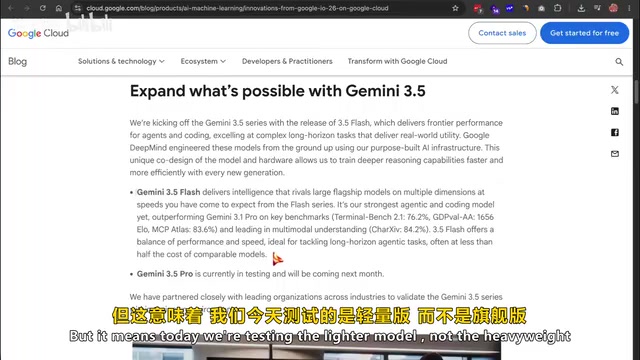
The core model powering the entire ecosystem is Gemini 3.5 Flash. Google claims it surpasses Gemini 3.1 Pro on nearly all benchmarks while being four times faster than other frontier models. But to be clear, this is Flash (the lightweight version), not Pro (the flagship). Gemini 3.5 Pro is expected to launch next month.
In the large language model product lineup, the difference between Flash and Pro isn't merely a reduction in parameter count—it involves systematic trade-offs in training strategy and inference optimization. Flash models typically employ Knowledge Distillation techniques to compress the capabilities of a larger model into a smaller one, combined with inference acceleration methods like Quantization and Speculative Decoding to dramatically increase throughput. This explains why Gemini 3.5 Flash excels at agentic tasks (which require many short-cycle calls) while lagging behind on humanities exam-style tests that require deep chain-of-thought reasoning—the latter depends more on the model's parameter capacity and reasoning depth rather than response speed.
Benchmark Highlights
Based on the published data, Gemini 3.5 Flash's performance is genuinely impressive:
- General Terminal Coding Test: 76.2%, surpassing Gemini 3.1 Pro's 70.3%
- MCP Multi-step Workflow Benchmark: 83.6%, ranked first, beating Claude Opus and GPT 5.5
- Finance Agent v2: Outperforming Opus and GPT by 57.9%
- Multimodal Performance: Ranked first in Chart reasoning and MMU Pro tests
Notably, the MCP (Multi-step Completion Protocol) benchmark is an evaluation framework specifically designed to assess AI model performance on continuous multi-step tasks, fundamentally different from traditional single-turn QA benchmarks (like MMLU or HumanEval). It simulates real-world agent workflows: the model needs to maintain context across multiple interaction rounds, invoke tools, process intermediate results, and ultimately complete compound objectives. Gemini 3.5 Flash's top ranking at 83.6% on this test validates Google's strategy of specifically optimizing for agentic scenarios—highly aligned with their strategic focus on the agent orchestration layer. By contrast, traditional code completion benchmarks (like HumanEval) can no longer adequately reflect AI's true value in real-world development workflows.
Weaknesses and Limitations
However, Flash doesn't dominate across the board. Its disadvantages primarily show up in deep reasoning tasks:
- Humanities Last Exam: 40.2%, behind Opus's 46.9% and Pro's 44.4%
- MMU Reasoning Test: 72.1%, significantly behind GPT 4's 84.6%
- Swange Pro Multi-function Code Test: 55.1%, behind Opus and GPT
A more balanced assessment: Gemini 3.5 Flash is on par with frontier models for agentic tasks, excels at coding, but falls slightly short on deep reasoning. For a model that prioritizes speed, this is already an outstanding achievement.
AntiGravity 2.0 Desktop App: The Core Multi-Agent Parallel Experience
The flagship feature of the AntiGravity 2.0 desktop app is multi-agent parallel processing. You can spawn sub-agents, schedule background tasks, and they continue running while you do other things. It also integrates native voice commands, Google AI Studio, Firebase, and the Android toolchain.

The app's layout resembles Codex: a sidebar displaying project history and a model selector, with a chat area supporting free switching between Gemini, Claude, and GPT models. This multi-model support design is quite thoughtful, reducing migration costs for users.
Hands-On Experience: Building a React Project Management App
In actual testing, I asked AntiGravity 2.0 to build a React.js project management application with task management, team members, project status, and a Kanban board. The AI agent ran in the background for about 20 minutes to complete the task.

The generated app uses a standard dark mode, featuring a project list sidebar, notification top bar, profile menu, main panel displaying current projects and recent tasks, and even team activity feeds—these extra features were all inferred by the AI based on broad instructions. The result is usable with reasonable functionality, but would still need an hour or two of polish to reach production quality. Compared to the original Gemini CLI from a year ago, there's clear progress, but it hasn't yet reached the level of today's top-tier development environments.
AntiGravity CLI Rewrite: The Performance Leap from Node to Go
The AntiGravity CLI represents Google's most significant change. It's a complete rewrite of the old Gemini CLI in Go. The original Gemini CLI earned over 100,000 stars on GitHub, but its architecture was designed for early general-purpose coding patterns.
Rewriting the CLI from Node.js to Go is a decision with profound engineering significance. Node.js is based on the V8 engine and event loop, requiring the JavaScript runtime to load at startup with cold-start latency typically in the hundreds of milliseconds; Go compiles to native binaries, with startup times compressible to single-digit milliseconds. For CLI tools, this difference is significantly amplified in frequent-invocation scenarios. Additionally, Go's static type system and built-in concurrency primitives (goroutine/channel) make it naturally suited for building command-line tools that need to concurrently handle multiple agent tasks. Many high-performance CLI tools on GitHub (such as kubectl, Hugo, Terraform) are written in Go—Google's choice of Go for this rewrite continues mainstream industry practice.
The rewritten CLI
Related articles
 Product Reviews
The Programmer's Desk Setup Guide: Building a Workspace That Feels Like Home
Discover how programmers build productive, comfortable workspaces. From multi-monitor setups to ergonomic design, explore the desk philosophy that drives focus and flow.
 Product Reviews
Qoder vs Cursor Real-World Comparison: Which $20/Month AI IDE Is Better?
Hands-on comparison of Qoder vs Cursor AI IDEs: Agent autonomy, human interaction count, and architecture decisions. Qoder needed only 2 interactions vs Cursor's 8.
 Product Reviews
Cursor Cloud Agent Demo: Eliminating Bottlenecks Across the Entire Software Development Lifecycle
Deep analysis of Cursor's Cloud Agent demo showing how cloud VMs, automated test artifacts, and a full-chain control plane systematically eliminate human bottlenecks across the software development lifecycle.