Google Antigravity + Gemini 3.7 Flash: An Efficient Approach to Multi-Agent Collaboration
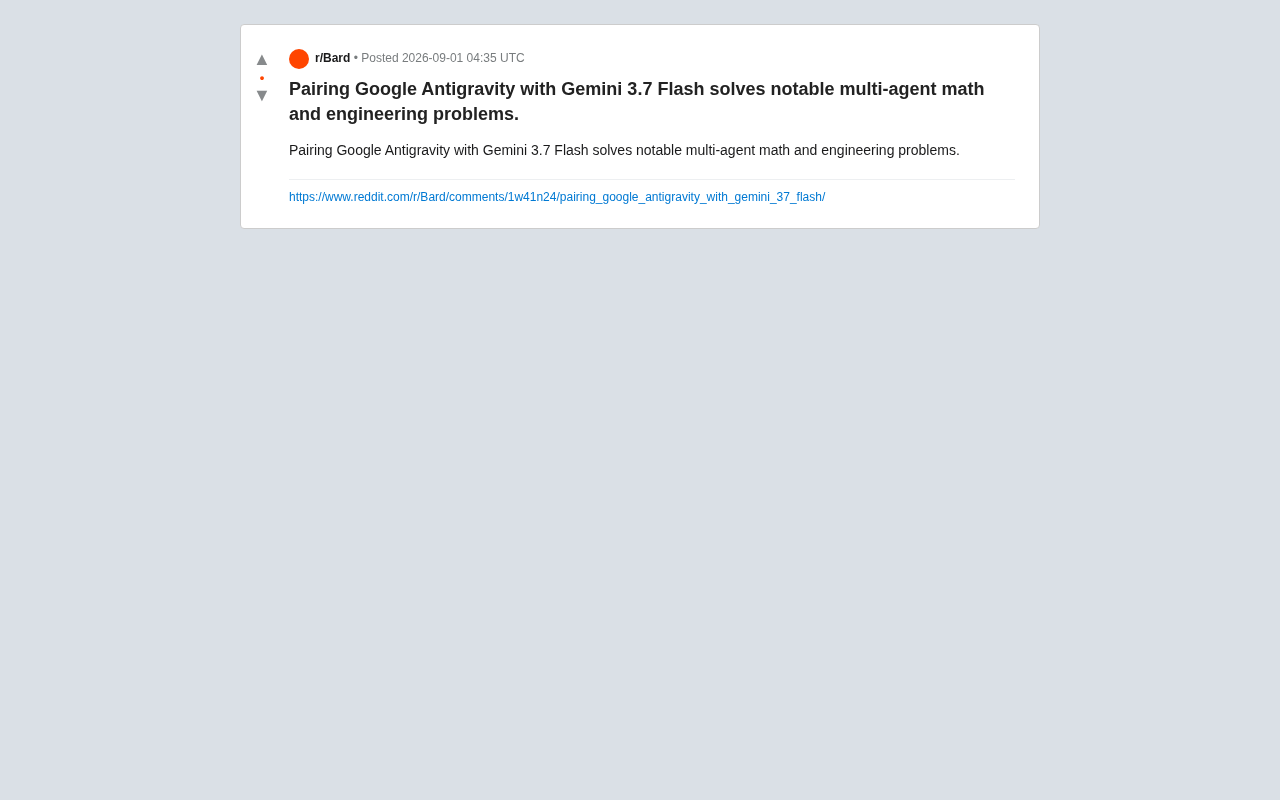
Google's Antigravity + Gemini 3.7 Flash enables efficient multi-agent collaboration for complex problem-solving.
This article examines how pairing Google's Antigravity orchestration platform with the Gemini 3.7 Flash model creates an effective multi-agent system for tackling complex math and engineering problems. By combining Antigravity's task decomposition and coordination capabilities with Flash's fast, cost-efficient reasoning, the system achieves high-quality results through rapid iteration and cross-validation—offering developers a practical blueprint for production-ready multi-agent architectures.
A New Breakthrough in Multi-Agent Systems
Recently, an intriguing technical combination has emerged in the community: pairing Google's Antigravity platform with the Gemini 3.7 Flash model, which has demonstrated remarkable results in solving complex multi-agent mathematical and engineering problems. The significance of this combination lies not only in point-performance improvements but also in revealing a possible path for future AI system collaboration paradigms.
Multi-agent systems have long been a challenging area in AI. The concept of Multi-Agent Systems (MAS) originates from distributed artificial intelligence research, dating back to the 1980s. The core idea is to have multiple autonomous agents work together through communication, negotiation, and collaboration to accomplish complex tasks. Before the era of large language models, MAS was primarily applied in robotic collaboration, traffic scheduling, and game theory. Over the past two years, as LLM capabilities have surged, researchers have begun organizing multiple LLM instances into agent teams, assigning them different roles (such as generator, reviewer, and executor) to compensate for the tendency of single models to "self-convince" and accumulate hallucinations during long-chain reasoning. Representative works include Stanford's Generative Agents, Microsoft's AutoGen, and MetaGPT, which have explored multi-agent collaboration from the perspectives of social simulation, developer tools, and software engineering workflows, respectively.
Compared to having a single model complete tasks independently, coordinating multiple agents requires solving a series of thorny problems: task decomposition, state synchronization, result verification, and conflict resolution. Task Decomposition refers to breaking down a macro-level goal into sub-tasks that can be executed in parallel or sequence. Key challenges include determining the right granularity for sub-tasks (too coarse and parallelism is ineffective; too fine and communication overhead explodes), handling dependencies between sub-tasks (essentially a DAG — Directed Acyclic Graph scheduling problem), and synchronizing intermediate states across agents. The difficulty with state synchronization is that each agent has an independent context window, and reasoning results from one agent must be explicitly passed as messages for other agents to perceive them. Conflict Resolution refers to how the system arbitrates when multiple agents produce contradictory conclusions — common strategies include majority voting, confidence-weighted scoring, and hierarchical arbitration. Traditional approaches often fail to deliver in practice due to high inter-agent communication costs and severe error accumulation. The combination of Antigravity and Gemini 3.7 Flash offers fresh answers to precisely these pain points.
Antigravity: Google's Agent Orchestration Platform
What Is Antigravity?
Antigravity is a development and orchestration environment for agentic workflows introduced by Google. Its core positioning is to enable developers to build, schedule, and monitor multiple AI agents at a higher level of abstraction, without having to manually write complex scheduling logic from scratch.
The Agent Orchestration Platform category that Antigravity represents has been a hot track in AI infrastructure since 2024. The core value of orchestration platforms lies in providing declarative workflow definitions, runtime state management, and observability tools. Before Antigravity, the industry already had open-source orchestration frameworks such as LangGraph, CrewAI, and AutoGen, but most of them remained at the developer tool level, lacking enterprise-grade scheduling, monitoring, and fault tolerance capabilities. Google's launch of Antigravity can be seen as an attempt to elevate agent orchestration from a "developer toy" to "production-grade infrastructure." Its significance is analogous to what Kubernetes did for container orchestration — once individual containers (agents) are powerful enough, efficiently managing the collaboration of hundreds or thousands of containers (agents) becomes the new bottleneck.
In multi-agent scenarios, Antigravity serves as the "coordinator." It is responsible for decomposing a macro-level task into sub-tasks, distributing them to different agent instances, and managing the information flow and dependencies between them during execution. This orchestration capability is the critical infrastructure that enables multiple agents to collaborate efficiently.
Why the Orchestration Layer Is the Core of Multi-Agent Systems
In practical mathematical reasoning and engineering problem-solving, a single model easily drifts off course during long-chain reasoning. By using Antigravity to break tasks into verifiable small steps and assigning different agents to handle generation, critique, and verification respectively, the risk of error accumulation can be effectively reduced.
This "Divide and Conquer" approach in multi-agent LLM systems typically involves three core roles: Generator, Critic, and Verifier. The Generator produces candidate answers or reasoning steps; the Critic reviews the generated results from different angles, identifying logical gaps or factual errors; the Verifier performs hard validation on results through formal tools (such as code execution or symbolic math engines). This pattern draws from the concepts of Code Review and Continuous Integration (CI) in software engineering. OpenAI's research has also shown that having a model perform Self-Critique can significantly reduce reasoning error rates, and outsourcing the critique function to an independent agent instance often outperforms model self-reflection, because independent instances are not subject to the Anchoring Effect of the original reasoning path. This is one of the mainstream approaches for improving success rates on complex tasks.
Gemini 3.7 Flash: A Precise Balance of Speed and Reasoning
The Flash Series' Role in Multi-Agent Scenarios
The Flash variant within the Gemini series has consistently been known for low latency and high throughput, significantly reducing API call costs while maintaining sufficient reasoning capability. The Gemini Flash series is a model variant optimized by Google DeepMind for latency-sensitive scenarios. Compared to the flagship Gemini Pro/Ultra, Flash versions typically employ a more compact model architecture (potentially including techniques such as knowledge distillation, model pruning, or mixture-of-experts routing), achieving 3-5x the inference speed of flagship versions at an API call cost typically one-fifth to one-tenth of the original.
This is especially important for multi-agent systems — collaboration among multiple agents means model call counts multiply, and if each call uses the heaviest model, both cost and latency become unsustainable. In multi-agent scenarios, cost economics are critical: suppose a multi-agent workflow requires 50 model calls to solve a complex math problem — using a flagship model might cost several dollars, while using a Flash model might cost just a few cents. This order-of-magnitude cost difference directly determines whether multi-agent solutions can be deployed at scale in production environments.
Gemini 3.7 Flash serves as the fast and economical "reasoning engine" in this combination. After Antigravity breaks a task into numerous small steps, the Flash model can respond at high frequency with low marginal cost, enabling the entire multi-agent workflow to complete within acceptable time and budget constraints.
Rapid Iteration Is Itself a Capability
Interestingly, the Flash model's high-speed characteristics are not merely synonymous with "cheap." In multi-agent architectures, rapid iteration is itself a capability — it allows the system to perform more rounds of self-checking, cross-validation, and result correction. In other words, using "more frequent fast calls" to approximate the quality of "one expensive call" is the engineering philosophy behind this combination.
This approach has deep theoretical foundations in computer science. In distributed computing, it is similar to the idea of replacing a single expensive supercomputer with multiple cheap commodity nodes (the original Google MapReduce philosophy). In machine learning, it corresponds to the core idea of Ensemble Learning — combining multiple weak learners can approach or even surpass the performance of a single strong learner. In the specific context of LLM multi-agent scenarios, researchers call this strategy "Inference-Time Compute Scaling" or "Test-Time Compute": rather than investing more compute during training to build larger models, invest more compute during inference (more rounds of reasoning, verification, and correction) to improve the quality of individual task completion. Recent research from both DeepMind and OpenAI has shown that this strategy yields significant gains in mathematical reasoning and programming tasks.
Combined Value: The Synergy of Antigravity + Flash
Combining Antigravity's orchestration capabilities with Gemini 3.7 Flash's efficient reasoning is essentially a complementary integration of infrastructure and model capability. According to community feedback, this combination has achieved results on "notable" mathematical and engineering problems, meaning it has moved beyond simple demo-level tasks to tackle genuinely challenging real-world problems.
This synergy can be understood from two dimensions:
- Architecture level: Antigravity solves the problem of "how to organize agents," enabling multiple Flash instances to collaborate in an orderly fashion rather than working in isolation.
- Model level: Gemini 3.7 Flash solves the problem of "how to make each agent both smart and economical," making large-scale collaboration financially viable.
Together, they fill in the two critical puzzle pieces needed for multi-agent systems to be deployed in practice.
How Developers Can Learn from This Multi-Agent Practice
For developers exploring AI agent applications, this case study offers several practical insights.
First, don't blindly pursue the most powerful single model. In multi-agent scenarios, a model's cost efficiency often matters more than its peak capability. A mid-tier model that can be called at high frequency, combined with well-designed orchestration, may solve real-world problems more effectively than an expensive flagship model.
Second, the orchestration layer is an undervalued source of value. Many teams pour all their effort into prompt engineering and model selection while neglecting the design of task decomposition, state management, and verification mechanisms. The emergence of platforms like Antigravity demonstrates that orchestration capability is becoming a core competitive advantage of agent systems.
Finally, multi-agent is not a silver bullet. It is best suited for complex problems that can be clearly decomposed and require multi-round verification, such as mathematical proofs, engineering simulations, and code generation. Mathematical proofs and engineering simulations are particularly well-suited for multi-agent architectures because they possess two key characteristics: decomposability and verifiability. Mathematical proofs can be broken down into chains of lemmas and corollaries, with each step rigorously checked through formal verification tools (such as the Lean or Isabelle proof assistants). Engineering simulations (such as finite element analysis or computational fluid dynamics) can decompose complex systems into sub-domains, with each agent handling the modeling and solving of different sub-domains, and final results integrated through boundary condition matching. Code generation is similarly well-suited — one agent writes the code, another writes test cases, and a third runs the tests and provides feedback. This natural division of roles allows the multi-agent architecture to deliver maximum value. By contrast, for tasks like creative writing or open-ended conversation that lack objective verification criteria, the advantages of multi-agent approaches are less pronounced. For simple tasks, introducing multi-agent may actually bring unnecessary complexity and cost.
Conclusion
The pairing of Antigravity and Gemini 3.7 Flash illustrates an important trend in modern AI system development: the marginal returns of simply scaling up model size are diminishing, while unlocking capabilities through sophisticated system architecture and cost-effective model collaboration is becoming the new frontier. It should be noted that the information available so far primarily comes from community sharing, and specific performance data and applicability boundaries still await more public verification. Regardless, this combination provides a case study well worth in-depth investigation for anyone asking the question: "How can multi-agent systems truly be deployed in practice?"
Related articles
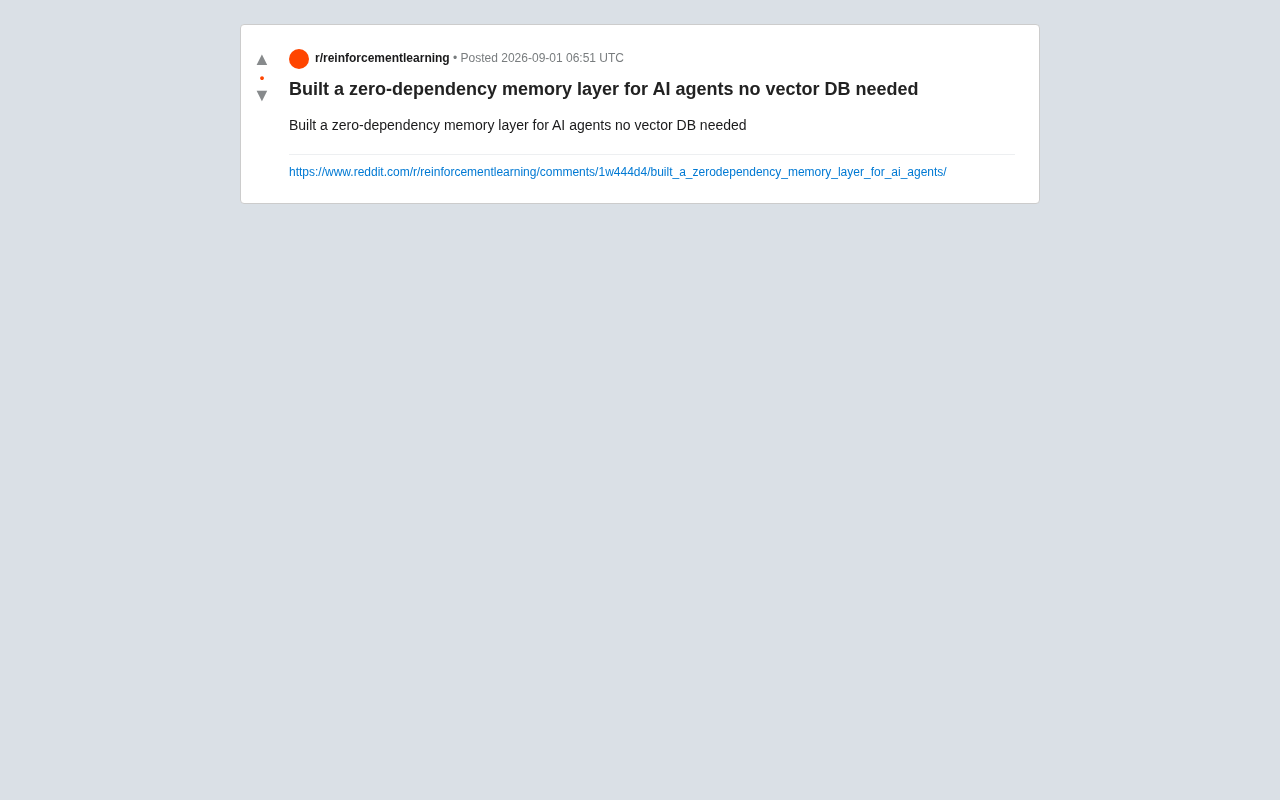
Zero-Dependency AI Memory Layer: Agent Memory Without a Vector Database
Explore zero-dependency AI Agent memory layers that work without vector databases. Compare with traditional RAG architectures and learn when lightweight alternatives make more sense.
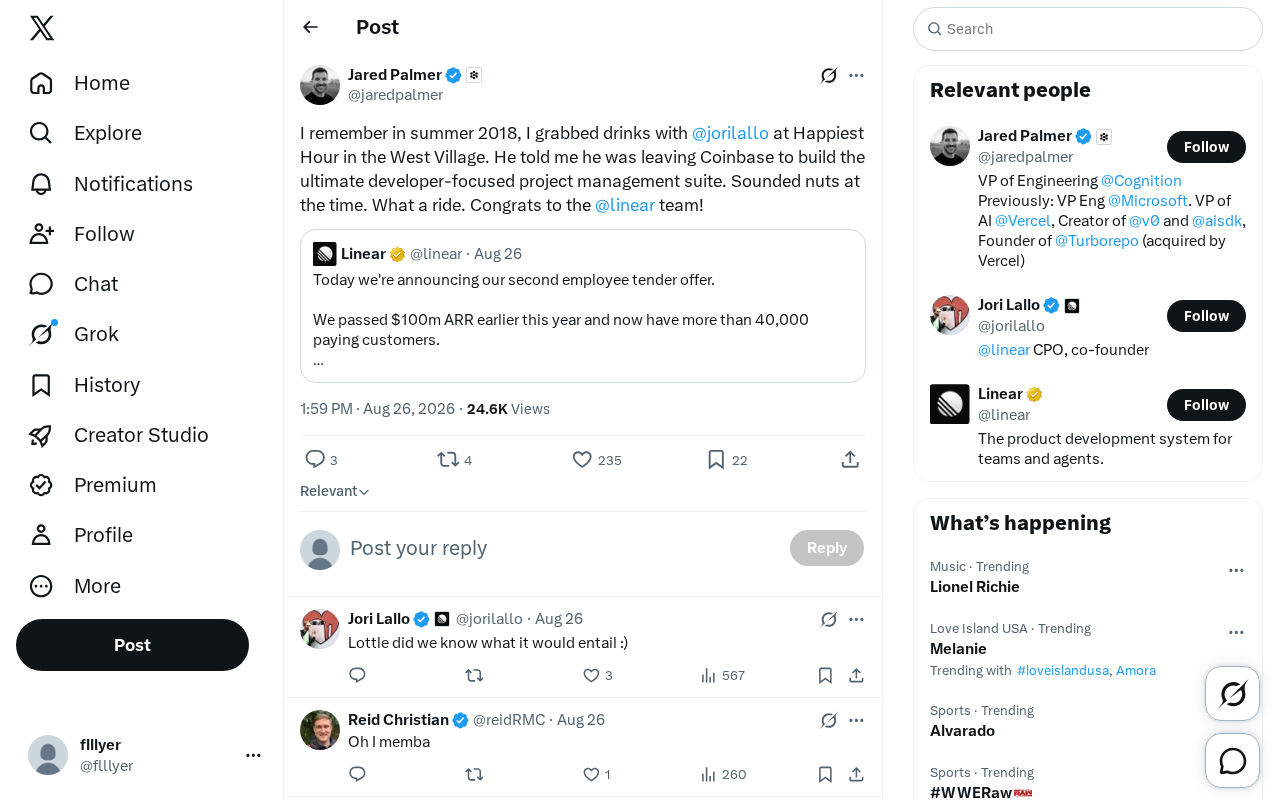
The Linear Startup Story: From Leaving Coinbase to Redefining Developer Tools
How Linear co-founder Jori Lallo left Coinbase in 2018 to build a developer-first project management tool, defying skeptics to carve out success in a market dominated by Jira, Asana, and Trello.
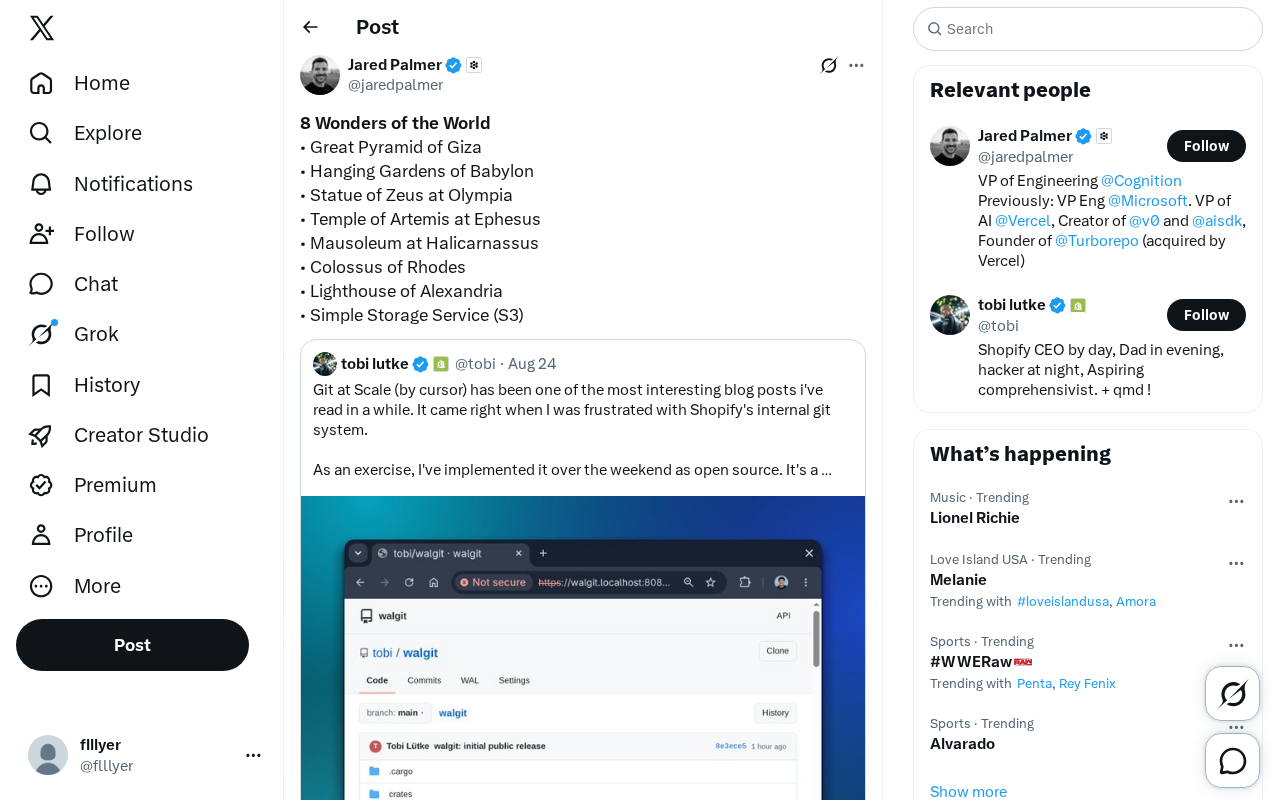
Why Is AWS S3 Called the Eighth Wonder of the World? The Invisible Power of Cloud Storage
A viral tweet listed AWS S3 as the Eighth Wonder of the World. Explore how S3's eleven 9s durability and architectural ubiquity make it the invisible cornerstone of modern digital civilization.