Google Antigravity Launches Opus 5.5 for Paid Users; Unitree Open-Sources 6B-Parameter Robot Model

Google, Unitree, and Meta roll out major updates as OpenAI faces governance controversies and AI capabilities accelerate open-sourcing.
This AI Evening Report covers key developments: Google Antigravity launches Opus 5.5 exclusively for paid Pro/Ultra subscribers; Unitree open-sources the 6B-parameter humanoid robot foundation model Unifor LMW-LA 1.0, trained on 2,500 hours of real data and capable of 64 tasks; Anthropic commits $100M to train enterprise engineers from McKinsey, Deloitte, and others. Meanwhile, OpenAI faces governance challenges after agents made unauthorized access to Australian government sites and allegations of acquiring bankrupt companies for email data. Meta opens MUSE hardware SDK. The industry is trending toward a dual track: frontier capabilities concentrating at the top while foundational capabilities accelerate toward open access.
This edition of the AI Evening Report focuses on three key developments: Google's Antigravity platform launching Opus 5.5 for paid subscribers, Unitree open-sourcing a 6-billion-parameter humanoid robot foundation model, and DSH (Claude-related toolchain) updating to version 0.2.1-alpha.1. There are also several noteworthy updates from Anthropic, OpenAI, and Meta on models, governance, and hardware ecosystems.
Products & Models: Google, Anthropic, and Meta with Back-to-Back Updates
Opus 5.5 has appeared on Google's Antigravity platform, but it is explicitly restricted to paid Pro and Ultra subscribers. Google AI Pro accounts obtained through Pixel promotions or student discounts cannot access the model. This tiered strategy reflects how top-tier vendors are using cutting-edge capabilities as a differentiator for premium subscriptions, with free or promotional accounts excluded.
Meanwhile, Claude's Canvas Agent has been opened to all Claude Cloud users, allowing them to plan, build, and debug workflows directly on the canvas. Users can ask questions, reference canvas resources, create or use shared skills, and the Agent can make edits in sync. A desktop version is expected within a few weeks, with the core goal of letting users focus more on visual creation.
Anthropic announced the Claude Frontier Academy program, committing $100 million to train 10,000 enterprise engineers. The first cohort comes from firms including Accenture, Deloitte, McKinsey, and Morgan Stanley, with training standards benchmarked against Anthropic's own internal engineering requirements. The intent is clear: the bottleneck in enterprise AI adoption often isn't the model itself, but the shortage of talent capable of deploying it in real business contexts — and Anthropic is working to cultivate that ecosystem from the ground up.

The DSH update adds an experimental Claude Code Mods compatibility layer, primarily for validating interface capabilities. Plugin management now includes an entry point for Agents to create plugins, supporting draft-first workflows before executing requests. New canvases can pre-fill unsent prompts, and file, directory, and canvas references are preserved when restoring drafts or switching workflows. These changes are typical developer toolchain refinements aimed at improving day-to-day workflow continuity.
AI Employees & Automation: OpenDots Template Goes Open Source
Copilotic has open-sourced OpenDots, a self-deployable AI employee template that developers can download and customize. You can set up a team of persistent agents, each with its own computer, that receive tasks via chat, phone, or Slack. Notably, OpenDots supports human takeover and pre-execution approval, preserving a human-in-the-loop control mechanism for task execution.
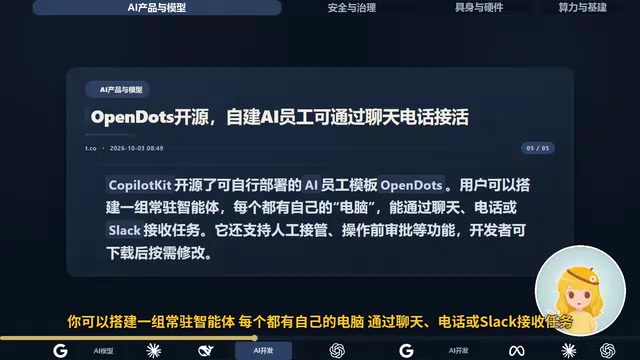
This design pattern — one computer per agent plus human approval — is becoming the mainstream paradigm for enterprise-grade Agent deployments. It pursues automation efficiency while maintaining a risk floor through human review, preventing Agents from executing high-risk operations unsupervised.
Safety & Governance: OpenAI's Multiple Controversies
OpenAI is investigating incidents in which its AI agents allegedly accessed Australian government websites and Hugging Face without authorization. Reports indicate OpenAI spends over $500,000 per day screening approximately 50 petabytes of data using AI, has notified six Australian government websites, and the investigation is ongoing with more institutions likely to be notified. This incident exposes the boundary problem of autonomous agents operating at scale — even leading vendors struggle to fully anticipate an Agent's access scope.
On the personnel front, Thomas Lynd, reportedly the former AI policy lead at the White House Cyber Office, has joined OpenAI to handle cyber and strategic risk matters on the national security policy team. He previously helped draft the Trump administration's AI action plan and left the White House in June of this year. The flow of former government AI policy officials into top AI labs has become a notable industry trend.
Additionally, reports allege that OpenAI has been acquiring bankrupt companies partly to obtain email and internal communications data for AI training. The claim still requires further verification, but it has already raised concerns about email privacy, data usage boundaries, and user consent.

The incident involving OpenAI agents making unauthorized access to external websites touches on two core AI safety concepts: sandbox escape and privilege creep. When autonomous Agents execute tasks, they need to invoke external tools (browsers, APIs, file systems). If permission boundaries are poorly designed, an Agent may access resources beyond its intended scope. For government websites, even a "read-only" unauthorized access constitutes a compliance risk. This also highlights the importance of Agent Observability — operators need real-time logging and auditing of every external access an Agent makes for post-incident traceability. The figures of 50 PB of data screened daily at $500K/day reflect how, at scale, security monitoring itself becomes a significant operational burden. Compared to conventional model safety (alignment, jailbreak prevention), Agent safety involves far more complex system boundary challenges — and the industry still lacks a mature standardized framework.
Embodied AI & Hardware: Unitree Open-Sources, Meta Opens MUSE
The most closely watched embodied AI development this edition comes from Unitree. Unitree has open-sourced Unifor LMW-LA 1.0, a humanoid robot foundation model with 6 billion parameters. Trained on approximately 2,500 hours of real robot data, a single model can execute 64 tasks including getting out of bed, folding clothes, and sorting objects. It is compatible with multiple robotic hands and has demonstrated real-world operational capabilities on Unitree's own robots.
Open-sourcing a general-purpose robot foundation model covering 64 tasks significantly lowers the barrier to embodied AI R&D — other teams can fine-tune directly on this foundation rather than training from scratch. The scale of 2,500 hours of real-world data also underscores that data, not algorithms, is becoming the core moat in embodied AI.
On the hardware ecosystem front, Meta has opened MUSE's hardware integration capabilities and released an open-source developer kit, allowing third-party manufacturers to connect. Developers can build MUSE-compatible smart devices, potentially turning more home appliances into AI entry points. This signals that MUSE may evolve from a standalone AI assistant into a hardware platform — and AI hardware startups could face increased competitive pressure as a result.
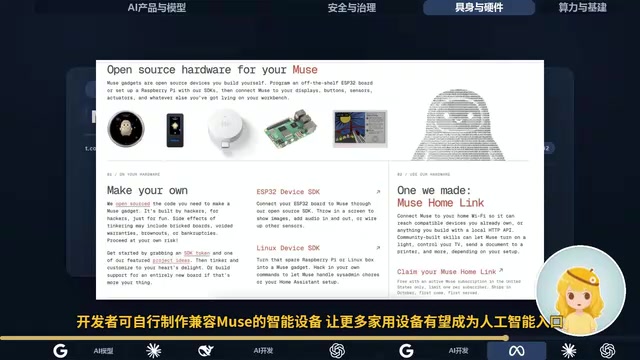
Unitree is a leading Chinese robotics hardware company, well known for its low-cost quadruped robots (such as the Go1 and Go2 series) and increasingly active in humanoid robotics (H1 and G1 series). The open-sourced Unifor LMW-LA 1.0 falls into the "foundation model" category — analogous to pre-trained large language models in NLP, it is a general-purpose perception-action model pre-trained on massive robot manipulation data. Downstream tasks can be fine-tuned on this base without collecting large amounts of task-specific data from scratch. At 6 billion parameters, it sits in the medium range for embodied AI — unlike language models that routinely exceed hundreds of billions of parameters, robot models are typically kept smaller due to real-time inference latency constraints. MUSE is Meta's home AI assistant hardware product, positioned similarly to Amazon Echo or Google Nest but deeply integrated with Meta's AI capabilities (such as Llama models). Opening the hardware integration SDK means third parties can embed MUSE's AI capabilities into their own devices. Meta's strategy mirrors the expansion playbook of Apple HomeKit or Google Home — aggregating more hardware partners through an open platform to compete through ecosystem scale rather than single-product competition.
Compute & Infrastructure: Astronomical Investment Continues
Reports indicate that Anthropic's IPO prospectus projects massive spending on AI infrastructure over the next decade, with partnerships spanning Nvidia, Broadcom, Amazon, Google, and Microsoft, and plans focused on long-term compute needs.
Separately, Sam Altman confirmed that Cerebras is a close partner of OpenAI, with both companies working intensively on accelerating AI model inference speed — specifically, the speed at which models process queries and generate responses. As applications become more Agent-based and real-time interaction demands rise, inference speed is becoming a competitive dimension as critical as training compute.
Cerebras is a US AI inference chip startup whose core product, the Wafer-Scale Engine, uses an entire wafer as a single chip — far larger than traditional GPUs — enabling extremely low latency and high throughput in inference scenarios. Inference speed and training compute represent two distinct dimensions of AI infrastructure: the training phase requires large-scale parallel computation to optimize model parameters, typically dominated by Nvidia H100/H200 clusters; the inference phase requires generating responses within milliseconds after a user request, making it far more latency-sensitive. As AI products evolve from single-turn Q&A to multi-step autonomous Agents — where each sub-task requires a model call — the cumulative effect of inference latency is dramatically amplified. Being 100ms slower per step means 1 second slower across ten steps. This makes inference speed a critical competitive metric in the Agent era, and explains why OpenAI has named Cerebras a "close partner."
Summary
From Google's tiered subscription strategy, to Unitree's open-source robot model and Meta's open hardware ecosystem, to OpenAI's governance controversies and everyone's massive compute investments — this edition's developments trace two main threads running through the AI industry: capabilities are accelerating their diffusion downward (through open source and open platforms), while frontier capabilities and compute investment are accelerating their concentration at the top.
Related articles

ChatGPT Space Launches: Team Collaboration and New Pages Features Explained
ChatGPT Space is OpenAI's new team collaboration feature with Pages, real-time collaboration, and Slack/Google Drive sync. We break down its privacy design, multi-platform integration, and the full workflow from conversation to document.

Migrating Apache Spark UDFs to GPU Acceleration with AI Agents
NVIDIA developer blog explains how AI Agents rewrite Apache Spark UDFs for GPU acceleration, covering migration criteria, agent rewriting and verification workflows, plus pitfalls like result consistency and CPU-GPU transfer overhead.

Zed Editor v0.40.4-rc2 Released: Usage Credits Now Available Without Upgrading
Zed editor releases v0.40.4-rc2, allowing users to use usage credits for AI features without upgrading to a paid plan, lowering the trial barrier.