Google Beam Experiment Upgraded: Life-Size Visuals + Spatial Audio Reshape Hybrid Meeting Experience

Google Beam redefines hybrid meetings with life-size imagery and spatial audio technology.
Google has launched a new experimental feature for Google Beam that uses light field display systems to render remote participants at 1:1 life-size scale, with spatial audio that makes sound come from the direction of each person's image. The goal is to solve the marginalization of remote participants in hybrid meetings. Unlike Meta's VR headset approach and Microsoft Mesh's virtual avatars, Google opts for a headset-free solution emphasizing real imagery, though large-scale commercialization still faces hardware cost and network bandwidth challenges.
Google Beam's New Experiment: Redefining Hybrid Meetings with Life-Size Visuals and Spatial Audio
Google recently announced a new experimental feature for Google Beam, designed to bring a more immersive experience to group meetings. The core goal of this update is to enable hybrid meeting participants to see and hear their colleagues at true-to-life size and sound, making interactions between remote and in-person participants more natural and equitable.
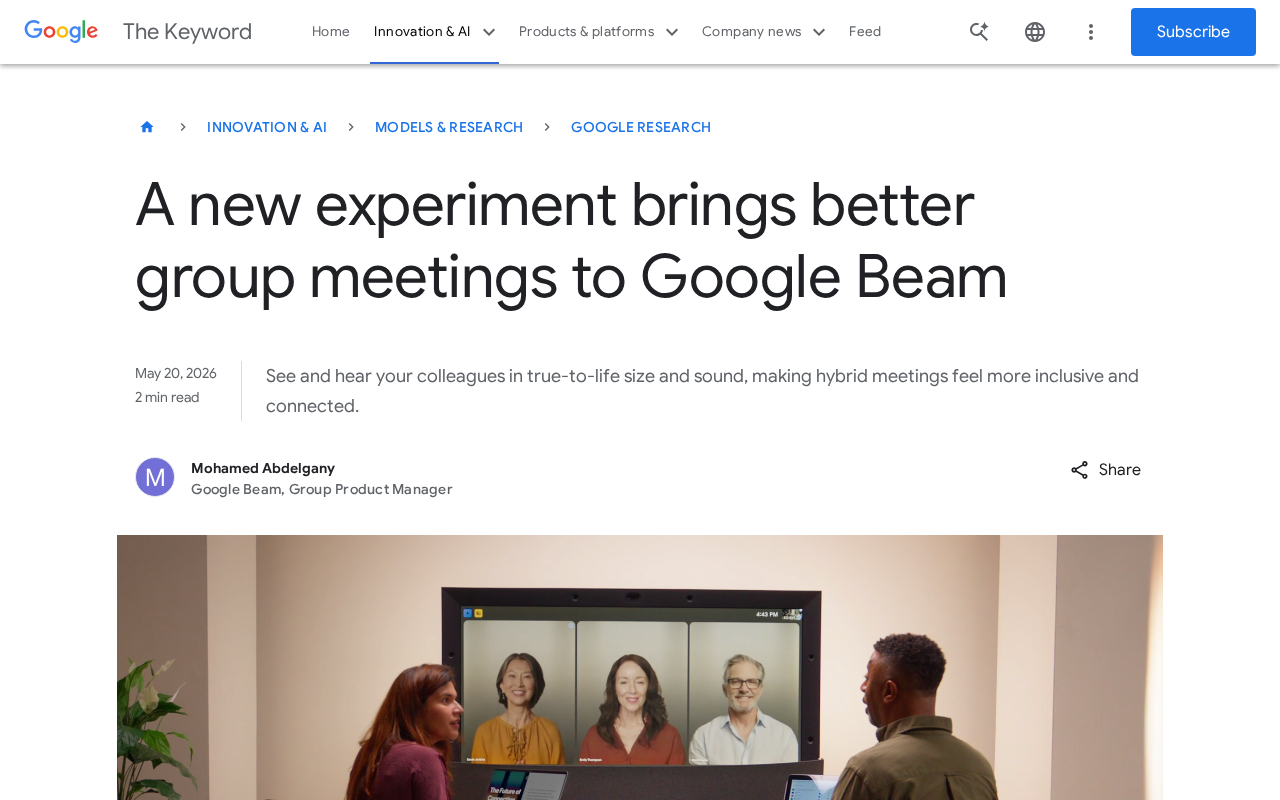
What Is Google Beam? Google's Immersive Communication Exploration
Google Beam is a cutting-edge product in Google's exploration of immersive communication. Unlike traditional video conferencing tools, Beam's design philosophy centers on deeply integrating hardware and software to create a "face-to-face" remote communication experience. Participants are no longer small rectangles on a screen — instead, they appear before others at near life-size proportions.
Notably, Google Beam (formerly Project Starline) relies on core technologies including Light Field Display systems and real-time 3D reconstruction. The system uses multiple cameras to simultaneously capture participants from different angles, employing AI algorithms to synthesize depth-aware 3D images in real time, which are then projected onto a specialized glasses-free 3D display. This means viewers can perceive the other person as "physically present" on the other side of the screen without wearing any glasses or headsets. The challenge with this technical approach lies in the enormous computational demands — early versions required custom high-performance workstations to support real-time rendering, which is a key reason why commercialization has been slow.
This design philosophy stems from a simple but profound insight: In traditional video conferencing, remote participants are often treated as "second-class citizens." Their video is compressed into small windows, their voice comes from laptop speakers, and they're easily overlooked during discussions. Google Beam aims to fundamentally solve this problem.
Three Core Improvements in Google Beam's New Experiment
True-to-Life Visual Representation: 1:1 Reproduction of Remote Colleagues
A major highlight of this experiment is "true-to-life size" — visual representation at actual human scale. Remote participants' images will be displayed at approximately 1:1 proportions, making people in the meeting room feel as though their remote colleagues are sitting right across from them. This proportional visual representation significantly enhances non-verbal communication, including the transmission of facial expressions, gestures, and body language.
Spatial Audio Technology: Sound Comes from the Direction of the Image
Beyond the visual layer, authentic sound reproduction is equally central to this upgrade. Through spatial audio technology, a remote participant's voice will come from the direction where their image is located, rather than from a fixed speaker.
Spatial Audio is an audio technology that creates a sense of direction and distance by simulating how sound propagates in three-dimensional space. Its core principle is based on Head-Related Transfer Function (HRTF), which describes the frequency response differences that occur as sound waves arrive at the ears from different directions due to the shape of the pinnae, head, and torso. By digitally simulating these differences, the system can make listeners perceive sound as coming from specific directions — even when using ordinary speakers or headphones. In multi-person meeting scenarios, spatial audio can assign each remote participant an independent sound field position corresponding to their image location, dramatically reducing cognitive load when multiple people speak simultaneously, enabling the brain to naturally distinguish different speakers just as it would in a real environment. This directional sense of sound makes multi-person discussions more natural — you can determine who is speaking by the direction the sound comes from, just like in a real meeting room.
More Inclusive Hybrid Meeting Design
Google specifically emphasized the keyword "inclusive" in its announcement. In an era where hybrid work has become the norm, ensuring remote participants have equal presence and influence as in-person participants is the core challenge facing all collaboration tools. This Google Beam update is a direct technical response to that challenge.
There is deep psychological evidence behind this challenge. Stanford communications professor Jeremy Bailenson systematically identified "Zoom Fatigue" in his 2021 research, pointing out that traditional video conferencing causes fatigue through multiple dimensions: social pressure from sustained eye contact, self-evaluation anxiety from seeing one's own real-time image, cognitive overload from limited body language transmission, and physical discomfort from maintaining a static seated position for extended periods. True-to-life representation and spatial audio specifically address the core pain points of "limited body language transmission" and "lack of directional sound cues," reducing at the neurocognitive level the extra effort the brain requires to process remote communication signals.
The Technology Race for Immersive Hybrid Meetings: Google vs Microsoft vs Meta
Google is not the only tech giant pushing in this direction. Microsoft's Microsoft Mesh, Meta's Quest series, and Cisco's Webex Hologram are all exploring how to make remote meetings more immersive. However, each company takes a different technical approach, driven by distinct strategic logic:
- Meta focuses on VR/MR headset-driven virtual meeting spaces. Meta bets on mixed reality headsets (MR Headsets), building fully immersive virtual workspaces through the Quest series. Their long-term goal is to build a metaverse office ecosystem, but high device costs and wearing comfort remain barriers to adoption.
- Microsoft integrates 3D avatars into Teams through Mesh. The logic is to reduce dependence on cameras and bandwidth, allowing users to participate in meetings as 3D avatars without turning on their cameras — better suited for asynchronous collaboration and large-scale virtual event scenarios.
- Google has chosen a path that emphasizes "realism," prioritizing real human imagery over virtual avatars. Essentially, it seeks the optimal enterprise solution between "immersion" and "ease of adoption" — no change in user behavior required, while delivering presence that surpasses ordinary video conferencing.
Google's strategy has its unique advantages: no headset required, lowering the barrier to entry while preserving authentic interpersonal interaction. This may offer greater practical value in enterprise application scenarios.
Google Beam's Outlook: How Far from Experiment to Commercial Deployment?
While this feature is still in the experimental stage, it represents an important direction in the evolution of hybrid work technology. As remote work continues to proliferate, meeting experience equality will become an increasingly important factor when enterprises choose collaboration tools.
Widespread adoption of immersive meeting solutions still faces several practical challenges:
- Procurement and deployment costs of specialized hardware (custom hardware like light field displays costs far more than standard meeting room equipment)
- High-quality video transmission bandwidth requirements (multi-camera real-time 3D data streams place higher demands on enterprise network infrastructure)
- Enterprise IT department evaluation and deployment cycles
Whether Google Beam can move from experiment to large-scale commercial deployment still needs time to verify. But Google's sustained investment in this direction signals the tech industry's firm confidence in the "next-generation meeting experience." When the technology is mature enough, the "Zoom fatigue" that plagues countless remote workers may finally see fundamental relief, ushering in an era of more natural, equitable remote collaboration.
Related articles
 Product Reviews
The Programmer's Desk Setup Guide: Building a Workspace That Feels Like Home
Discover how programmers build productive, comfortable workspaces. From multi-monitor setups to ergonomic design, explore the desk philosophy that drives focus and flow.
 Product Reviews
Qoder vs Cursor Real-World Comparison: Which $20/Month AI IDE Is Better?
Hands-on comparison of Qoder vs Cursor AI IDEs: Agent autonomy, human interaction count, and architecture decisions. Qoder needed only 2 interactions vs Cursor's 8.
 Product Reviews
Cursor Cloud Agent Demo: Eliminating Bottlenecks Across the Entire Software Development Lifecycle
Deep analysis of Cursor's Cloud Agent demo showing how cloud VMs, automated test artifacts, and a full-chain control plane systematically eliminate human bottlenecks across the software development lifecycle.