Google Brings Personalized Gemini AI Assistant to Cars

Google brings Gemini's personalization capabilities to in-car systems, reshaping driving interactions with personal data.
Google is extending Gemini's Personal Intelligence feature to in-car systems, enabling drivers to receive customized responses based on personal data from Gmail, Calendar, Maps, YouTube, and more. The article notes that in-car voice assistants have long remained at the stage of executing simple commands, whereas personalization enables the assistant to provide contextually relevant answers by combining schedules, routes, emails, and content preferences. In driving scenarios, attention is limited and voice is the primary mode, so how well the assistant "knows you" directly determines its value. Through this, Google is using personalized data to build an ecosystem moat and raise switching costs for users, but it also raises privacy and control issues around cross-service data access. Competition in in-car AI is shifting from "whether it can understand" to "whether it understands you well enough," although the feature's launch timeline, supported vehicle models, and regional scope remain unclear.
Title
Google Brings Personalized Gemini AI Assistant to Cars
Meta Description
Google is bringing the Personal Intelligence capabilities of its Gemini AI assistant to cars, enabling access to personal data from Gmail, Calendar, Maps, YouTube, and more to deliver personalized responses in driving scenarios. This article analyzes its value, privacy boundaries, and impact on in-car AI competition.
Article Content
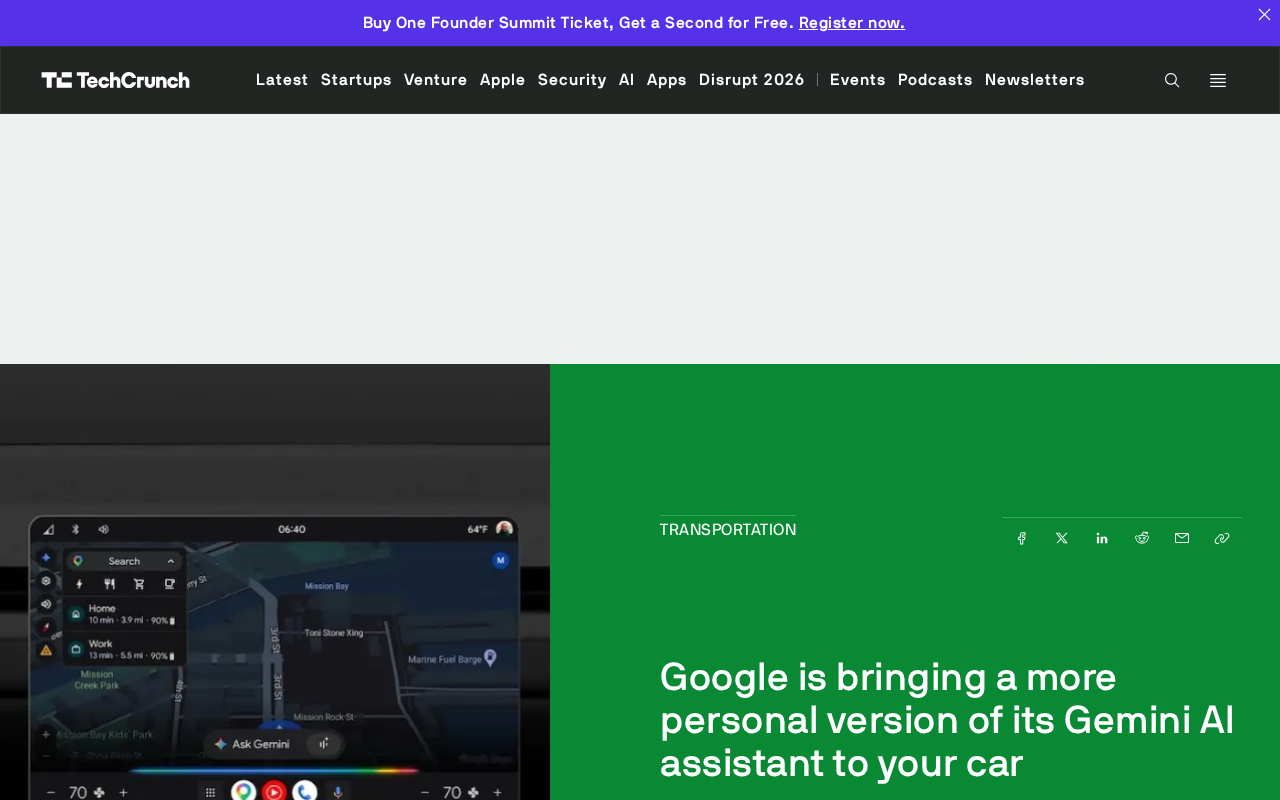
Google is extending the personalization capabilities of its Gemini AI assistant to the automotive context. According to the latest news, Gemini's Personal Intelligence feature will arrive on in-car systems, allowing drivers to receive customized responses based on personal data while on the road.
Personalized AI Enters the Cockpit
In-car voice assistants are nothing new, but most products remain at the stage of executing simple commands—navigating to a destination, playing a song, making a call. What sets Gemini Personal Intelligence apart is its ability to draw on information from Google services such as Gmail, Calendar, Maps, and YouTube to deliver more contextually relevant answers in driving scenarios.
This means the assistant is no longer merely responding passively to commands, but can proactively understand the user's schedule, frequent routes, email exchanges, and content preferences. For example, on the morning commute, it might combine calendar data to remind you that the location of your first meeting today has changed; or on a long drive, recommend suitable podcasts or music based on your YouTube watch history.
Gemini Personal Intelligence is a personalization layer that Google has introduced within the Gemini assistant. Its core mechanism is to inject the user's personal data from Google services such as Gmail, Calendar, Maps, and YouTube as context into the model's reasoning process. Unlike ordinary Gemini conversations, Personal Intelligence emphasizes cross-application "situational memory": the assistant can retrieve the user's historical emails, schedules, frequent locations, and content preferences to generate answers tailored to the individual's circumstances rather than generic responses. This capability essentially relies on data authorization and unified identity under the Google account system, and represents an important step in Google's effort to turn data scattered across its products into differentiation for its AI experience.
Why the In-Car Scenario Deserves Attention
Driving is one of the most valuable deployment scenarios for AI assistants—and also one of the hardest to get right. A driver's attention is naturally limited, and interaction must be voice-first with safety as a precondition. Under these constraints, how well the assistant "knows you" directly determines whether it is genuinely useful.
By choosing to bring Personal Intelligence into cars, Google is essentially building a moat with personalized data. When the assistant can connect information across email, calendar, maps, and video platforms, the cost for users to switch to another in-car system rises significantly. This also continues Google's strategy in recent years—gradually embedding Gemini from a standalone chat tool into search, productivity, mobile, and now mobility scenarios.
In-car voice assistants have undergone two generations of evolution, from fixed command sets to cloud-based semantic understanding. Early systems (such as rule-based in-car voice) could only recognize preset commands with low fault tolerance; after connecting to cloud-based ASR and NLU, assistants could handle natural language but still focused mainly on single-turn task execution. Gemini Personal Intelligence represents a third stage: the assistant not only understands "what is said" but can also infer "why it is said" and "what is needed next" by combining long-term user data. In driving scenarios, this contextual capability is especially critical, because drivers cannot correct commands over multiple turns as they would on a phone—a single interaction must hit the intent, which places higher demands on the assistant's degree of personalization.
The Convenience and Boundaries of Data Integration
Behind the personalized experience is data interconnection across services. Gemini Personal Intelligence needs to access the user's data across multiple Google products in order to generate responses tailored to personal circumstances. For heavy Google users, the convenience brought by this integration is intuitive; but it also means the in-car assistant will touch fairly private dimensions of information.
The original article did not disclose details about data permissions, privacy control options, or phased rollout plans for this feature in the in-car environment. What can be expected is that Google needs to find a balance between personalized experience and user trust, especially in a space like the car that is both private and public.
Cross-service data interconnection technically involves mechanisms such as OAuth authorization, data minimization, and purpose limitation. Google typically uses account-level authorization to let third parties or its own AI features access specific scopes of data, and users can view and revoke authorization in account settings. But in the in-car environment, data access faces additional complexity: vehicles may be shared by multiple people, voice interactions may be overheard by passengers, and personalized information returned by the assistant (such as email content or schedule details) risks being learned by others in the car. Therefore, in-car personalized assistants usually need designs such as driver identity recognition, sensitive information filtering, and "driver-only audible" output. These privacy control details are precisely the gaps in the currently disclosed information.
Impact on the In-Car AI Competitive Landscape
By putting Gemini's personalization capabilities into cars, Google is sending a signal to automakers and third-party in-car assistant providers alike: competition in in-car AI is shifting from "whether it can understand" to "whether it understands you well enough." Whoever can better integrate the user's service ecosystem and data is more likely to occupy the interaction entry point in the cockpit.
At present, the specific launch timeline, supported vehicle models, and regional scope of the feature remain unclear. But the direction is clear—AI assistants are moving from phones and desktops into another important space users face every day.
One-line Summary
Google brings Gemini's personalization capabilities to in-car systems, reshaping driving interactions with personal data.
Paragraph Summary
Google is extending Gemini's Personal Intelligence feature to in-car systems, enabling drivers to receive customized responses based on personal data from Gmail, Calendar, Maps, YouTube, and more while on the road. The article notes that in-car voice assistants have long remained at the stage of executing simple commands, whereas personalization enables the assistant to provide contextually relevant answers by combining schedules, routes, emails, and content preferences. In driving scenarios, attention is limited and voice is the primary mode, so how well the assistant "knows you" directly determines its value. Through this, Google is using personalized data to build an ecosystem moat and raise switching costs for users, but it also raises privacy and control issues around cross-service data access. Competition in in-car AI is shifting from "whether it can understand" to "whether it understands you well enough," although the feature's launch timeline, supported vehicle models, and regional scope remain unclear.
Related articles

Python 3.15 New Feature: Is the sentinel Type Better Than None?
Python 3.15 adds the sentinel type, using named unique sentinel objects to replace None and bare object(), resolving confusion among missing values, explicit emptiness, and invalid input while avoiding type hint failures.

Deep Learning's Three Architectures and the Universal Approximation Theorem: A Complete Guide to MLPs, CNNs, and Transformers
Explaining the inductive bias differences among MLP, CNN, and Transformer, the existence meaning of the Universal Approximation Theorem (UAT), and the role of Taylor expansion in approximation analysis, while clearing up common misconceptions.

GitLab Emergency Patch Release: Analysis of Critical Security Fixes
GitLab releases critical patch 19.5.1, sparking 355 points of discussion on Hacker News. This article analyzes the background, upgrade steps for self-hosted instances, and verification points to help DevOps teams respond quickly to security updates.