Google Cloud Accidentally Deletes All Data of Australian $124 Billion Fund: CEO Apology and Disaster Recovery Lessons

Google Cloud accidentally deleted all UniSuper data; third-party backup was the only lifeline.
In 2024, Google Cloud accidentally deleted the entire cloud infrastructure of Australian pension fund UniSuper. Regional replication failed completely because the deletion operation was synchronously replicated across all zones. UniSuper recovered its data thanks to an independent third-party backup but still experienced days of service outage. Google Cloud CEO issued a rare public apology. The incident warns enterprises: regional replication is not backup, and organizations must build data protection strategies independent of any single vendor.
Google Cloud Deletes All UniSuper Data: What Happened
In 2024, a rare cloud computing incident shocked the global fintech community: Google Cloud Platform (GCP) accidentally deleted the entire cloud infrastructure of Australian pension fund UniSuper. The fund manages $124 billion in assets and serves hundreds of thousands of members. The incident not only exposed potential data security risks inherent in cloud service providers but also triggered deep industry reflection on cloud computing reliability.
Fortunately, UniSuper relied on a third-party backup service that preserved a complete copy of their data, preventing catastrophic permanent loss. However, the incident still caused a service outage lasting several days, leaving hundreds of thousands of fund members unable to access their accounts.
Regional Replication Completely Failed: Why Multiple Redundancies Couldn't Save the Day
A Systemic Vulnerability in Google Cloud's High-Availability Architecture
The most shocking aspect of this incident is that Google Cloud's Regional Replication mechanism failed to prevent the data deletion.
To understand this, you need to first understand how regional replication works technically. Taking Google Cloud as an example, its infrastructure is divided into multiple "Regions," each containing at least three physically isolated "Availability Zones." Under normal conditions, data is automatically synchronized across these availability zones, ensuring that services continue running even if any single data center experiences hardware failure, power outage, or natural disaster. This design is built to combat single points of failure at the "physical layer."
However, regional replication has a fundamental architectural blind spot: it replicates data state, not data safety. When a deletion command is executed at the Control Plane level, the "delete" operation itself is synchronously replicated to all copies, causing data across all availability zones to disappear simultaneously. This is exactly the core mechanism behind the UniSuper incident — the redundancy system faithfully executed the erroneous operation rather than blocking it. Google Cloud's highly-touted high-availability architecture was rendered useless in the face of a systemic error.
This fact overturns many enterprises' fundamental assumptions about cloud service security — relying solely on a cloud provider's own redundancy mechanisms does not fully guarantee data safety. Regional replication can protect against hardware failures, but it cannot prevent cascading deletions caused by configuration errors or operational mistakes.
Third-Party Backup Became the Only Lifeline
UniSuper was able to recover its data entirely because it had adopted a third-party backup solution independent of Google Cloud. For a financial institution managing over $124 billion in assets, the consequences of data loss would be unthinkable — retirement savings records for hundreds of thousands of members, complex portfolio data, and complete transaction histories. The permanent loss of any of these could trigger legal and regulatory crises.
Notably, UniSuper is regulated by the Australian Prudential Regulation Authority (APRA), and APRA's CPS 234 information security standard explicitly requires regulated entities to establish independent data recovery capabilities. This means UniSuper's adoption of third-party backup was not just a technical decision but also a compliance obligation — a regulatory framework that in hindsight proved remarkably forward-thinking and set a benchmark for data protection across the entire industry.
Google Cloud CEO Thomas Kurian Issues Rare Public Apology
Top Management Takes Direct Responsibility
Following the incident, Google Cloud CEO Thomas Kurian issued a rare public statement, directly acknowledging the error and accepting responsibility. This is extremely uncommon in the cloud computing industry — major cloud providers facing service failures typically prefer to downplay issues using technical language, and rarely have CEOs personally step forward to apologize.
Google Cloud's response demonstrated the severity of the situation. As one of the world's three major cloud service providers, GCP has long held the third-place market position, accounting for approximately 10-11% of global cloud infrastructure market share, far behind Amazon AWS (approximately 32%) and Microsoft Azure (approximately 22%). To close the gap, Google Cloud has been aggressively pushing into the enterprise market in recent years, particularly targeting high-value industries such as financial services and healthcare, leveraging its technical advantages in data analytics (BigQuery), AI/ML (Vertex AI), and Kubernetes container orchestration (GKE) as core selling points. Large financial institutions like UniSuper are precisely the flagship customers GCP has been actively pursuing.
This incident occurred during a critical period of GCP's enterprise customer expansion, and the reputational damage far exceeded the technical level — it directly undermined potential enterprise customers' fundamental trust in GCP's reliability and provided competitors AWS and Azure with powerful PR ammunition.
Enterprise Cloud Security Best Practices: Lessons from the UniSuper Incident
Multi-Cloud Deployment and Independent Backup Strategies Are Essential
This incident served as a wake-up call for enterprises worldwide. Here are several key takeaways:
-
Multi-cloud or hybrid cloud deployment reduces single-point risk: Even a top-tier cloud provider like Google can make serious mistakes. Enterprises should consider multi-cloud architectures or at minimum maintain completely independent backup solutions.
-
Regional replication ≠ true backup: Data replication within the same provider cannot protect against systemic errors. True disaster recovery requires physical and logical isolation from the primary provider.
-
Financial institutions need protection standards beyond SLAs: Service Level Agreements (SLAs) are contractual commitments between cloud providers and customers regarding service availability, performance, and compensation standards. Mainstream cloud providers typically promise 99.9% to 99.99% availability. However, SLAs have fundamental limitations: compensation caps are usually only a percentage of monthly service fees, far insufficient to cover actual losses from data loss. More critically, SLAs guarantee "service availability," not "data integrity." Institutions managing large-scale assets cannot rely solely on cloud providers' SLA commitments and should establish higher-standard data protection systems.
-
Conduct regular disaster recovery drills: Disaster Recovery (DR) drills are the most easily overlooked yet critically important component of an enterprise's data protection system. The industry typically measures DR capability using two core metrics: Recovery Time Objective (RTO) — the maximum allowable time from disaster occurrence to system restoration; and Recovery Point Objective (RPO) — the maximum acceptable data loss time window. The multi-day service outage in the UniSuper incident was partly due to the complexity of large-scale data restoration — even with complete backups, redeploying PB-scale data to a cloud environment requires significant time and precise coordination. Many enterprises establish backup mechanisms but never conduct complete recovery drills, only to discover corrupted backup data or missing recovery procedures when a real disaster strikes.
Conclusion: Data Protection in the Cloud Era Is a Must-Have, Not a Nice-to-Have
The Google Cloud deletion of UniSuper's data is a landmark case in the history of cloud computing. It reminds all enterprises that rely on cloud services: no matter how advanced the technology, human error and systemic risks always exist. Building a data protection strategy independent of any single vendor is not overkill — it is a life-or-death necessity.
UniSuper's experience proves that what may seem like a "redundant" backup investment is precisely what saves an organization when disaster strikes.
Related articles
Meta Muse Hits 900K Downloads in Six D…
Meta Muse Hits 900K Downloads in Six Days: The AI Agent Era Has Officially Arrived
Meta's AI agent Muse hit 902K downloads in 6 days, topping US App Store and Google Play charts above ChatGPT and Claude. A deep dive into Muse's capabilities and the AI Agent race.
 Industry Insights
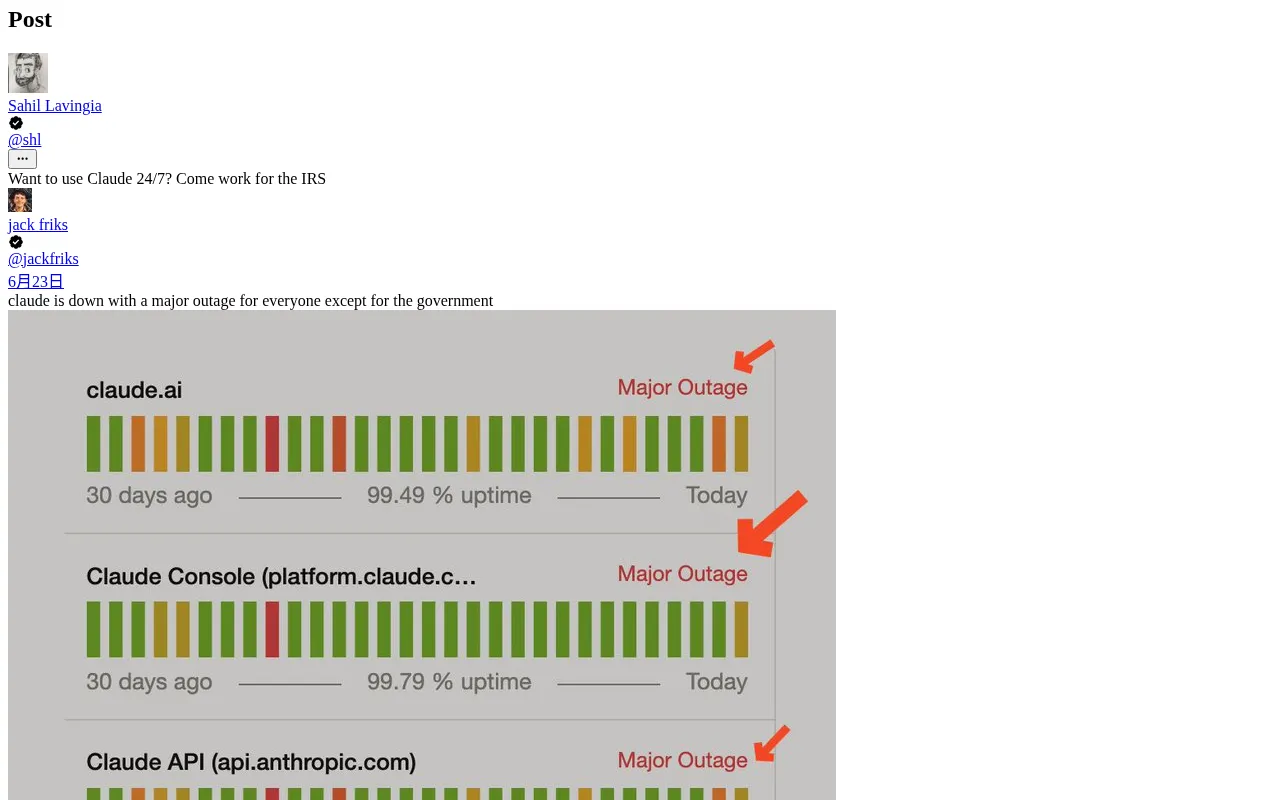
IRS Fully Embraces Claude AI, Accelerating Federal Government's AI Adoption
The IRS is recruiting staff with 24/7 Claude AI access, marking Anthropic's breakthrough into the federal government. Explore the strategic implications and tax use cases.
 Industry Insights
The IRS Mobile App Debate: A Trust Crisis in Government Digital Transformation
The IRS's proposed mobile app has sparked heated debate. This article analyzes the core arguments, exploring data security, privacy, and the trust crisis in government digital transformation.