Google Cuts Prices 50%, OpenAI Boosts Speed 14x: The AI Inference Cost War Is Fully Underway

Google halves inference prices while OpenAI claims 14x speed gains, signaling a new AI cost-and-speed war.
On August 13, Google launched Gemini 3.7 Flash at half the previous generation's price ($0.75/M input tokens), targeting Agent workflows, while OpenAI previewed GPT-5.6 Sol Ultra Fast with up to 14x speed improvements powered by Cerebras chips. The simultaneous announcements signal AI competition shifting from pure capability to a three-axis battle of capability, cost, and speed—though real-world validation of these claims remains pending.
Two Starting Guns Fire Simultaneously in the AI Inference Market
On August 13, two starting guns for a price war fired almost simultaneously in the AI inference market. Google released Gemini 3.7 Flash with pricing slashed to half of the previous generation, while OpenAI previewed GPT-5.6 Sol Ultra Fast, claiming up to 14x speed improvements.
These two announcements may appear independent, but they point to the same trend: competition among model providers is shifting from pure "capability comparison" to simultaneously fighting on three fronts—capability, cost, and speed. For developers and everyday users, this means the barrier to accessing large language models is rapidly dropping.
A basic concept worth understanding here: "inference" refers to the stage where an AI model actually works after training is complete—receiving user input and generating output. Unlike the one-time investment of tens of millions of dollars during training, inference represents an ongoing cost. As AI applications achieve mass adoption, the total compute consumed during inference is surpassing training, becoming the largest computational bottleneck in the AI value chain. This is precisely why Google and OpenAI have independently shifted their competitive focus to inference cost and speed—it's currently the highest-value, most fiercely contested segment of the industry.
One telling detail: the fact that both giants chose to release signals on the same day carries strong market strategy implications—neither wants to fall even half a step behind on the new battlefields of cost and speed.
Google Gemini 3.7 Flash: Prices Cut in Half
Google Gemini 3.7 Flash's new pricing is $0.75 per million input tokens and $3.75 per million output tokens—a straight 50% reduction from the previous generation.
It's worth explaining the concept of token-based pricing here. Tokens are the basic units that large language models use to process text, and they don't simply equate to individual characters or words. In English, one token corresponds to roughly 4 characters or 0.75 words; in Chinese, one character typically maps to 1-2 tokens. Model providers charge per million tokens, distinguishing between input (the prompts users send) and output (the responses the model generates). Output pricing is typically higher than input because the generation process requires autoregressive computation token by token, demanding more compute. Understanding this mechanism is essential for truly evaluating how price cuts impact actual usage costs.

More critically, consider the positioning. Google has explicitly targeted this model at coding and Agent workflows. These scenarios share a common characteristic: high-frequency calls—an automated Agent completing a task might need to invoke the model dozens or even hundreds of times consecutively. In such cases, even a reduction of a few cents per call accumulates into significant cost savings at scale.
An AI Agent refers to an intelligent system capable of autonomously perceiving its environment, formulating plans, and executing multi-step tasks. Unlike traditional single-turn Q&A, Agents employ a "Reason-Act-Observe" (ReAct) loop: first analyzing the current state, then invoking tools or APIs to perform actions, then deciding the next step based on returned results. A typical Agent task—such as automated data analysis or code debugging—may involve dozens of model calls, each consuming tokens. This multiplier effect makes per-inference cost a decisive factor in the economic viability of Agent applications.
Strategic Significance of Targeting Agent Workflows
Agent applications are one of the core directions for AI deployment today, but their economic model has always been constrained by inference costs. When an Agent needs to repeatedly "think-act-observe," token consumption grows exponentially. Google's choice to cut prices 50% at this juncture is essentially clearing cost barriers for Agent ecosystem scaling. This isn't just a pricing strategy—it's ecosystem positioning. Once developers build Agent applications on Google's platform and accumulate extensive workflows and prompt templates, the cost of migrating to other platforms increases significantly. This lock-in effect is the core logic of ecosystem competition.
OpenAI GPT-5.6 Sol Ultra Fast: 14x Speed Improvement
If Google is playing the price card, OpenAI is betting on speed. GPT-5.6 Sol Ultra Fast delivers hard metrics: up to 14x speed improvement, outputting 750 tokens per second, powered by Cerebras's specialized inference chips.
Cerebras Systems is a company focused on AI accelerator chips. Its core product, the WSE (Wafer Scale Engine), is currently the world's largest single chip, using an entire silicon wafer as one complete chip with an area over 50 times that of a typical GPU. This design eliminates the interconnect bandwidth bottlenecks in traditional multi-chip systems, allowing data to flow at high speed on-chip—particularly suited to the stringent low-latency and high-throughput demands of inference scenarios. Unlike NVIDIA GPUs, which rely on batching large numbers of requests for parallel processing to improve efficiency, Cerebras's architecture has a structural advantage in single-request latency performance. This is the hardware foundation enabling such high token output speeds.
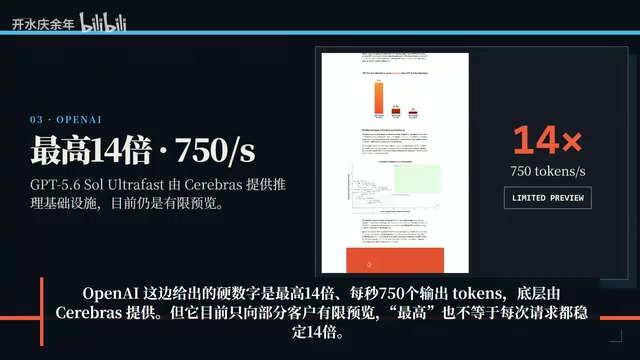
Two qualifiers here demand sober assessment. First, it's currently only available as a limited preview to select customers and hasn't been broadly released. Second, "up to 14x" means this is a peak figure—it doesn't mean every request will consistently achieve 14x acceleration.
What 750 Tokens Per Second Output Speed Means
An output speed of 750 tokens per second far exceeds human reading speed. For an intuitive conversion: 750 tokens equals approximately 560 English words or 375-750 Chinese characters per second, meaning a thousand-word article can be generated in 1-2 seconds. For real-time conversation, code completion, streaming generation, and similar scenarios, this speed essentially means a "zero-wait" interaction experience. As the underlying compute provider, Cerebras's wafer-scale chips do possess unique advantages in inference throughput. However, the gap between "limited preview" and "general availability" is often bridged only by surviving the rigorous test of real business workloads.
Three Axes of AI Inference Competition: Capability, Cost, Speed
On the same day, Google and OpenAI pushed inference competition along three axes: capability, cost, and speed. Model providers have begun simultaneously driving down per-call pricing and wait times.
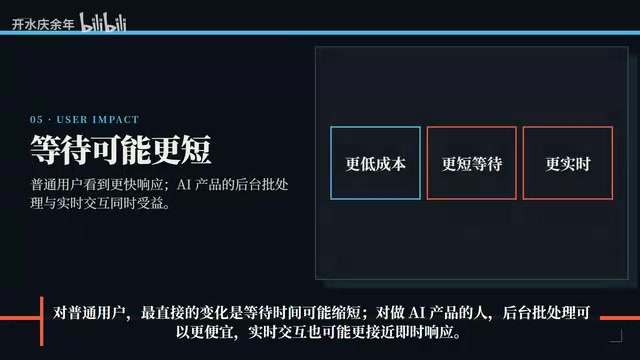
This shift affects different stakeholders differently:
- For everyday users: The most immediate impact is potentially shorter wait times, with AI responses approaching "instant."
- For AI product developers: Backend batch processing tasks become cheaper, and real-time interactions approach instantaneous response—opening space for new product paradigms.
Over the past two years, industry competition focused primarily on "model capability"—who scores higher on benchmarks, who handles more complex tasks. Now, as leading models converge in capability, cost and speed have become the new differentiation battleground. This transition follows a classic pattern in technology industries: when core technical metrics become homogenized, competition inevitably extends to cost efficiency and user experience. Just as the cloud computing market initially sold on features and performance, mature-stage competition increasingly revolves around pricing, latency, and service level agreements.
Can Launch Day Numbers Survive Real-World Business Validation?
We must acknowledge this competition is still in its early stages. The real test lies in whether several key metrics can be delivered.
In AI inference services, "up to X times faster" typically refers to peak performance under ideal conditions—including shorter input sequences, lower server concurrency, specific model configurations, and so on. In actual production environments, when thousands or millions of users send requests simultaneously, resource contention causes queuing delays, long-context processing increases per-inference time, and the average speed users actually experience may be only a fraction of peak performance. This is why the industry typically uses percentile metrics like P50 (median latency) and P99 (latency ceiling for 99% of requests) to measure real service quality rather than relying solely on peak numbers. Similarly, whether post-discount model quality suffers from precision loss or "corner-cutting" distillation is a critical question that requires independent evaluation to verify.
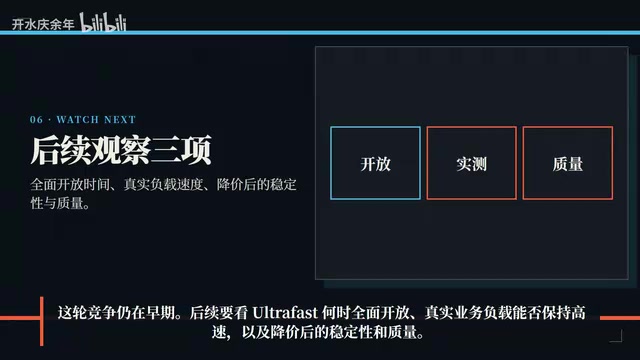
Core questions to watch going forward include:
- When will Ultra Fast become generally available, rather than remaining in preview for a handful of customers;
- Whether high speeds can be maintained under real business loads—peak speed and average speed are often very different things;
- Whether stability and quality will be compromised after price cuts.
If all these metrics are delivered, AI applications will simultaneously benefit from "lower costs" and "shorter wait times"—a dual dividend that will tangibly accelerate AI adoption. But if only the peak figures from announcements materialize, this competition remains at the presentation-slide level.
Conclusion: The Signal Is Clear, Validation Lies in Real-World Performance
The signal released on August 13 is clear: AI inference costs and wait times are declining simultaneously. This marks another critical phase the industry has entered following the model capability race.
But launch day numbers are ultimately just a starting point. Whether it's Google's 50% price cut or OpenAI's 14x speed boost, both ultimately need to be validated through real-world business scenarios. The next round of competition won't be decided by promotional figures from launch events, but verified by model performance in actual production environments. For all AI practitioners, the observation window over the coming months may be worth more attention than the launch event itself.
Related articles

Workbuddy for Absolute Beginners: How a Desktop AI Agent Fits Into Real Workflows
A beginner's guide to the Workbuddy desktop AI agent: installation, claiming credits, file management, and building automated workflows—compared with CodeX for fit and cost, helping professionals shift from AI question-askers to AI managers.

OpenAI's New Agent Stack: Computer Use, Decisions API, and Ultra-Fast Workflows
OpenAI Dev Day unveiled a new agent stack: Computer Use outperforms humans, Decisions API delivers ultra-low-latency classification via Luna, Agents API opens the same Computer Use capabilities, and GPT-6.1 Sol costs only one-seventh of Astra. Core updates, benchmark data, and developer insights.

Liang Wenfeng Open-Sources DeepInfo Inference Framework, Takes On U.S. Ban
DeepSeek open-sources its DeepInfo inference framework after its models, featuring GPU/CPU cross-pipelining, small-model prediction with large-model verification, and full Huawei Ascend and NVIDIA chip support—facing the U.S. federal ban head-on. This article analyzes its significance for AI deployment and open-source strategy.