Google DeepMind Quietly Launches Math Horizon Repository, Reigniting Interest in AI Mathematical Reasoning
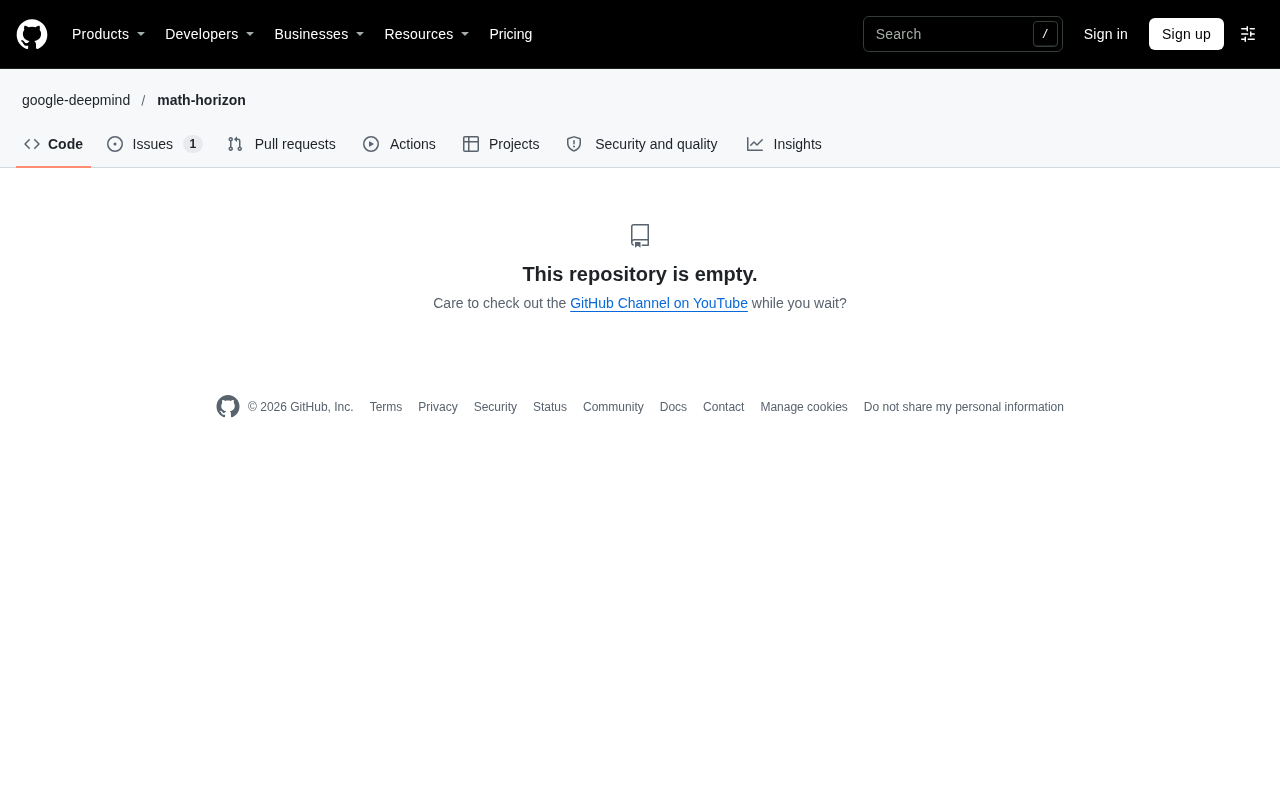
DeepMind was found to have created the Math Horizon repository after it was exposed on Hacker News, sparking speculation about its mathematical reasoning strategy.
Google DeepMind created a code repository called Math Horizon a few hours ago, which was discovered by Hacker News users and sparked discussion. The word Horizon in the repository name suggests it may point to frontier exploration in mathematical reasoning, echoing DeepMind's existing investment in formal mathematics, theorem proving, and large-model reasoning. The article points out that mathematical reasoning has long been regarded as a key yardstick for measuring machine intelligence because it requires strict logical chains and multi-step derivation. Since no official README or blog explanation has been released, community reactions are mainly cautious observation and reasonable speculation, with the view that an empty repository may simply be an internal project management action. If code or evaluation benchmarks are made public later, it could affect the way AI mathematical capabilities are evaluated and the open-source tool ecosystem.
According to Hacker News users, Google DeepMind created a code repository called "Math Horizon" a few hours ago. The move quickly sparked discussion in the tech community, although the official purpose and details of the repository have not yet been announced.
Repository Emerges: High Attention Behind a Low-Key Move
Judging from the Hacker News post, the discussion thread's initial popularity was not high, with only 3 points and 2 comments, but that does not prevent it from being a signal point in the AI research circle. DeepMind's positioning in mathematics and reasoning has always been closely watched, and the appearance of any new repository may be interpreted as a bellwether for the focus of its next phase of research.
The name "Math Horizon" itself is also worth pondering. The word Horizon often carries the meaning of "frontier" or "vision," suggesting that the repository may involve frontier exploration in mathematical reasoning rather than being a mere engineering tool. Considering DeepMind's sustained investment in formal mathematics, theorem proving, and the reasoning capabilities of large language models in recent years, this naming direction echoes its existing research lineage.
Hacker News is a tech community owned by Y Combinator, centered on user-submitted links, vote-based ranking, and comment discussions, and it has strong information diffusion capability among developers and AI researchers. Once a project is submitted to the site, even if its initial points are very low, it may quickly gain attention due to the community's sensitivity to specific institutions (such as DeepMind). The "3 points and 2 comments" mentioned in the original text is a typical early state on the site, indicating that the discussion is still at the information-discovery stage rather than having formed a consensus.
Why Mathematical Reasoning Is a "Hard Nut" for AI
Mathematical ability has long been regarded as a key yardstick for measuring the depth of machine intelligence. Unlike natural language tasks, mathematical problems require strict logical chains, symbolic manipulation, and multi-step derivation, with very little room for error. Large language models often suffer from broken reasoning or skipped steps when handling complex math problems, which has prompted researchers to systematically restructure everything from datasets and evaluation benchmarks to training methods.
DeepMind's previous work on math-related benchmarks has already shown its emphasis on this direction. If the new repository is related to mathematical reasoning evaluation, formal proofs, or synthetic data generation, it could have a practical impact on the community. However, in the absence of official documentation, any specific judgment is premature.
Formal mathematics and theorem proving are key background for understanding this direction. Formal mathematics refers to expressing mathematical definitions, theorems, and proofs completely in computer-verifiable formal languages (such as Lean, Coq, and Isabelle) so that every step of derivation can be checked line by line by a machine. Related theorem-proving tasks require models not only to give answers but also to generate proof scripts acceptable to proof assistants, which imposes requirements on symbolic precision and logical completeness far higher than those of natural language generation. DeepMind's previous work in related fields (such as collaboration with the Lean community and synthetic mathematical data generation) has advanced along this path, with the aim of moving the reasoning process of large models from "seemingly plausible" to "verifiably correct."
Community Reaction: Cautious Observation and Reasonable Speculation Coexist
The discussion on Hacker News shows typical early-stage reaction characteristics—limited information and mostly speculation. Some commenters tend to associate the repository with DeepMind's existing mathematics research projects, while others caution against overinterpreting it before a README or official blog explanation is available.
This cautious attitude is reasonable. When research institutions create empty repositories or private repositories, it is sometimes just a routine part of internal project management, and public release may still be a long way off. But from another perspective, DeepMind's choice to create a repository with a clear thematic direction at this time at least shows that the mathematics direction occupies a place in its current workflow.
README is an explanatory file usually named README.md in the root directory of a code repository, used to introduce the project's purpose, installation method, usage examples, and license agreement, and it is the primary basis for outside observers to judge the nature of a repository. For research institutions, repositories often have no README at the initial stage of creation, or contain only internal placeholder content; some projects are also developed first as private repositories and only made public when a paper or blog post is released. Therefore, "the repository exists but has no documentation" is not equivalent to "about to be released," which is also the technical reason the community calls for cautious interpretation.
Practical Significance for Developers and Researchers
For developers concerned with AI reasoning capabilities, the subsequent developments of the Math Horizon repository are worth continued tracking. If the repository eventually makes code or datasets public, it may provide new reference implementations for the open-source tool ecosystem related to mathematical reasoning; if an evaluation benchmark is released alongside it, it may affect how the community assesses models' mathematical abilities.
When information is still incomplete, the rational approach is to stay attentive rather than rush to conclusions. The repository's name, commit history, and subsequent documentation updates will gradually reveal its true positioning. Competition in AI mathematical reasoning continues, and whether this move by DeepMind is a routine action or an important strategic layout, time will tell.
One-line Summary
DeepMind was found to have created the Math Horizon repository after it was exposed on Hacker News, sparking speculation about its mathematical reasoning strategy.
Paragraph Summary
Google DeepMind created a code repository called Math Horizon a few hours ago, which was discovered by Hacker News users and sparked discussion. The word Horizon in the repository name suggests it may point to frontier exploration in mathematical reasoning, echoing DeepMind's existing investment in formal mathematics, theorem proving, and large-model reasoning. The article points out that mathematical reasoning has long been regarded as a key yardstick for measuring machine intelligence because it requires strict logical chains and multi-step derivation. Since no official README or blog explanation has been released, community reactions are mainly cautious observation and reasonable speculation, with the view that an empty repository may simply be an internal project management action. If code or evaluation benchmarks are made public later, it could affect the way AI mathematical capabilities are evaluated and the open-source tool ecosystem.
Related articles

Michael Nielsen Takes Down His Classic Neural Network Textbook, Sparking Community Discussion
Michael Nielsen's classic free textbook Neural Networks and Deep Learning has been taken offline, sparking discussion on Hacker News about the reasons and impact.

Inside the AI Training Data Market: The Trade-off Between Exclusivity and Discounts
G2i founder Gabe Greenberg reveals the dual-track pricing of the AI training data market: labs pay a premium for exclusive data or accept discounts that allow others to buy it.

SessionGraph: Unifying All Coding Agent Sessions in One Interactive Graph
SessionGraph aggregates coding agent sessions into an interactive graph, helping developers review, debug, and manage AI coding workflows across sessions. This article examines its positioning, value, and open questions.