Google EmbeddingGemma 2: A Lightweight, Open Multimodal Embedding Model

Google open-sources EmbeddingGemma 2, unifying text, image, video, and audio embeddings in a 740M-parameter edge-ready model.
Google's EmbeddingGemma 2 is a multimodal embedding model that maps text, images, video, and audio into a single high-dimensional embedding space, fundamentally simplifying cross-modal retrieval. With a maximum of 740M parameters optimized for edge hardware, it outputs 768-dimensional vectors by default and supports truncation to 128 dimensions via Matryoshka Representation Learning. It enables on-device natural language photo search, precise video moment retrieval, and fully offline RAG pipelines when paired with lightweight generative models — all without data leaving the device. Model weights are available on Hugging Face with support for fine-tuning on specialized domains.
Google's newly released EmbeddingGemma 2 maps text, images, video, and audio into a single shared embedding space, aiming to solve a long-standing pain point in cross-modal retrieval: the need to maintain multiple independent models for different modalities. The model is designed to be lightweight and open, with a maximum of 740 million parameters, yet it outperforms larger competitors on several benchmarks and is purpose-built for edge hardware.
One Model, All Modalities
Cross-modal retrieval has traditionally required separate models for text, vision, and audio — a fragmented approach that's both cumbersome and hard to coordinate. EmbeddingGemma 2's core innovation is mapping text, images, video, audio, or any combination thereof into a single unified high-dimensional embedding space.
To use Google's own analogy: a photo of a cat, the word "cat," and the sound of a cat meowing would all cluster close together in this shared embedding space. This unified representation allows a single model to support search, retrieval, classification, and clustering across modalities — without switching between different models.

Parameter and Dimension Design Built for the Edge
The model uses a modular design, capping at 740 million parameters with a clear goal: efficient inference on edge hardware. It outputs 768-dimensional vectors by default, but thanks to Matryoshka Representation Learning (MRL), developers can truncate the output down to as few as 128 dimensions to flexibly trade off between accuracy and resource usage.
Combined with an 8,000-token context window, EmbeddingGemma 2 can embed long documents, codebases, and even lengthy audio recordings directly on-device for downstream search and retrieval. Google positions this model as setting a new standard for sub-billion-parameter models, outperforming larger models on several benchmarks.
What is Matryoshka Representation Learning (MRL)? MRL is a technique for training embedding models, inspired by Russian nesting dolls. During training, it applies supervision loss at multiple vector dimensions simultaneously, so that shorter prefix vectors (e.g., the first 128 dimensions) are themselves meaningful embeddings — not random truncations. This means developers can simply take the first N dimensions of a vector, without retraining the model, and still get useful representations with only a minor drop in accuracy. For edge scenarios constrained by storage and memory bandwidth, MRL provides a practical way to dynamically trade retrieval quality for resource efficiency. For example, when indexing millions of media items, 128-dimensional vectors reduce the vector store size by roughly 6× compared to 768-dimensional ones.
On-Device Use Cases: Offline Search and Video Moment Finding
In demos from the Google AI Edge Guide, EmbeddingGemma 2 showcases two practical capabilities. The first is instant media search — users can query photos and visual assets using natural language. The second is a Video Moment Finder: search for "blowing out candles" in a birthday video, and the model instantly pinpoints that exact moment.

Critically, all of this happens locally on the device — no intermediate speech-to-text step, no external API calls. In other words, search can run entirely offline.

Privacy-First RAG and Agentic Workflows
When paired with a lightweight generative model (such as models from the Gemma family), EmbeddingGemma 2 can power RAG pipelines and agentic workflows while keeping sensitive user data entirely on the local hardware.
In an example from the AI Edge Foresight app, the application continuously listens in the background, embeds the audio stream, detects questions, generates summaries in real time, and retrieves relevant system architecture diagrams from local storage — all with embeddings computed on-device, keeping sensitive information strictly private.
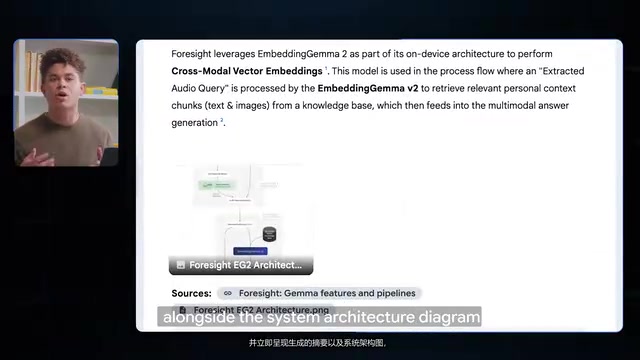
What is RAG (Retrieval-Augmented Generation)? RAG is an architectural paradigm that combines information retrieval with large language model generation. The basic flow: encode a knowledge base into embedding vectors stored in a vector database; when a user asks a question, encode the query and retrieve the most semantically relevant document chunks; inject those chunks as context into a generative model, enabling it to answer based on up-to-date or private knowledge rather than solely relying on what was baked in during training. Traditional RAG pipelines typically depend on cloud APIs, requiring data to leave the device. EmbeddingGemma 2 combined with a lightweight generative model makes it possible for the first time to run a complete RAG pipeline on edge devices like smartphones — users' documents, call recordings, and other sensitive data never need to be uploaded, ensuring both privacy and functionality in offline environments.
Fine-Tuning Beyond Out-of-the-Box Performance
Beyond strong out-of-the-box quality, EmbeddingGemma 2 supports fine-tuning for domain-specific vocabularies and specialized content — whether indexing complex legal contracts, medical imagery, or technical product catalogs. Fine-tuning can improve retrieval precision without increasing model size, which is especially valuable for vertical industry deployments.
Google has made the model weights available on Hugging Face and provides companion notebook examples in the Gemma cookbook for developers to get started quickly.
Summary
EmbeddingGemma 2 is more than just another embedding model. Its significance lies in combining unified multimodal representation, lightweight edge deployment, and privacy protection in a single package. For developers looking to build offline search or retrieval-augmented generation applications on edge devices like smartphones, this is an open-source option well worth exploring.
Related articles

Chain of Thought Isn't Just for AI: How Humans Can Use CoT to Improve Thinking Quality
Chain of Thought isn't just a prompt trick for large models. Starting from a Hacker News discussion, this article analyzes why CoT works for human thinking too, breaks down actionable ways to transfer it, and highlights the key differences between human CoT and machine CoT.
Cloudflare Teams Up with OpenAI: Closi…
Cloudflare Teams Up with OpenAI: Closing the Loop from Vulnerability Discovery to Defense with AI
Cloudflare uses OpenAI Daybreak to investigate security vulnerabilities and generate reviewable remediation plans, while developers use Codex to boost coding efficiency and quality.

Orca Multi-Agent Orchestration in Practice: A Guide to Parallel Collaboration with Claude and Codex
Orca is Stable AI's free open-source agent workbench supporting 34 agents like Claude Code and Codex in parallel. Learn its Git worktree isolation, multi-model orchestration, and mobile management.