Google Finance Official Launch: AI Q&A + New Android App

Google Finance exits Beta with AI Q&A and a new native Android app.
Google has officially launched a revamped Google Finance, ending its Beta phase and releasing a new Android app. The upgrade centers on AI-powered natural language Q&A built on Gemini, redesigned data visualizations, and a native mobile experience — positioning Google to compete more aggressively with Yahoo Finance and Bloomberg in the personal finance information space.
Google Finance Gets a Major Upgrade
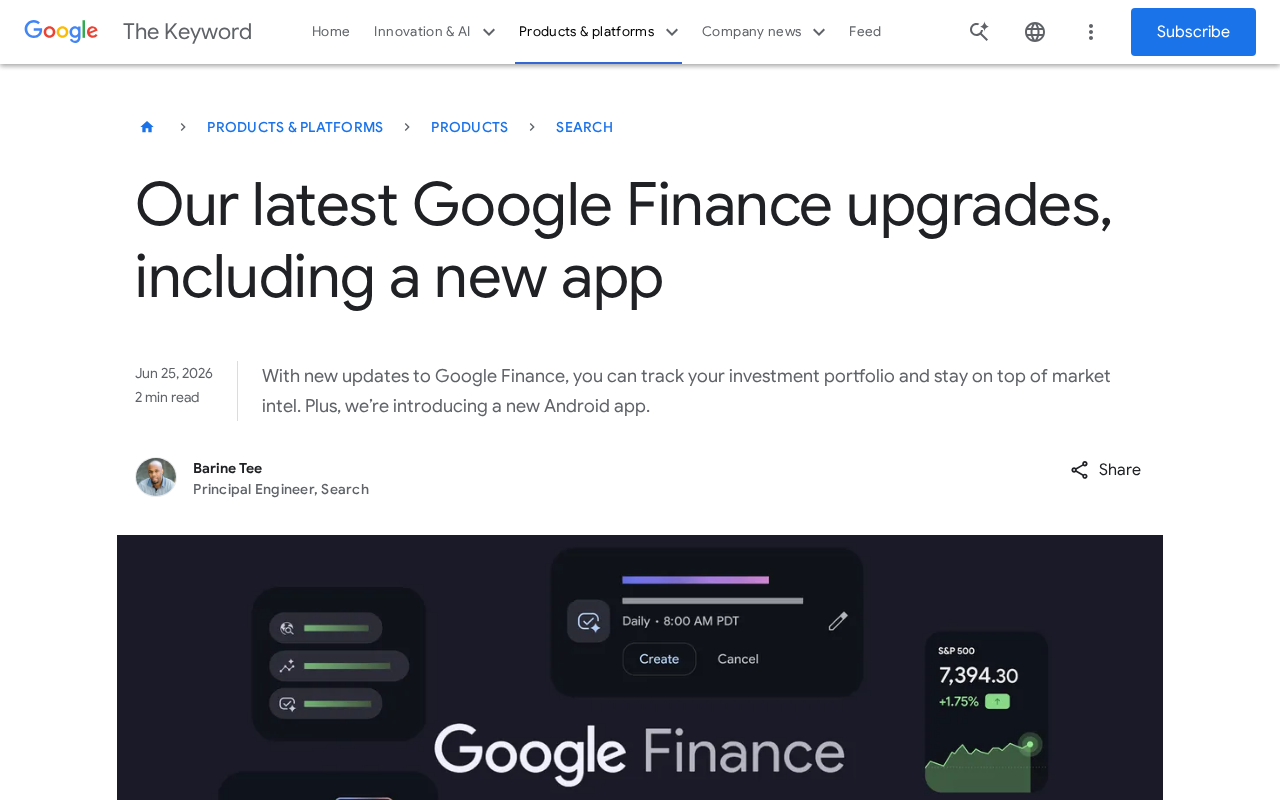
Google has officially announced that the new Google Finance has exited its Beta testing phase, with a brand-new Android app launching alongside it. This marks another significant move by Google into the personal finance and investment information space. For users who have long relied on Google Search to check stock prices and market data, this upgrade isn't just a visual refresh — it's a meaningful leap forward in integrating AI capabilities into financial information services.
Google Finance originally launched in 2006, primarily as an extension of Google Search, offering basic stock quotes, financial data, and news aggregation. Around 2012, Google significantly scaled back its features, frustrating users, and the product remained in a maintenance-mode state for years, falling noticeably behind competitors like Yahoo Finance and Bloomberg. This official exit from Beta, paired with a native Android app, represents Google's first substantive revival of the product in years — driven by the maturation of its own AI capabilities, including Gemini.
As large language models (LLMs) become increasingly prevalent in information retrieval and analysis, traditional financial data platforms are under growing pressure to transform intelligently. LLMs — deep learning models based on the Transformer architecture and trained on massive text datasets, with GPT-4, Gemini, and Claude as leading examples — offer core value in financial contexts through "semantic understanding." They can convert unstructured news, earnings reports, and research notes into a searchable, conversational knowledge base, enabling users to access in-depth market analysis without needing to master specialized terminology. By embedding AI into Google Finance, Google is not only riding this wave but also building a new competitive edge against established players like Bloomberg and Yahoo Finance.
What Leaving Beta Actually Means
A product moving from Beta to general availability typically signals that the team has thoroughly validated feature stability, data accuracy, and user experience. Beta testing sits between internal Alpha testing and public release in the software development lifecycle — it opens the product to real users to gather feedback and surface edge-case issues. For financial products, this step is especially critical. The bar for validation is far higher than for consumer apps: it requires verifying data source licensing compliance, ensuring quote delays meet exchange requirements (such as the SEC's 15-minute delay rule for real-time quotes), and confirming that AI-generated content doesn't cross the regulatory line into investment advice. Investors have extremely high expectations for data timeliness and accuracy, and any delay or error can lead to real decision-making losses. The move from Beta to general release signals that Google has completed this round of compliance and stability validation.
AI-Powered Natural Language Q&A
The centerpiece of the new Google Finance is its use of Google's own AI capabilities to help users understand market dynamics more efficiently. Users can ask questions in natural language and receive comprehensive answers about individual stocks, sector trends, and macroeconomic conditions — no longer limited to isolated price figures.
This conversational approach to information retrieval is essentially a natural language interface (NLI) layered on top of financial data, standing in sharp contrast to traditional financial information terminals. The Bloomberg Terminal, for instance, uses a "command-line + structured query" paradigm — users must learn a proprietary command set to use it effectively, with an annual subscription fee of roughly $25,000, primarily targeting professional institutional investors. Google's conversational experience lets ordinary retail investors ask plain-language questions like "How has Apple's recent revenue performed?" to get deep analysis, dramatically lowering the barrier to understanding complex financial information. This trend is what the industry calls the "democratization" of financial information services.
More Intuitive Data Visualization
Beyond AI Q&A, the upgraded Google Finance also delivers a more intuitive data presentation experience. Charts, trend comparisons, real-time quotes, and other modules have been completely redesigned, allowing users to quickly capture key information within a single view. This integrated experience represents the product moat Google is building by leveraging its natural strength in information organization.
The Strategic Significance of the New Android App
Perhaps the most noteworthy part of this upgrade is the launch of a native Android app. For a long time, Google Finance existed primarily as a web product, without a dedicated mobile entry point.
Native Android apps offer several key technical advantages over mobile web versions in financial contexts: push notification capabilities to alert users in real time during significant market moves; local data caching to allow access to historical data even in low-connectivity environments; and background process management to support real-time portfolio P&L updates without requiring manual user interaction. Native apps can also deeply leverage device-level features like biometric authentication and home screen widgets, providing greater security and richer information display. In a mobile-first era, a dedicated app means Google can deliver more timely market alerts, more convenient watchlist management, and interactions better suited to the smartphone experience.
For Android's enormous user base, this native app has the potential to quickly accumulate a substantial active user community. As an independent entry point, the app also enables Google to systematically collect user behavior data to optimize AI recommendations and analytical capabilities, creating a positive feedback loop for product iteration.
Competitive Landscape and Future Outlook
Competition in the personal financial information space never stops. Yahoo Finance, Bloomberg Terminal, and various brokerage apps are all competing for user attention and time. Google's advantages lie in its omnipresent search entry point, powerful AI infrastructure, and its ability to aggregate vast amounts of public data.
It's foreseeable that as AI capabilities continue to deepen, Google Finance will evolve from a tool for "checking quotes" into an intelligent assistant for individual investors — interpreting earnings reports, analyzing news sentiment, and providing personalized market insights. Of course, this also raises the bar for data accuracy and regulatory compliance. In the financial domain, the core regulatory risk for AI-generated content centers on the definition of "investment advice" — the SEC and regulatory bodies in other countries impose strict licensing requirements for "investment advisory" services, and if an AI system's output is deemed to constitute specific buy or sell recommendations, the platform could face compliance risks. Furthermore, AI hallucination is a particularly damaging problem in financial contexts: incorrect financial data or fabricated news summaries can directly mislead investment decisions. In finance, the reliability of AI-generated content will be the key to winning user trust.
For everyday users, the most direct value this upgrade delivers is making financial information simpler and smarter to access and understand. For the broader industry, Google's assertive entry into this space may also accelerate the race toward intelligent financial information services, pushing more platforms to embrace AI transformation at a faster pace.
Key Takeaways
Related articles

The Truth Behind Codex 'Build a Website in 5 Minutes': AI Isn't Creating Sites—It's Helping You Copy Them
Exposing the truth behind viral Codex 5-minute website videos: creators aren't building original sites with AI—they're copying shared prompts or scraping others' work. Learn AI coding tools' real limits.

Getting Started with AI Agent Development: A Complete Guide from Concept to Practice
A comprehensive guide to AI Agent architecture and development, covering automated marketing, intelligent customer service, and investment analysis scenarios with single and multi-agent collaboration.

The Truth Behind Codex 'Build a Website in 5 Minutes': AI Isn't Creating Sites — It's Helping You Copy Them
Exposing the truth behind viral Codex 5-minute website videos: creators aren't building original sites with AI — they're copying shared prompts or scraping others' work.