Google Genie 4 Released: The World Model Can Talk

Google DeepMind releases the Genie 4 world model, capable of synchronized audio and visuals, character dialogue, and real-time world rewriting.
Google DeepMind has released Genie 4, its next-generation world model. The biggest change is that it can generate music and ambient sound in sync with the visuals and make characters speak. Officially summarized as four capabilities: real-time world rewriting, more realistic physics and character performance, native sound and dialogue generation, and, with Jammin' I, simulating complex multi-step events. Jammin' I can automatically expand short prompts into complete instructions and verify the frame step by step. But the demo also exposed stability shortcomings, with scenes holding steady for at most two minutes. The official team has not disclosed parameters or benchmark data, and it is currently open only to a handful of testers, with Ultra membership and API access to follow.
Google DeepMind has just released Genie 4, the next generation of its world model. The biggest change this time is that it can generate music and ambient sound in sync with the world, and even support interactive dialogue. When a knight shouts "Let's storm the castle," it actually says it out loud; a train conductor speaks up to announce "The next train will leave in two minutes." A single sentence can rewrite the world: type "a goldfish tail rises behind," and the golden tail flips out of the water; type "it starts snowing," and snowflakes blanket the frame. Wave a magic wand, and a peacock turns into a cat, the cat into a radio, a marble bust comes crashing down, and a watermelon bursts on the spot. The director behind it all is Jammin' I—you only type "it starts snowing," and it automatically expands that into a complete instruction sequence and watches the frame, verifying step by step.
Four Core Capabilities
Officially, Genie 4 is summarized as having four core capabilities: real-time world rewriting, more realistic physics and character performance, native sound and dialogue generation, and, together with Jammin' I, simulating complex multi-step events.
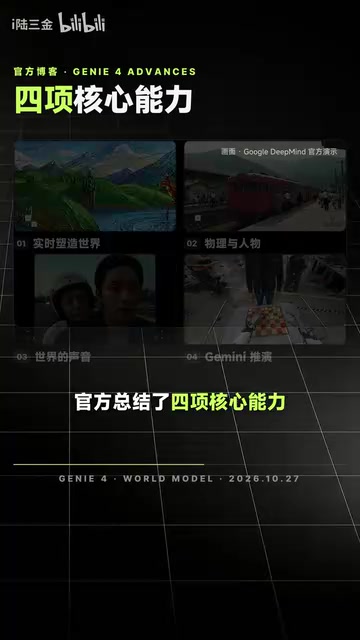
Among these four, "real-time world rewriting" is the most groundbreaking. Previous world models were more about generating static or short video clips, whereas Genie 4 lets users keep feeding instructions during generation, with the model responding in real time and changing where the scene goes. This means the world model has taken a step from "video generator" toward "interactive simulator."
World Model: In the context of world models, a world model refers to a model that can internally represent and predict how the state of an environment changes with actions. Its goal is not merely to generate video-like frames, but to simulate a dynamic scene that can be intervened in and continuously evolves. Traditional video generation models typically output a clip in one shot given text or an image, making it hard for users to change the direction midway; an interactive world model, by contrast, allows continuous actions or instructions to be received during generation and updates subsequent states accordingly. The "real-time world rewriting" that Genie 4 emphasizes is precisely the productization of this "state transition" capability: users inject new instructions while the scene is running, and the model must change the subsequent evolution without breaking the existing context, which places higher demands on temporal consistency, physical plausibility, and instruction following.
Sound and Dialogue: A New Dimension for World Models
The most eye-catching new capability of Genie 4 is sound. It doesn't just generate visuals—it also synchronously generates matching music and ambient sound, and makes characters in the scene speak.

From the demo, the train announcements and the knight's shouts are all synchronized with the on-screen action. This audio-visual integrated generation approach brings the output of the world model closer to an experienceable virtual scene rather than just a silent animation. The addition of dialogue further enhances interactivity—users are not just directors but can also become participants in the scene.
Jammin' I: The "Director" That Automatically Expands Instructions
The partnership between Genie 4 and Jammin' I is another highlight. Users only need to enter a short prompt, and Jammin' I expands it into a complete instruction sequence, continuously reviewing the frame and verifying the generated results step by step.
This "you type one sentence, it handles execution and verification" model lowers the barrier to use. Complex multi-step events—such as an object being struck down, shattering, and splashing—no longer require users to manually break them into multiple steps; the model can choreograph them on its own.
Prompt Expansion: Prompt expansion is a technique that automatically completes a user's short natural-language input into a more specific, executable instruction sequence. It typically combines large language models for intent parsing, scene element completion, and step decomposition, expanding vague short sentences like "it starts snowing" into a full description including details such as snowfall range, intensity, duration, and visual style. In interactive generation scenarios, expansion also needs to be combined with frame verification: the system repeatedly checks whether the generated result satisfies the expanded conditions, and if not, adjusts the instructions and regenerates. This "expansion—execution—verification" loop lowers the barrier to use, but also brings new risks: expansion may introduce elements the user did not expect, and if the verification criteria are unstable, the frame is prone to inconsistency.
The Shortcomings Are Equally Obvious: The Scene Only Holds Steady for Two Minutes
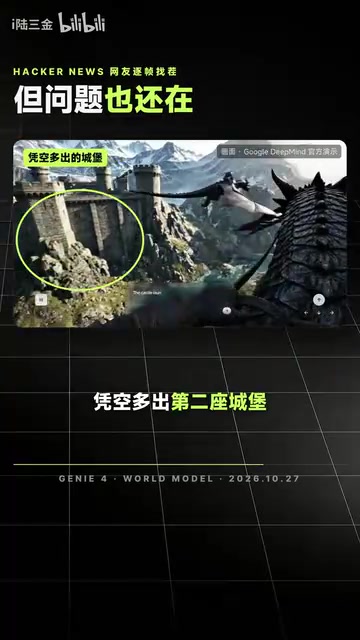
Genie 4's problems cannot be ignored either. The demo showed clear stability defects: the frame easily turns around, a second castle appears out of nowhere in the scene, the driver who originally wore no helmet suddenly has one on, and an 1980s Japanese train conductor speaks fluent English.

According to the launch event, the scene can hold steady for at most two minutes, double that of the previous generation. But the official team gave no parameters and no benchmark data. Currently Genie 4 is only open to a handful of testers; later it will first roll out to Google's most expensive Ultra members and the Jammin' I API, and users can join a waitlist.
Temporal Consistency and Long-Form Generation: Temporal consistency refers to the ability of generated content to keep character appearance, scene layout, physical laws, and narrative logic stable along the timeline. Autoregressive video or world models tend to accumulate errors in long-form generation: small deviations in each frame are amplified by subsequent steps, manifesting as objects appearing out of thin air, sudden changes in character clothing or equipment, and drifting scene structure. The "extra second castle" and "driver suddenly wearing a helmet" in the Genie 4 demo are typical examples of identity and layout drift. Raising the stable duration from one minute to two minutes means the model needs to maintain state memory over a longer context window while controlling computational cost; the fact that the official team disclosed neither parameters nor benchmarks also makes it hard for outsiders to judge whether this improvement comes from architectural changes or inference strategy adjustments.
What It Means for World Models to Become "Conversational"
Genie 4's direction is clear: world models are no longer just about generating visuals, but about generating a world with sound, capable of dialogue, and rewritable in real time. The two-minute stability limit shows it is still far from practical use, but the two capabilities of audio-visual synchronization and automatic instruction expansion have already changed the product form of world models. For content creators and game developers, this ability to "generate an interactive scene from one sentence" may be more worth watching than mere improvements in image quality.
One-line Summary
Google DeepMind releases the Genie 4 world model, capable of synchronized audio and visuals, character dialogue, and real-time world rewriting.
Paragraph Summary
Google DeepMind has released Genie 4, its next-generation world model. The biggest change is that it can generate music and ambient sound in sync with the visuals and make characters speak. Officially summarized as four capabilities: real-time world rewriting, more realistic physics and character performance, native sound and dialogue generation, and, with Jammin' I, simulating complex multi-step events. Jammin' I can automatically expand short prompts into complete instructions and verify the frame step by step, lowering the barrier to use. But the demo also exposed stability shortcomings: the frame turns around, castles appear out of nowhere, character equipment changes abruptly, and the scene holds steady for at most two minutes. The official team has not disclosed parameters or benchmark data, and it is currently open only to a handful of testers, with Ultra membership and API access to follow.
Related articles

Jensen Huang Returns to Nvidia: The Power Game Behind an "Aggro Reset"
Nvidia's board reappointed Jensen Huang as CEO less than two weeks after his scandal-driven resignation. This analysis explores the board's decision-making, Trump's political intervention, media power failure, and market reaction behind the dramatic return.

Why Voice AI Can't Understand Kenyans' Everyday Conversations
Swahili speech recognition hits 3.24% error on read text, but everyday Kenyan speech mixes English, Sheng slang, and accents—leaving mainstream voice AI struggling.

Data Centers Build Their Own Natural Gas Plants: AI Compute's Breakout Around a Decade-Long Grid Wait
Grid interconnection approvals can take a decade, so xAI and others are building off-grid natural gas plants to power AI clusters. This article analyzes the drivers, costs, and impact of behind-the-meter generation on AI infrastructure.