Google Genie 4 World Model Generates 3D Scenes from a Single Image, Disrupting Game Development

Rodin, Genie 4, and Microsoft's editing model show AI moving from generating content to generating interactive worlds.
Based on the AI daily roundup by Bilibili creator EverAI, the article reviews three product lines pointing to the same trend: Rodin introduces an agent mode into 3D scene generation, enabling automatic segmentation of props from a single image and generating block-editable 3D models with lighting and materials; Google's Genie 4 can generate photorealistic virtual worlds in real time, simulate physical motion and character behavior, synchronously generate audio and ambient sound, and allow users to explore with arrow keys and change scene events in real time via text; Microsoft's image editing model strengthens scene reconstruction, style transfer, and lighting adjustment, ranking second only to Image 2.5. The author argues that the common signal is that AI is evolving from a point tool into an agent within workflows, with the interaction paradigm shifting to "intent-driven"; world models are expected to greatly accelerate game prototyping and level iteration, but controllability, consistency, physical accuracy, and copyright ownership remain bottlenecks for deployment.
From One Image to a World: AI Agents Are Rewriting 3D Content Production
In the past, building an interactive 3D scene required modelers, texture artists, animators, and programmers to collaborate for days or even weeks. Now, AI agents are trying to compress this process down to "one image + one sentence." According to the AI daily roundup by Bilibili creator EverAI, the 3D modeling platform Rodin was the first to introduce an agent mode into 3D scene generation, Google released the interactive world model Genie 4, and Microsoft also updated its image editing model. These three developments point to the same trend: AI is moving from "generating content" to "generating interactive worlds."

Rodin: Agent-Driven Automation of Single-Image 3D Scenes
Rodin's agent mode allows users to upload a single image, automatically segment the various props in the scene, and generate 3D models with lighting and materials for each of them. Unlike earlier "whole-scene baking" approaches, Rodin emphasizes block-level editability — each generated object can have its position, material, or lighting adjusted individually, then recombined into the complete scene. This means AI is no longer a black box that produces an image with one click, but a collaborative tool embedded in the 3D workflow. For indie developers and small studios, this automated segmentation capability can significantly reduce the upfront cost of scene construction.
Genie 4: A Real-Time, Playable World Model
Google's Genie 4 is the most imaginative part of this roundup. It supports real-time generation of photorealistic virtual worlds and simulates physical motion and character behavior. Users explore the scene with arrow keys as if playing a game, and can change scene events at any time with text — for example, adding characters or triggering dialogue.
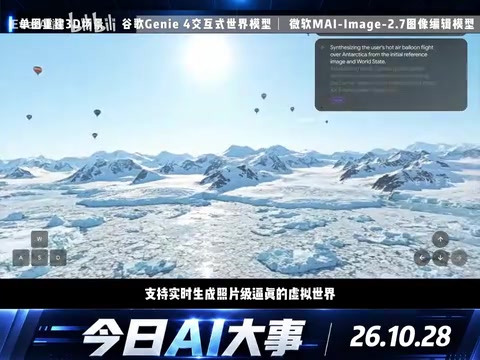
More importantly, Genie 4 can synchronously generate original audio and ambient sound, and even simulate character dialogue. In the demo, the input "make the man turn around, and the girl asks the man what he thinks" prompted the model to react in real time. This synchronized generation of "vision + hearing + interaction" moves world models from static video generation into the playable prototype stage.

World model is a core concept in current AI research, referring to a generative model capable of learning and simulating the dynamic laws of an environment: it does not merely predict the next frame, but implicitly understands how objects move, how collisions occur, and what consequences actions will lead to. Compared with video generation models, world models emphasize interactivity — given an action (such as pressing a key to move), the model must generate subsequent states causally consistent with it. This makes them naturally suited as a source of data for game prototypes, robot training simulation, and embodied intelligence. The Genie series has evolved along this path: earlier versions could already generate playable platform games from a single image, while subsequent versions have continued to improve resolution, duration, and physical consistency, and added text-based event control, moving closer to a "programmable virtual world."
Microsoft's Image Editing Model: Scene Reconstruction and Text Modification
Microsoft's image editing model (the source material mentions "没有阴密质2.7," likely a speech transcription error) strengthens scene reconstruction, style transfer, lighting adjustment, and in-image text modification capabilities, with overall performance second only to Image 2.5. Although it does not directly generate 3D, this kind of fine-grained editing capability is an important upstream step for 3D scene asset generation — consistency in lighting and style directly affects the immersion of the final scene.
What World Models Mean for Game Development
In traditional game development, scene prototypes need to go through greyboxing, art replacement, lighting baking, logic binding, and many other stages. The path demonstrated by Genie 4 is: input a concept image or a piece of text, and the model directly outputs an explorable, interactive, audio-equipped dynamic world. Although it is currently closer to a "playable prototype" than a finished level, its role in accelerating early concept validation and level design cannot be ignored.

The creator judges in the video that Genie 4 "will most likely be widely used in the game industry in the future." The supporting point for this judgment is that real-time generation means developers can rapidly iterate on scene atmosphere and event scripts without waiting for a complete asset pipeline. For narrative-driven games, the ability to trigger events via text could even be used directly for branching story testing.
Challenges Remain
For world models to enter production pipelines, controllability, consistency, and copyright ownership still need to be resolved. Genie 4's real-time generation is currently more oriented toward demo scenarios, and scene consistency during long exploration sessions, physical accuracy, and the editability of generated content remain unknown. Although Rodin's agent-based segmentation improves controllability, segmentation precision and material fidelity still need to be tested in real projects.
Greybox is a common term in game level design, referring to a temporary level built with simple geometry (cubes, cylinders) and basic materials, used only to validate spatial scale, movement rhythm, and gameplay layout, without pursuing artistic presentation. In the traditional pipeline, greyboxing is followed by art asset replacement, lighting baking, collision and logic binding, and other stages, each of which is highly dependent on manual work. Lighting baking is especially time-consuming: it precomputes indirect lighting from static light sources into textures in exchange for runtime performance. The potential value of world models lies in skipping or compressing these intermediate stages: concept images are directly converted into explorable spaces, with lighting and atmosphere produced alongside generation, allowing designers to focus their energy on validating gameplay and narrative rather than waiting on asset pipelines.
Scene consistency is one of the main technical obstacles to the deployment of world models. Generative models perform stably in short demos, but during long exploration sessions they are prone to issues such as object deformation, spatial layout drift, and scenes "changing" after looking away — essentially because the model lacks persistent 3D memory and explicit geometric representation. Controllability is equally tricky: natural language instructions struggle to precisely specify object position, size, and physical parameters, while production pipelines require pixel-level or parameter-level reproducible control. In addition, copyright ownership involves training data sources, commercial licensing of generated assets, and the definition of ownership relative to traditional art assets. There is currently no mature legal or industry consensus, which is also why major companies are generally cautious about formal productization.
The Common Signal Across Three Product Lines
Rodin, Genie 4, and Microsoft's editing model correspond to three layers respectively — 3D assets, interactive worlds, and 2D editing — but what they share is this: AI is evolving from a point tool into an agent within the workflow. Users no longer need to operate every parameter step by step; instead, they describe their intent in natural language, and the model decomposes the task, executes it, and supports local modifications. For content creators, understanding this "intent-driven" interaction paradigm early is more valuable in the long run than chasing individual model versions.
Related articles

A New Paradigm for Text Editing in Compose: TextFieldState Replaces the Old API
Jetpack Compose introduces the TextFieldState API to fix dropped characters and cursor jumps from async input. The old value/onValueChange callbacks will be deprecated in 1.13. This article covers InputTransformation, OutputTransformation, four state hoisting patterns, and new formatted text editing capabilities.

Remote Compose: A New Document-Driven Paradigm for Cross-Platform UI on Android
Remote Compose transmits compact binary documents instead of screen pixels, enabling efficient UI rendering on remote surfaces like Wear OS and widgets. This article covers its document creation API, expression animations, size optimization techniques, and Wear OS progress.

How Crashlytics Eliminates Android Memory and Responsiveness Issues
Through the Chroma Clip case study, this article explains how Firebase Crashlytics uses Application Exit Info, Profiling Manager, GWP ASAN, and ARM MTE to pinpoint ANRs, OOMs, memory limit terminations, and native memory corruption—solving the challenge of stack traces that don't point to the real culprit.