Google Genie 4 World Model Released: More Realistic and Real-Time Editable

Google releases Genie 4 world model, featuring more realistic generation, real-time natural language editing, audio, and the Gemini 3.8 Flash foundation.
Google released the Genie 4 world model for AI-generated interactive experiences, with four updates: more realistic world generation, real-time natural language editing, audio generation, and being built on Gemini 3.8 Flash. The article notes that real-time editing is the most transformative—it compresses the traditional "generate—preview—regenerate" process into continuous interaction, allowing users to instantly modify scenes with a single sentence while the world is running. Audio completes multimodal immersion, and Gemini 3.8 Flash's low latency supports real-time interaction. The article argues that world model competition is shifting from generation quality to controllability and real-time performance, and Google's bet on "interactive generation" turns world models from content tools into the creative environment itself.
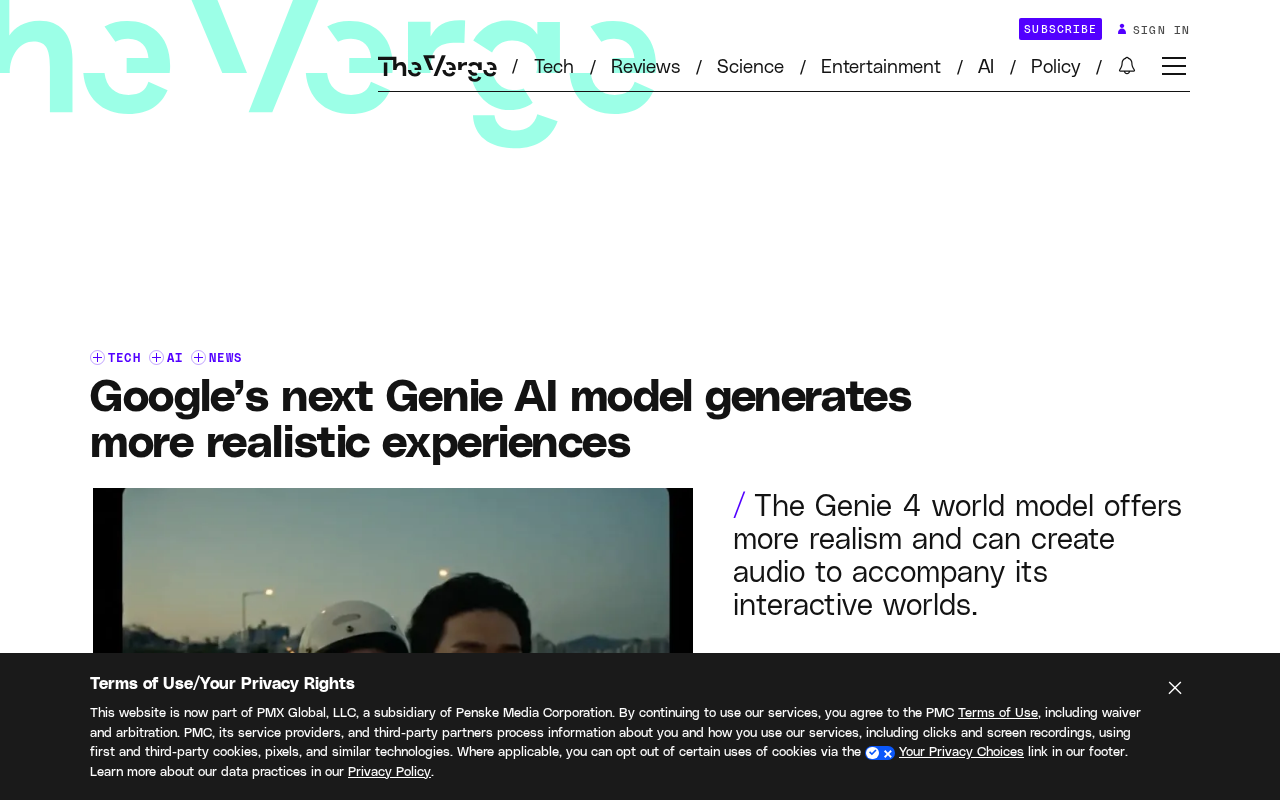
Google today released its Genie 4 world model for generating interactive experiences with AI. According to the official announcement, the model brings four major updates: generating more realistic worlds, allowing users to update experiences in real time via natural language prompts, the ability to generate audio, and using Gemini 3.8 Flash under the hood for support.
Four Core Upgrades: From "Generation" to "Editable Interactive Worlds"
The Genie series has always been positioned as a "world model"—not just generating a video or an image, but generating dynamic environments that users can interact with and explore. Genie 4's updates continue this direction, but the focus shifts from "can it generate" to "how realistic and controllable is the generation."
Among the four updates listed officially, the most intuitive is more realistic world generation. This means the model has improved in physical consistency, scene details, and dynamic performance, making the generated interactive experience closer to the look and feel of the real world. For scenarios such as game prototyping, simulation training, and content creation, realism directly determines whether the generated content can be put to practical use.
The second update is real-time natural language editing. Users can update the current world during an experience with a single sentence prompt, without needing to regenerate the entire scene. This changes the traditional linear process of "generate—preview—regenerate," embedding editing capability into the interaction process itself.
The third is audio generation capability. Previously, world models mostly focused on the visual level; the addition of audio expands the generated experience from "visible and interactive" to "audible," which is clearly significant for completing immersion and scene integrity.
The fourth involves the underlying architecture: Genie 4 is built on Gemini 3.8 Flash. This indicates that Google is integrating its world model capabilities with its own Gemini model system, leveraging Gemini's multimodal understanding and generation capabilities to support more complex interactive generation tasks.
World Model is a concept originating from reinforcement learning and cognitive science, referring to an agent's internal representation of environment dynamics—it can predict the next state based on the current state and action, thereby supporting planning and decision-making. In recent years, this term has been borrowed by the generative AI field to refer to models capable of generating interactive, explorable three-dimensional dynamic environments. Representative works include Google DeepMind's Genie series, OpenAI's Sora (partly regarded as a prototype of a world simulator), and various playable video generation studies. Unlike ordinary video generation models, world models emphasize action-conditioned behavior and long-term consistency: every user action should trigger reasonable and coherent changes in the environment, rather than playing a preset sequence. This distinction determines the potential value of world models in scenarios such as game prototyping, robot simulation, and embodied intelligence training.
Why Real-Time Editing Is a Key Step
Among the four updates, real-time natural language updating of experiences deserves the most attention. What it changes is not just the mode of operation, but the creative paradigm.
The traditional process for generative content is discrete: input a prompt, wait for generation, view the result, and if unsatisfied, adjust the prompt and regenerate. There are waiting and trial-and-error costs between each step. Real-time editing compresses this process into continuous interaction—users can directly describe what they want to change based on what they see, and the model responds instantly.
This capability is especially significant for interactive experiences. The environments generated by world models are inherently dynamic and continuously running; if editing could only be done before generation, then any running scene that deviates from expectations would have to be scrapped and redone. Real-time editing makes "adjusting while running" possible, closer to real content debugging and gameplay design processes.
The real-time bottlenecks of diffusion models and autoregressive generative models provide the background for understanding the difficulty of "real-time editing." Mainstream image/video generation is mostly based on diffusion processes, requiring multiple denoising iterations, with a single generation often taking seconds to tens of seconds; even with distillation acceleration, low latency in continuous interaction scenarios remains a challenge. In addition, video generation must maintain temporal consistency—no flickering or object "drift" between frames. When users modify the world in real time with natural language during runtime, the model must locally respond to the modification instruction while preserving the existing scene context, which involves techniques such as conditional generation, incremental updates, and cache reuse. The "Flash" suffix in Gemini 3.8 Flash typically indicates a lightweight version optimized for inference speed, and its low-latency characteristics are precisely the prerequisite for supporting real-time editing and interactive generation.
Audio and the Underlying Model: Two Dimensions That Complete the Experience
Audio generation may seem like a feature addition, but it is actually the missing piece of the immersion puzzle. No matter how high the visual realism, without a matching sound environment, the interactive experience will still feel thin. Genie 4's addition of audio generation means that the model no longer outputs just visuals, but complete scenes that include sound.
The underlying use of Gemini 3.8 Flash reveals Google's product strategy: the world model is not an isolated technical demo, but a capability module embedded in the Gemini ecosystem. The Flash series typically focuses on efficiency and response speed, which aligns with the latency-sensitive needs of real-time editing and interactive generation.
Audio-video alignment in multimodal generation is a background worth understanding here. Generating matching audio for dynamic scenes is far more than "adding a background track": the model needs to understand events in the visuals (such as footsteps, collisions, ambient wind) and generate temporally synchronized sound, technically known as audio-video joint generation. In recent years, research has begun to jointly model audio as an output modality alongside video, enabling sound to be triggered in real time by visual events. For interactive world models, audio must also respond to user actions—for example, the sound of a door opening should appear immediately upon interaction. This requires audio generation to have real-time performance and conditional responsiveness comparable to visual generation, which also explains why the speed advantage of the underlying model is equally critical for audio functionality.
The Competitive Focus of World Models Is Shifting
The direction of Genie 4's updates reflects an industry trend: competition in world models is shifting from "generation quality" to "controllability and real-time performance." Generating a realistic scene is no longer enough; whether the model can understand and execute users' modification intentions during runtime, and whether it can output a complete multimodal experience, is becoming the new dividing line.
By making real-time natural language editing a core selling point, Google is effectively betting on the "interactive generation" form. When users can continuously shape a dynamic world through conversation, the world model transforms from a content production tool into the creative environment itself. Whether this direction can be delivered as a widely available product experience still depends on actual generation quality and response speed, but the direction itself is already clear.
One-line Summary
Google releases the Genie 4 world model, featuring more realistic generation, real-time natural language editing, audio, and the Gemini 3.8 Flash foundation.
Paragraph Summary
Google released the Genie 4 world model for AI-generated interactive experiences, bringing four updates: more realistic world generation, real-time natural language editing, audio generation capability, and being built on Gemini 3.8 Flash. The article points out that real-time editing is the most transformative—it compresses the traditional discrete process of "generate—preview—regenerate" into continuous interaction, allowing users to instantly modify scenes with a single sentence while the world is running, closer to real debugging and gameplay design. Audio completes multimodal immersion, and Gemini 3.8 Flash's low latency supports real-time interaction needs. The article argues that the competitive focus of world models is shifting from generation quality to controllability and real-time performance, and Google's bet on "interactive generation" turns world models from content tools into the creative environment itself.
Related articles

Will GitHub Die? Open Source Maintainer Burnout and the Collaboration Crisis in the AI Era
Lex Fridman podcast discussion on open source maintainer burnout and GitHub's predicament: massive pull requests overwhelm core maintainers, and AI worsens code bloat. Using math journal peer review and Poincaré conjecture verification as analogies, the article analyzes why verification in knowledge production must be deliberately slow, and how open source communities can avoid the failure mode of maintainers exiting.

Stop Building Cookie-Cutter AI Websites: 3 Tools That Transform Your Coding Agent
Three tools that boost AI coding agents: FFmpeg skill for local video editing in Claude Code and Cursor, Hallmark's 50 design themes to fix cookie-cutter AI sites, and Jailbreaks' 25+ model prompts.

How America's Gerontocracy Squeezes the Younger Generation
Americans over 55 hold nearly three-quarters of national wealth, alongside an 80-year-old president and elderly congressional leaders. The Atlantic's Idrees Kahloon explains how gerontocracy drives up housing costs, squeezes opportunities for the young, and explores zoning reform and child poverty reduction as practical fixes.