Google Home Speakers Rack Up Hundreds of GB of Downloads Due to Firmware Update Bug

Some Google Home speakers are stuck in a firmware update loop, downloading hundreds of GB of traffic in the background.
Some Google Home smart speaker users have discovered their devices continuously downloading hundreds of GB of data in the background, suspected to be stuck in an endless loop of repeated downloads without successful installation during firmware updates. Affected users face overage charges, occupied bandwidth, and device overheating, and factory reset cannot resolve the issue. Google has not yet responded. The incident exposes the lack of transparency and robust error handling in smart home device background update mechanisms. Users can temporarily mitigate the issue through router speed limits or disconnecting from the network, but a permanent fix requires the manufacturer to push a fix firmware.
Google Home Speakers Rack Up Hundreds of GB of Downloads Due to Firmware Update Bug
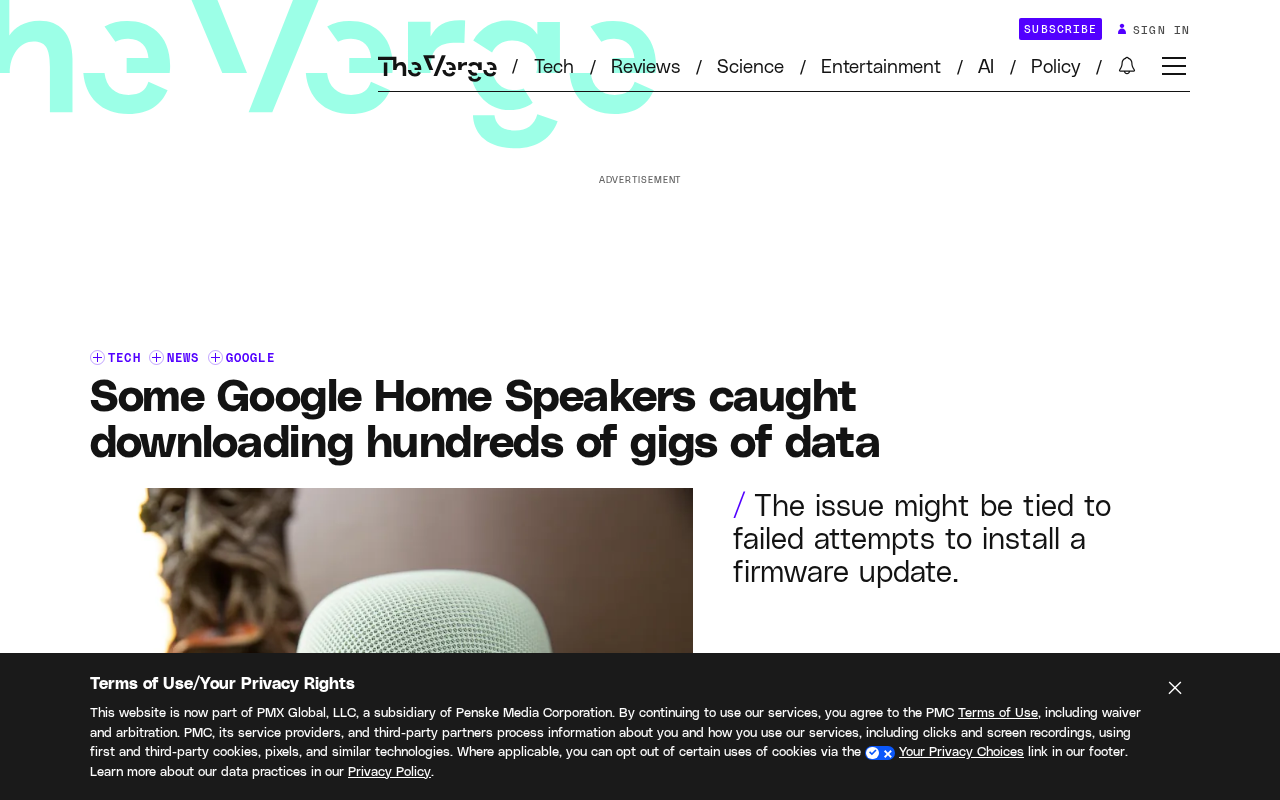
Over the past week, some Google Home smart speaker users have noticed a spike in their network traffic, with devices continuously downloading hundreds of GB of data in the background. According to reports from 9to5Google and multiple users in the Reddit community, this abnormal behavior likely stems from the speakers getting stuck during the firmware update process, falling into an endless loop of repeatedly downloading without being able to install.
Incident Recap: Users Notice Abnormal Traffic
The first users to notice the problem spotted it when checking their router traffic statistics. One Reddit user said their Google Home speaker downloaded over 300GB of data in just a few days, equivalent to hundreds of hours of continuous HD video streaming. Another user reported that their home internet plan's data cap was quickly exhausted, resulting in extra overage charges.
According to information compiled by 9to5Google, affected devices are mainly concentrated among certain models of Google Home speakers, though the specific models and scope of impact remain unclear. Google has not yet made a public statement on the matter.
Root Cause: Firmware Update Stuck in a Loop
Based on speculation from users and analysts, the problem likely lies in the firmware update mechanism. When the speaker attempts to download new firmware, for some reason (such as network instability, server-side issues, or insufficient storage space), the download completes but cannot be properly verified or installed. The system then keeps retrying, and each retry re-downloads the complete firmware package, resulting in continuous data consumption.
This "download-fail-redownload" loop is not uncommon in embedded devices, but a large-scale, multi-day situation like this with Google Home is relatively rare. Some users tried factory resetting the device but the problem persisted, suggesting the firmware-level bug may not be fixable through conventional means.
Firmware is the low-level software embedded in hardware devices, responsible for controlling basic device functions and hardware initialization, sitting between the hardware and the operating system. Unlike regular application software, firmware is typically released by manufacturers with the device, cannot be freely replaced by users, and updates often require downloading the complete firmware image package rather than just a differential patch. Many embedded devices use A/B partitioning or dual-image mechanisms: new firmware is first written to a backup partition, and after verification passes, the system switches to boot from it; if it fails, it reverts to the old version. If the verification step repeatedly fails due to network interruptions, signature mismatches, or insufficient storage space, the device may enter a retry loop, pulling the entire image package each time. Google Home speaker firmware packages can be tens to hundreds of MB in size, and high-frequency retries over several days can accumulate hundreds of GB of traffic — exactly the typical characteristic of this incident.
Scope of Impact and User Responses
Based on current reports, the problem is not universal across all Google Home devices, but affected users face significant practical issues: occupied network bandwidth, overage charges, device overheating, and more. Some users have chosen to temporarily disconnect their speakers from the network or limit their download speed through router settings.
You may not have noticed, but this type of problem exposes the lack of transparency in smart home devices' background update mechanisms. Users often cannot intuitively see what their devices are doing until abnormal traffic bills appear.
Overage charges stem from carriers' billing models: most home broadband plans have monthly data caps or throttling thresholds, with tiered rates applied for exceeding them, which is why some users received high bills. On the router side, users can set bandwidth limits for smart speakers individually through QoS (Quality of Service) rules, or use parental controls/device pause features to temporarily cut off their internet access; some routers also support viewing real-time traffic by device, making it easier to identify anomalies. Factory reset doesn't work because firmware update logic is controlled by the device's low-level bootloader — resetting only clears user configurations and does not change the firmware version or update scheduling policy. The issue requires the manufacturer to push a fix firmware to resolve.
Hidden Concerns of Smart Home Device Background Updates
The Google Home incident is not an isolated case. As smart home devices become more widespread, the traffic consumption, privacy issues, and device stability risks associated with firmware updates are gradually coming to light. Manufacturers typically enable automatic updates by default to ensure device security and feature iteration, but lack fine-grained control and user notification during the update process.
For users, regularly checking router traffic logs and setting up separate network speed limits for smart devices are currently feasible preventive measures. For manufacturers, more robust error handling and fallback strategies need to be incorporated into update mechanisms to prevent a single point of failure from causing resource waste.
Currently, Google has not provided an official timeline for a fix. We will continue to monitor the situation.
Background
From a technical architecture perspective, automatic updates for smart home devices are typically driven by update policies delivered from the cloud. Devices periodically poll servers to check for new versions, then download, verify signatures, and install. If server-side version numbers are misconfigured, CDN distribution is abnormal, or device clock skew causes certificate verification failures, infinite retries can be triggered. Such issues have drawn more attention with the promotion of emerging smart home standards like Matter and Thread, because firmware for cross-ecosystem devices is maintained by different manufacturers, making update behavior less observable. Industry best practices include: implementing exponential backoff retry strategies, setting per-update traffic limits, pausing and reporting telemetry data after update failures reach a threshold, and pushing update status notifications to users. These mechanisms can significantly reduce the probability of a single failure escalating into large-scale resource waste.
One-line Summary
Some Google Home speakers are stuck in a firmware update loop, downloading hundreds of GB of traffic in the background.
Paragraph Summary
Some Google Home smart speaker users have discovered their devices continuously downloading hundreds of GB of data in the background, suspected to be stuck in an endless loop of repeated downloads without successful installation during firmware updates. Affected users face overage charges, occupied bandwidth, and device overheating, and factory reset cannot resolve the issue. Google has not yet responded. The incident exposes the lack of transparency and robust error handling in smart home device background update mechanisms. Users can temporarily mitigate the issue through router speed limits or disconnecting from the network, but a permanent fix requires the manufacturer to push a fix firmware.
Related articles

Kimi K3.1 Hands-On Test: Open-Source Model Nears Opus, Video Generation Steals the Show
Kimi K3.1 completed motion graphics, 3D rendering, mini-games, and video generation in a live test. Analysis of its 2.8T MoE architecture, gap vs Opus/GPT, and hidden video generation.

Sam Altman: Why Life's Biggest Advice Should Still Come from Humans
OpenAI CEO Sam Altman on the limits of AI advice: AI can talk you out of an impulsive email, but life's biggest advice should still come from humans.

"Black October": Did AI Uncover 3% of All Critical Vulnerabilities Ever?
A Reddit post claims 3% of all critical software vulnerabilities ever were found in the past month, dubbed 'Black October.' We break down the statistical issues, how AI-assisted code auditing accelerates discovery, and how developers should respond.