Google I/O 2025 Gemini Updates Roundup: Model Upgrades, Multimodal Interaction, and AI Agent Deep Dive

Google I/O 2025 delivers sweeping Gemini upgrades across models, multimodal, AI Agents, and ecosystem.
At Google I/O 2025, Gemini received comprehensive upgrades: the foundation model saw significant improvements in reasoning, context understanding, and code generation; multimodal interaction now supports a "see it, ask it" experience via images, voice, and video; AI Agent capabilities enable the leap from conversation to autonomous task execution; and Google leverages its ecosystem integration across Android, Search, Gmail, and more, along with developer-facing APIs and open-source strategies, to compete against ChatGPT and Copilot with clear differentiation.
Overview
At the 2025 Google I/O conference, Google unveiled a series of major updates to its AI assistant, Gemini. From next-generation foundation models to multimodal interaction, from AI Agent capabilities to developer tools, these updates span model performance, product experience, and ecosystem development—signaling Google's full-scale push in AI applications.
This article systematically reviews the core Gemini updates announced at Google I/O 2025 and analyzes their impact on the competitive landscape.
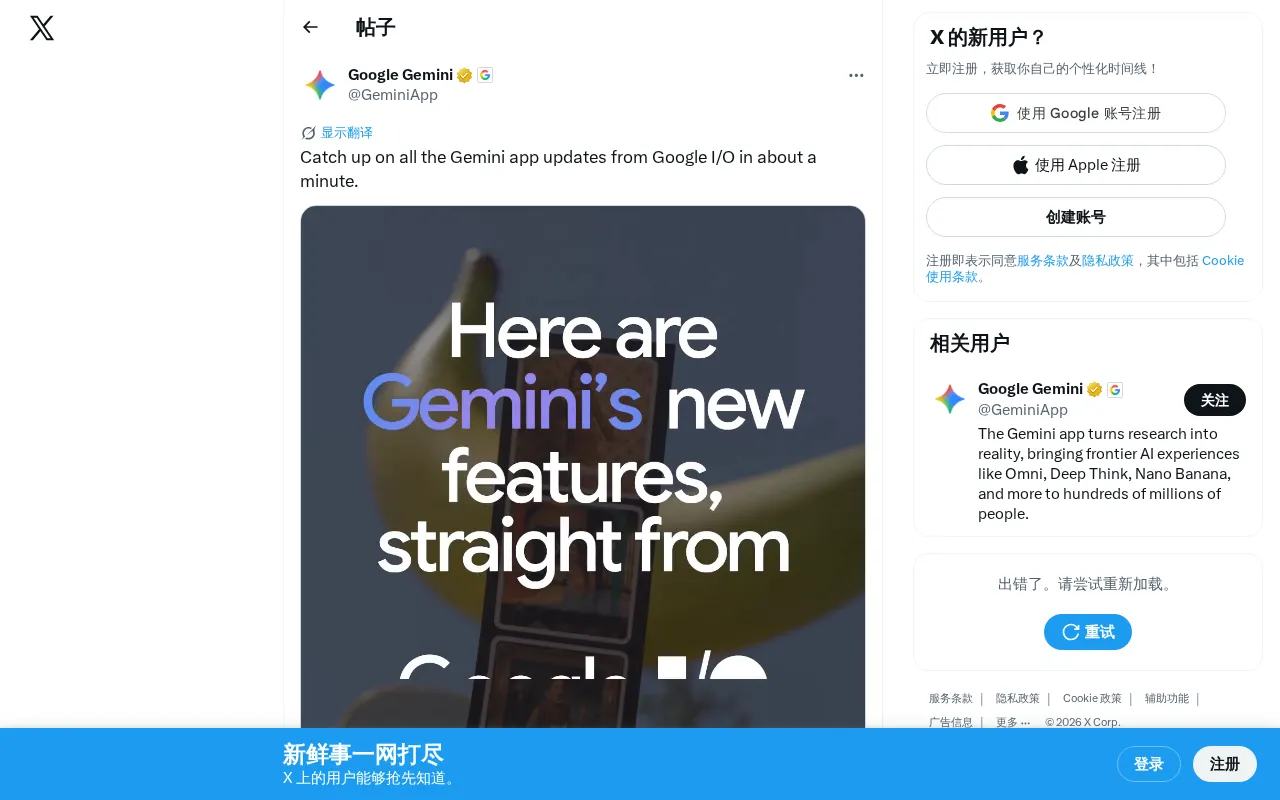
Major Upgrades to Gemini's Foundation Model
Gemini is a multimodal large language model launched by Google in late 2023, designed from the ground up with native multimodality as its core objective. This sets it apart from technical approaches like GPT-4, which first trained on text before layering on multimodal capabilities. The Gemini family includes Ultra, Pro, Flash, Nano, and other tiers, each targeting different computational needs and deployment scenarios, forming a complete capability matrix from cloud to on-device.
At this year's I/O, Google released the next-generation Gemini model, introducing more efficient attention mechanisms and larger-scale training data on top of the Transformer architecture, providing a more powerful foundation for the entire Gemini application ecosystem. The new model delivers significant improvements in several key areas:
- Reasoning: Notably higher accuracy on Chain-of-Thought tasks, with stronger performance on complex logical problems
- Context Understanding: Support for longer conversational context, more coherent multi-turn dialogue, and substantially enhanced long-document processing
- Code Generation: Further optimized code quality and efficiency in programming assistance scenarios
This means users will receive more accurate and intelligent responses in their everyday interactions with Gemini.
More importantly, Google is positioning Gemini as the AI core of its entire ecosystem. From Google Search to the Workspace productivity suite, from Android to developer platforms, Gemini's capabilities are being deeply integrated across all of Google's product lines. It's worth noting that Google's custom-designed TPU (Tensor Processing Unit) chips provide tailored computational support for Gemini model training and inference, offering certain advantages in cost and efficiency compared to competitors that rely on NVIDIA GPUs.
Comprehensive Deepening of Multimodal Interaction
Gemini's evolution in multimodal capabilities is one of the most eye-catching highlights of the Google I/O 2025 updates.
Multimodal AI refers to artificial intelligence systems capable of simultaneously processing and understanding multiple data types—text, images, audio, video, and more. The core technology maps data from different modalities into a unified vector space, enabling cross-modal reasoning. Google's technical implementation relies on deep integration between a real-time Visual Encoder and the language model, essentially merging Google Lens's image recognition capabilities with Gemini's language understanding at the foundational level, rather than simply stacking features on top of each other.
User interaction with Gemini is no longer limited to text input. The updated Gemini supports natural conversation through images, voice, video, and other modalities. During the demo, Google emphasized a "see it, ask it" interaction philosophy—users can simply point their phone camera at an object or scene, and Gemini can understand the visual content in real time and provide relevant answers. This technical approach directly competes with OpenAI's GPT-4o and Meta's multimodal LLaMA variants, though Google holds a natural deployment advantage through its mobile camera hardware ecosystem.
This enhancement in multimodal capabilities is transforming Gemini from a text-based chat tool into an all-around AI assistant that can see, hear, and understand the real world. The practical value is obvious for everyday scenarios like shopping identification, travel translation, and study assistance.
AI Agent: From Conversation to Action
Google prominently showcased Gemini's AI Agent capabilities at this year's conference—one of the most closely watched directions in the AI industry in 2025.
What Is Gemini's Agent Capability?
AI Agent refers to an AI system capable of perceiving its environment, autonomously planning, and executing multi-step tasks. Its core capabilities include Task Decomposition, Tool Use, and Feedback Loop. Unlike traditional conversational AI, Agent architectures are typically based on frameworks like ReAct (Reasoning + Acting) or Plan-and-Execute, allowing the model to dynamically adjust its strategy during execution rather than generating a one-shot answer.
Gemini no longer merely "answers questions"—it can proactively execute tasks and collaborate across applications. Its Agent capabilities are built on research from Google's Project Astra and Project Mariner, combined with proprietary API tool chains spanning Search, Maps, Calendar, and more, creating a closed-loop task execution system. Specifically, users can issue compound instructions to Gemini, and the AI will autonomously decompose the task and complete a series of operational steps.
Typical Use Cases
- Restaurant Reservations: Automatically searches, compares, and completes bookings based on user preferences and schedule
- Email Management: Automatically organizes the Gmail inbox, extracts key information, and generates summaries
- Trip Planning: Combines Google Maps and Calendar to generate comprehensive travel itineraries
This direction directly competes with OpenAI's Operator and Anthropic's Computer Use, and is widely regarded by the industry as a critical battleground for AI commercialization in 2025. The shift from conversational AI to action-oriented AI is the core competitive focus among tech giants like Google, OpenAI, and Microsoft in 2025.
Competitive Analysis: Gemini vs. ChatGPT and Copilot
Gemini's rapid-fire updates are directly aimed at OpenAI's ChatGPT, Microsoft's Copilot, and Apple's Apple Intelligence. So where does Google's differentiated advantage lie?
Google's Ecosystem Integration Advantage
Google's greatest moat is its massive product ecosystem, and this advantage extends beyond product coverage to deep accumulation at the data and infrastructure level. Google possesses the world's largest search index, a real-time geographic information database (Google Maps), and behavioral data from billions of users—assets of irreplaceable value for training and fine-tuning AI models.
The deep integration of over 3 billion Android devices, Google Search, Gmail, Google Maps, YouTube, and other products allows Gemini to function across far more scenarios than its competitors. Android's on-device AI deployment capability is particularly noteworthy, enabling Gemini Nano to run without network connectivity—a differentiated capability that purely cloud-based services like ChatGPT find difficult to replicate.
By comparison, while ChatGPT still leads in conversational quality and creative generation, it falls far short of Google in system-level integration. Microsoft's Copilot, though deeply embedded in the Office ecosystem, has similarly limited coverage.
This "ecosystem + AI" approach may well become Google's key differentiator in the AI assistant competition.
Strategic Developer Ecosystem Play
Google I/O is fundamentally a developer conference, and Gemini's updates equally target the developer community. Google's developer platform strategy is essentially a two-sided market play: by providing developers with powerful APIs and tools, it attracts third-party applications built on Gemini, thereby expanding end-user use cases, which in turn enhances the platform's appeal to developers.
At this year's conference, Google launched:
- More powerful Gemini API interfaces (via two pathways: Google AI Studio for individual developers and Vertex AI for enterprise deployment)
- More flexible model invocation and fine-tuning options
- Richer development tools and documentation
Notably, Google continues to advance its Gemma series of open-source models, using an open-source strategy to build influence in academic and developer communities. This closely mirrors Meta's strategic logic in open-sourcing the LLaMA series, aiming to counter OpenAI's closed-source approach with an open ecosystem. Through these initiatives, Google is attracting more developers to build third-party applications on Gemini. The success of this platform strategy will directly determine how robust the Gemini ecosystem becomes and will profoundly influence Google's market position in the AI era.
Summary: What Signals Did Google I/O 2025 Send?
The comprehensive updates to Gemini at this year's Google I/O clearly demonstrate Google's "All in AI" commitment.
Related articles
 Tech Frontiers
A Rare Quiet Day in AI: Recursive Self-Improvement Stirs Beneath the Surface
A rare quiet day in AI sees multiple sources go silent simultaneously. Behind the calm, Recursive Self-Improvement (RSI) research continues. What this means for the industry.
 Tech Frontiers
Reve 2 vs. Ideogram 4: A Deep Dive into Layout Control in AI Image Generation
A deep comparison of Reve 2 and Ideogram 4's layout control capabilities, covering technical approaches, real-world use cases, and industry trends for designers and creators.
 Tech Frontiers
In the Weights: Check Your Influence Score in the AI World
In the Weights is an AI influence search engine that quantifies your presence in the AI world with a score. Explore how it evaluates practitioners and what it means for digital identity.