google-jules-mcp: An MCP Server Bridging Google Jules Coding Agent
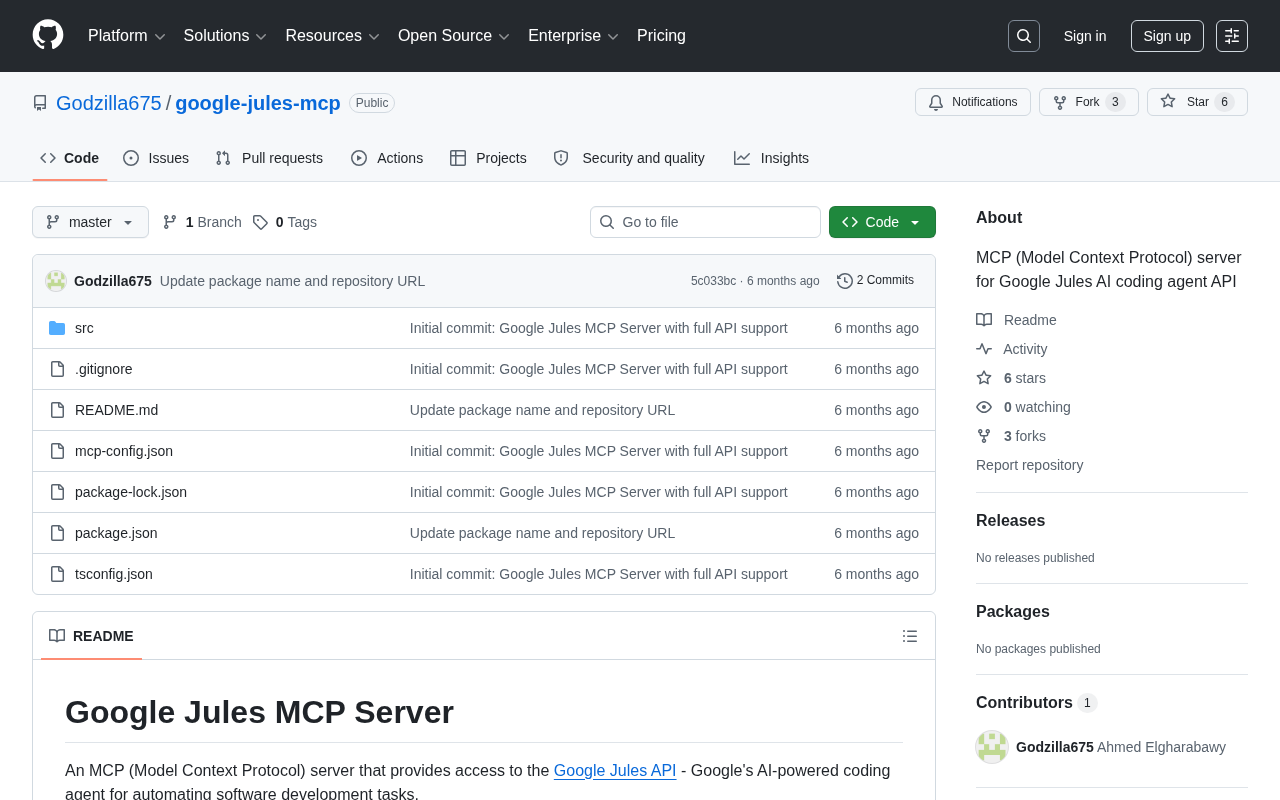
Wraps Google Jules coding agent as a standard MCP server for seamless integration into MCP-based workflows.
google-jules-mcp is an early-stage open-source project that wraps the Google Jules AI coding agent's API into a Model Context Protocol (MCP)-compliant server interface. MCP, an open protocol championed by Anthropic, standardizes how large models integrate with external tools. This project lets developers who already work within MCP-based workflows — such as MCP-compatible IDEs or agent frameworks — call Jules' coding capabilities directly without re-implementing the underlying API. While the project is currently small in scale and best suited for early adopters exploring the MCP ecosystem, it also reflects a broader trend of AI coding tools shifting from closed products toward composable, orchestratable capability modules.
What is google-jules-mcp
google-jules-mcp is an open-source project that provides a MCP (Model Context Protocol) server implementation for the Google Jules AI coding agent. Maintained by developer Godzilla675 and written in JavaScript, the project is in its early stages (7 stars, 3 forks).
In short, it acts as a bridge: enabling MCP-compatible clients — such as AI assistants and editor plugins — to invoke Google Jules' coding capabilities through a standardized interface, without having to wrap Jules' raw API themselves.
Two Key Concepts Behind the Project
MCP: A Common Language for AI Tool Calling
Model Context Protocol is an open protocol that has gained significant traction in the AI engineering community. Its goal is to standardize how large language models interact with external tools and data sources. Traditionally, integrating each new tool required developers to write a custom adapter — MCP aims to solve this "N×M" integration problem with a single standard protocol. Any MCP-compliant client can call any MCP-compliant server.
This project wraps Google Jules as a standard MCP server, making Jules directly consumable by the broader MCP ecosystem.
MCP was introduced and open-sourced by Anthropic in late 2024. It follows a client–server architecture: the MCP Client (typically embedded in an AI assistant or IDE) initiates requests, while the MCP Server exposes specific capabilities (tool calls, resource reads, prompt templates, etc.). The two communicate via JSON-RPC 2.0, with transport layers supporting both stdio (local process) and HTTP+SSE (remote service). The core advantage of this design is "implement once, reuse everywhere": developers only need to wrap a capability as an MCP Server, and all MCP-compatible clients — including Claude Desktop, Cursor, Zed, and others — can call it directly without per-client adaptation. Hundreds of community-maintained MCP Servers now exist, covering use cases like database queries, browser control, and code execution, with the ecosystem expanding rapidly.
Google Jules: Google's Coding Agent
Google Jules is an AI coding agent from Google that understands codebase context and executes programming-related tasks. It exposes its capabilities through an API, and what google-jules-mcp does is translate that API into an MCP interface.
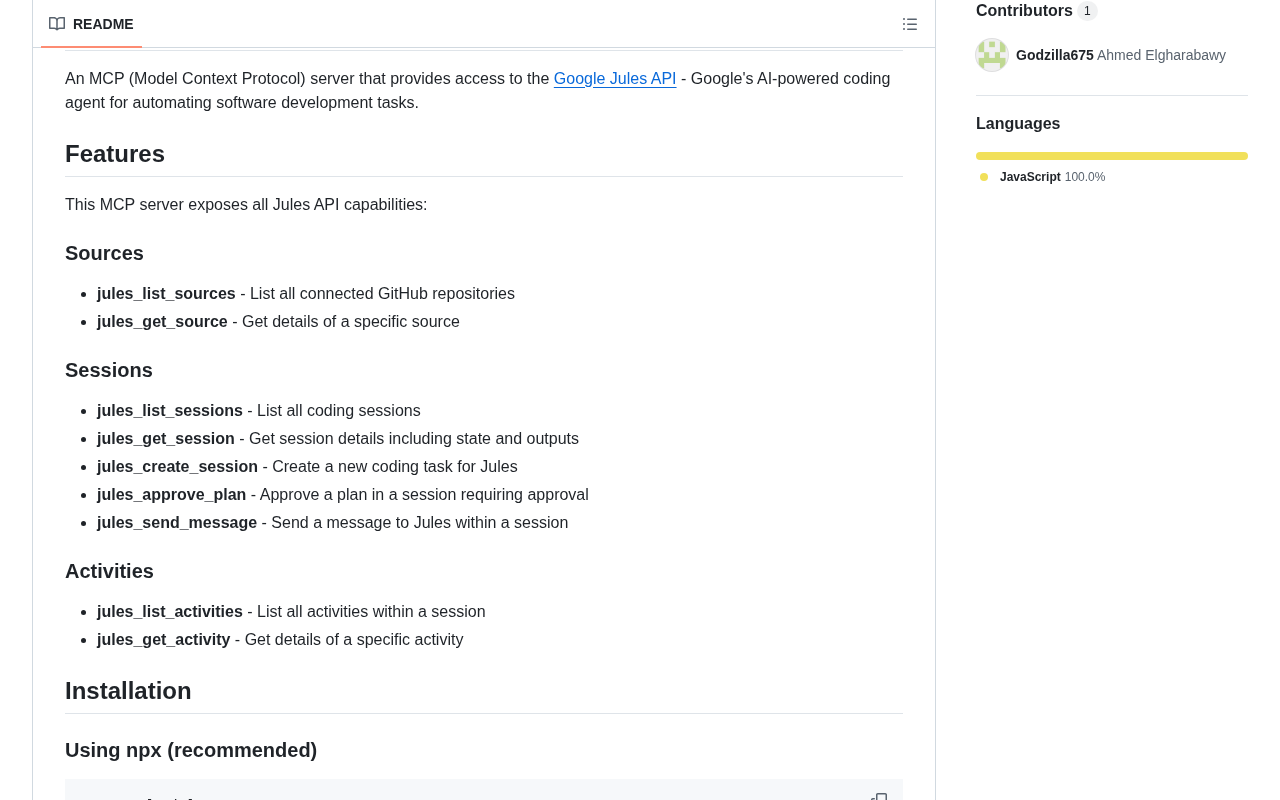
Google Jules was officially announced at Google I/O 2025, positioned as an async coding agent. Unlike real-time completion tools such as GitHub Copilot, Jules' design philosophy is "go off and get things done": after a developer submits a programming task, Jules clones the repository in a Google Cloud sandbox environment, drafts a plan, implements the changes, and returns the result as a Pull Request — with no need for continuous human supervision. Powered by the Gemini model, Jules can handle complex tasks like multi-file refactoring, dependency upgrades, and bug fixes, presenting an action plan to the user for confirmation before execution. It is currently in beta and available via a waitlist.
What Problem Does This Project Solve
For developers, directly integrating with the Jules API means dealing with authentication, request formatting, context passing, and a host of other details. If your workflow is already built on MCP — for instance, using an MCP-compatible IDE or AI client — reinventing the wheel doesn't make sense.
The value of google-jules-mcp lies in:
- Lower integration cost: Turns Jules into a plug-and-play MCP tool, so clients don't need to worry about underlying API details.
- Unified tool-calling paradigm: Lets Jules share the same invocation logic as other MCP servers (databases, file systems, search, etc.).
- Composability: In multi-agent or multi-tool orchestration scenarios, Jules can serve as a standard node that is flexibly scheduled alongside other tools.
Who Is This For
This project is best suited for developers who are already exploring the MCP ecosystem and want to bring Google Jules' coding capabilities into their AI workflows. If you're building an MCP-based agent system, or want to call Jules directly from an MCP-compatible editor, it provides a ready-made starting point.
It's worth noting that the project is currently small-scale with limited community activity (few stars and forks), which means it may still be iterating rapidly. Users should assess its stability and documentation quality independently. Thorough testing is recommended before any production deployment.
A Trend Worth Watching
google-jules-mcp is a small project, but it reflects a clear direction: AI coding agents are evolving from "closed, standalone products" into "capability modules that can be orchestrated via standard protocols." As MCP increasingly becomes the universal layer connecting large models with external capabilities, more "vendor API → MCP server" wrapper projects like this one will emerge. For developers following AI programming infrastructure, these projects are worth keeping an eye on.
Related articles
Insufficient Source Material: A Tweet With No Substantive Content
A single tweet reading 'Available until the goblins notice.' with two unexpanded links provides no substantive content to write an article from.
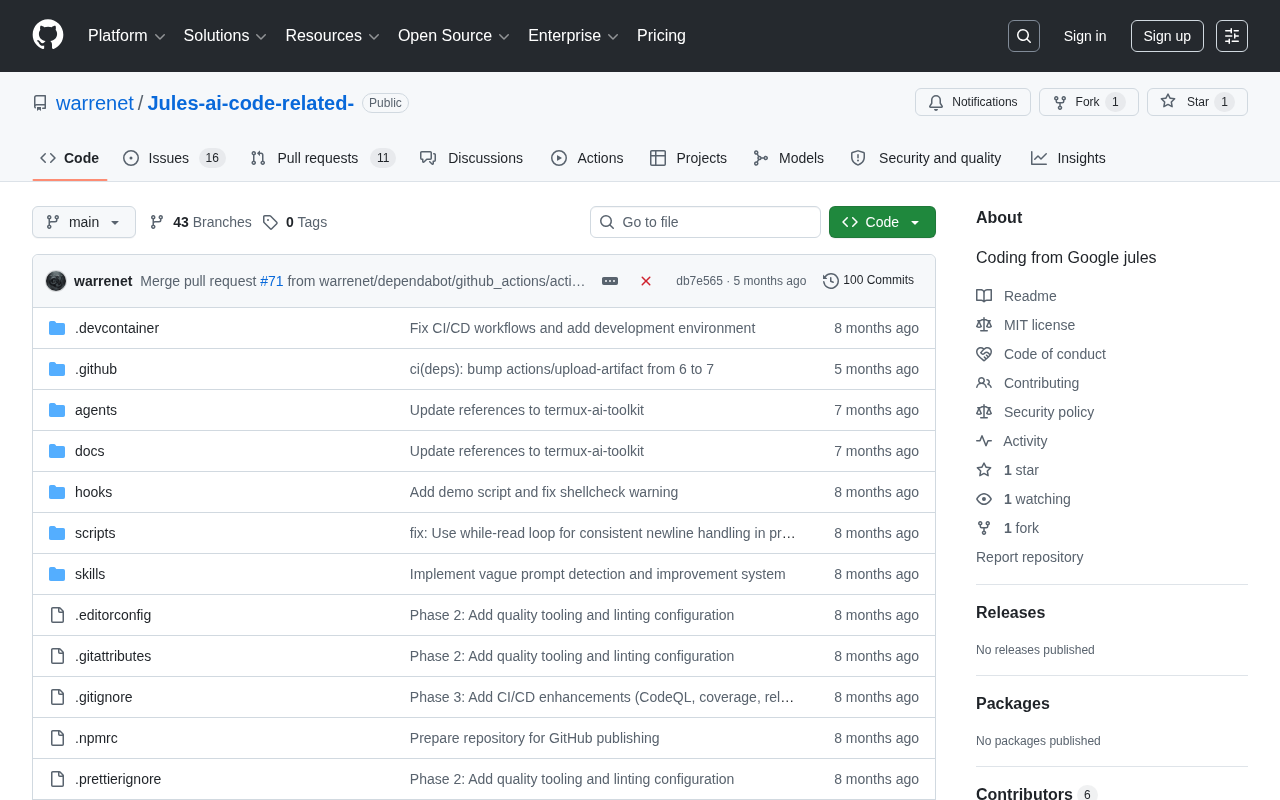
Google Jules AI Coding Assistant: A Quick Look at an Open-Source Practice Repo
A look at a small GitHub repo centered on Google Jules, an autonomous AI coding agent. Explores what Jules does, the repo's practical value, and how to evaluate early-stage AI tool projects.
GitHub Project Overview: prateek0221/jules — Critically Lacking Information
The GitHub repo prateek0221/jules has only 1 star, no code, and no README. We review available info and provide background on Google's Jules AI coding agent.