Withings Subscription Wall Sparks Outrage as Open-Source Solution Enables Free Data Sync

Withings' subscription wall sparks backlash as a developer builds an open-source project for free health data sync.
Withings recently required new users to subscribe to Withings Plus to sync health data to third-party apps, triggering strong community backlash. Developer Tom Anthony, frustrated by the bloated official app, built an open-source project that bypasses subscription restrictions by interacting directly with device or cloud interfaces to export data. The solution emphasizes code transparency and privacy but faces challenges including API changes, legal risks, and maintenance sustainability. The incident reflects the industry tug-of-war between health data portability and vendor lock-in, underscoring users' demand for data ownership. Open-source communities quickly fill gaps when business strategies clash with user expectations, and future debates over data portability will play out across more hardware categories.
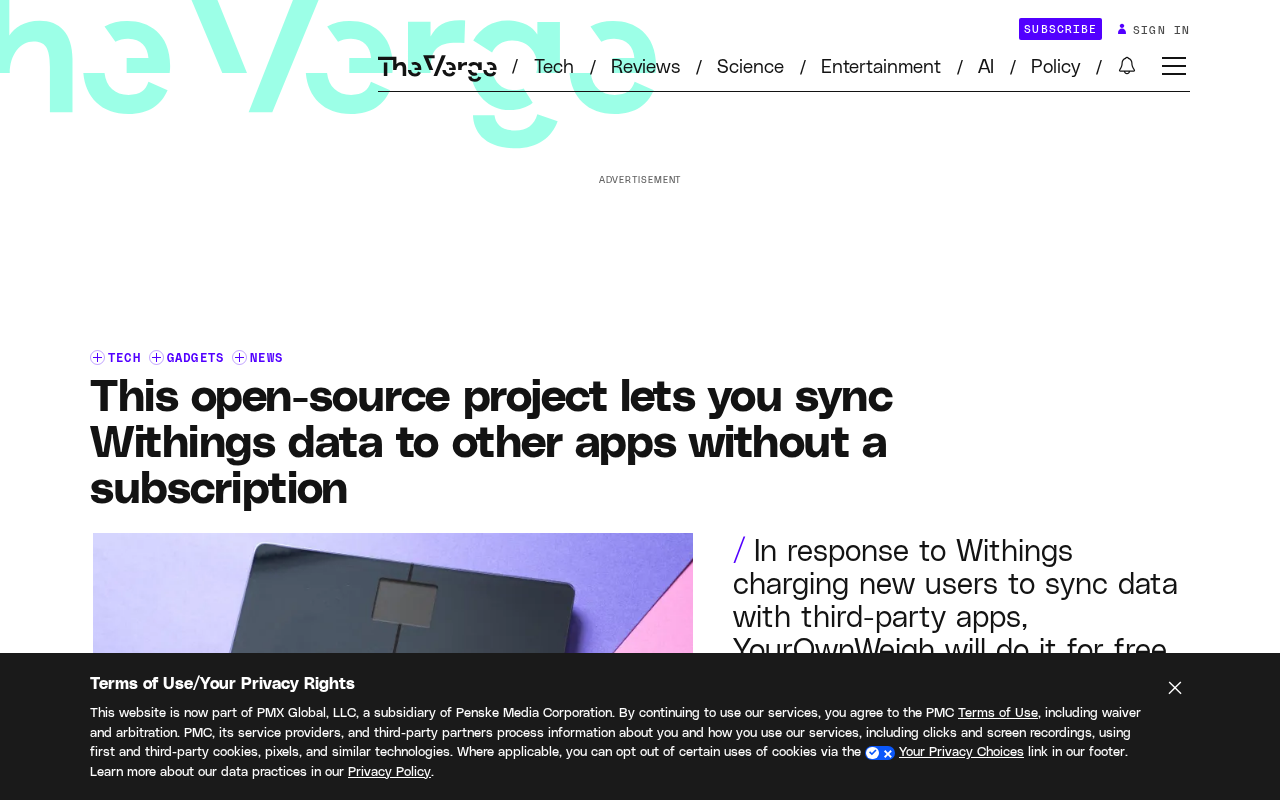
Withings recently announced that new users must subscribe to Withings Plus to sync their device health data to third-party apps—a policy that has triggered strong backlash in the community. Developer Tom Anthony, frustrated by the bloated experience of the official app, took the initiative to build an open-source project aimed at "liberating" his own health data.
The User Pain Points Behind the Subscription Wall
According to the original report, Withings' new policy requires new users to pay for a Withings Plus subscription in order to sync health data collected by their devices to other apps. For users already accustomed to freely flowing data, this amounts to an artificial barrier.
Tom Anthony's motivation was straightforward: he had long been dissatisfied with the Withings mobile app, calling it a "bloated mess." The subscription wall was the last straw, prompting him to build an alternative solution. This is not an isolated case—the issues of health data ownership and portability are becoming increasingly acute as subscription models proliferate.
Data Portability refers to users' right to export their personal data from one service or platform and import it into another. In health tech, this concept is particularly important because health data often has long-term value—users may switch device brands or want to use third-party analysis tools. Article 20 of the EU's General Data Protection Regulation (GDPR) explicitly establishes the right to data portability, requiring service providers to supply data in a structured, commonly used, and machine-readable format where technically feasible. However, hardware manufacturers often restrict data outflow through proprietary formats or subscription barriers, creating "vendor lock-in." Withings' subscription policy is a manifestation of this conflict: users buy the hardware, but the "exit" for their data is charged extra. The emergence of open-source tools is essentially a technical assertion of users' right to data portability.
How the Open-Source Project Bypasses Restrictions
The core approach of Anthony's project is to bypass official subscription restrictions, interact directly with Withings devices or cloud interfaces, and export and sync data to other apps. Although the original source did not disclose specific technical details, judging from the project's positioning, it targets the pressing need for "syncing without a subscription."
Open source means transparent, auditable code, so users need not worry about their data being processed by a third party behind closed doors. For health data users who value privacy, this is more appealing than the official subscription plan. The project also allows community contributions, continuously adapting to changes in Withings devices and interfaces.
API (Application Programming Interface) is a contract for interaction between software systems, allowing developers to access specific functions and data of a device or cloud service. Withings devices typically upload health data (such as weight, blood pressure, and step count) to the cloud via official APIs, and third-party apps obtain this data through authorization mechanisms such as OAuth 2.0. Anthony's project likely reverse-engineered Withings' API communication protocols or interacted directly with the device's Bluetooth interface, thereby bypassing the official app's subscription verification. It should be noted that reverse engineering or unofficial API calls may violate terms of service, and if the API changes, the project must adapt promptly. The advantage of the open-source model is that the community can collaborate on maintenance, but this also requires the project to have good documentation and test coverage to cope with interface uncertainty.
The Debate Over Health Data Portability
This incident reflects a broader industry issue: do hardware manufacturers have the right to restrict users' access to their own health data through subscription models? Withings' approach is not unique, but because health data involves personal privacy and long-term health management, users' expectations for its portability are naturally higher.
The emergence of open-source solutions is essentially a market response to vendor lock-in strategies. When official channels impose paywalls, community-driven alternatives find room to exist. However, such projects also face challenges including interface changes, legal risks, and maintenance sustainability—whether they can operate stably over the long term remains to be seen.
Vendor Lock-in refers to the phenomenon where users are bound to a specific vendor's products because migration costs are too high. In health hardware, lock-in effects come not only from the hardware itself but also from data formats, cloud services, and companion apps. Subscription models further reinforce lock-in: if users stop paying, they may lose data sync capabilities, making it difficult to switch to competitors. Open-source alternatives lower migration barriers by providing data export and sync features, but they themselves face sustainability challenges—a lack of a business model can lead to maintainer burnout. From an industry perspective, regulators are gradually paying attention to data portability; for example, the U.S. 21st Century Cures Act requires health IT systems to provide APIs to enable data interoperability. The Withings incident reflects a trend in which market forces and regulatory pressure jointly drive data openness.
Implications for Users and Developers
For Withings users, open-source sync tools offer a path around the subscription, but data security and project activity should be assessed before use. For developers, this once again proves that when business strategies create friction with user expectations, the open-source community can often quickly fill the gap.
Ownership of health data should not be held hostage by a subscription wall. The Withings incident may only be the beginning—future battles over data portability will play out across more hardware categories.
Related articles

T3 Code: The Open-Source AI Coding Assistant's Comeback Story
T3 Code is an open-source AI coding assistant that unifies subscriptions like Codex and Claude, with powerful remote control and parallel task management.

Never Elected, Yet Ruled New York for 30 Years: The Ultimate Case Study in the Mechanics of Power
Robert Caro's biographies reveal how unelected Robert Moses ruled New York for 30 years through legal drafting and public authorities, and how Lyndon Johnson built leverage as a "powerless" Senate Majority Leader. Unpacking the underlying logic of accumulating and sustaining power.

The CPython 3.10 Recursion Trap and Synthetic Recovery in TokenGuard, an LLM Circuit Breaker
TokenGuard's author recounts a recursion crash caused by OrderedDict.pop in CPython 3.10 and introduces v0.3.0's Loop Nudge synthetic recovery, inline DLP scanning, and other new LLM agent circuit-breaker capabilities.